
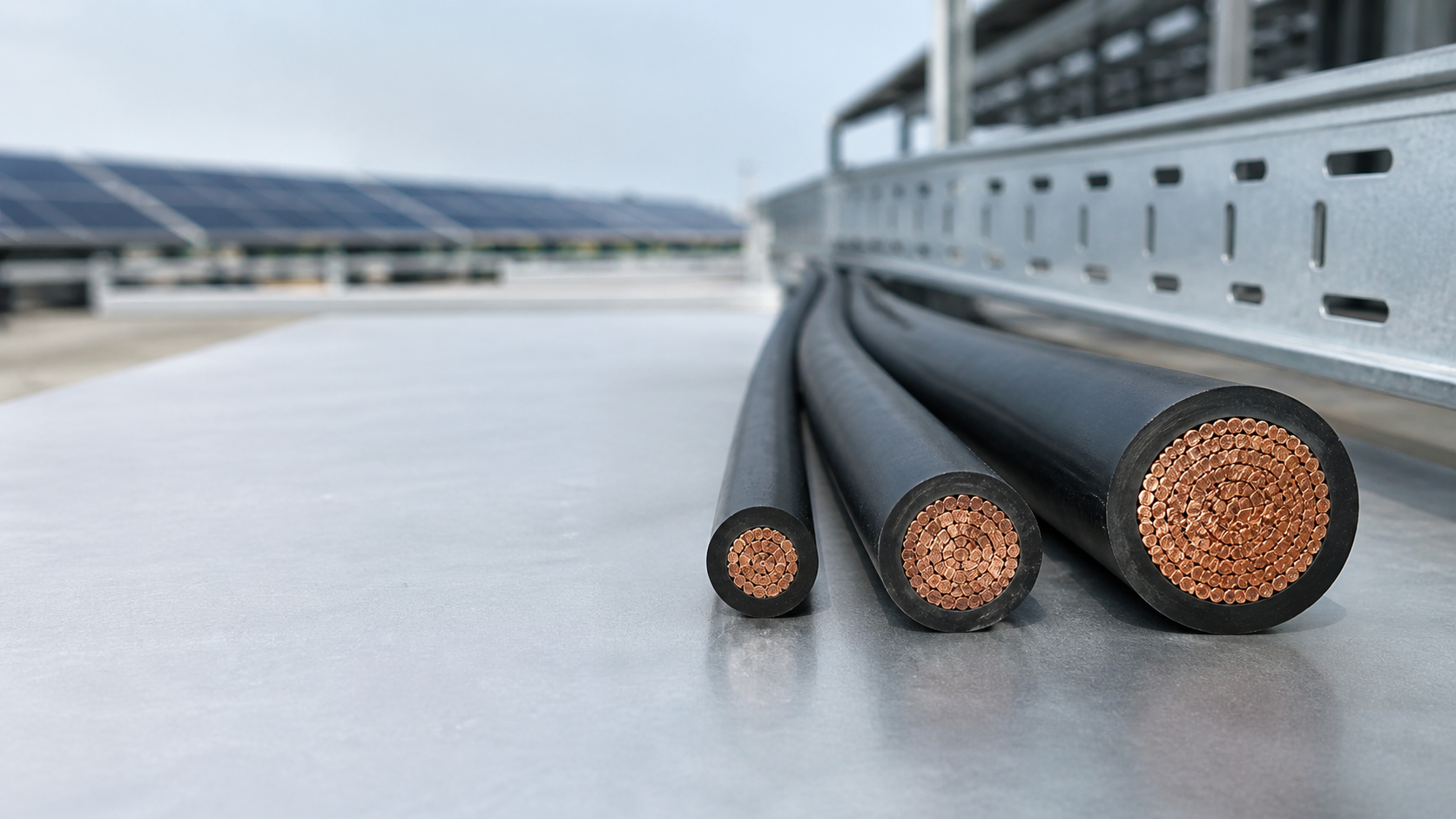
Why cable size matters
PV DC cable connects modules, strings, combiner boxes and the inverter. Undersized cable overheats, wastes energy and becomes a fire risk; oversized cable adds unnecessary cost and handling weight. Sizing is a balance between current capacity, voltage drop and mechanical practicality.
Current rating first
Ampacity is the starting point. A single H1Z2Z2-K cable laid on a surface at 40C ambient (IEC 60364-7-712) carries roughly 26A at 2.5mm2, 32A at 4mm2, 40A at 6mm2, 54A at 10mm2, 70A at 16mm2 and 92A at 25mm2.
- Derate by 0.82 for buried installation.
- Derate by 0.75 for bundled runs of four or more cables.
- Add the 1.25 x Isc safety factor on the string current before comparing to the rating.
Voltage drop is usually the deciding factor
Long runs are limited by voltage drop, not ampacity. The single-conductor-pair formula is dV = (2 x L x I x rho) / A. Keeping string voltage drop within 1% of system voltage is the IEC 62548 recommendation.
Example: a 1000V system, 13A string, 80m one-way run. On 4mm2, dV = (2 x 80 x 13 x 0.0215) / 4 = 11.2V, which is 1.12% and outside the limit. On 6mm2 the drop is 7.5V, 0.75%, so 6mm2 becomes the correct choice for that run.
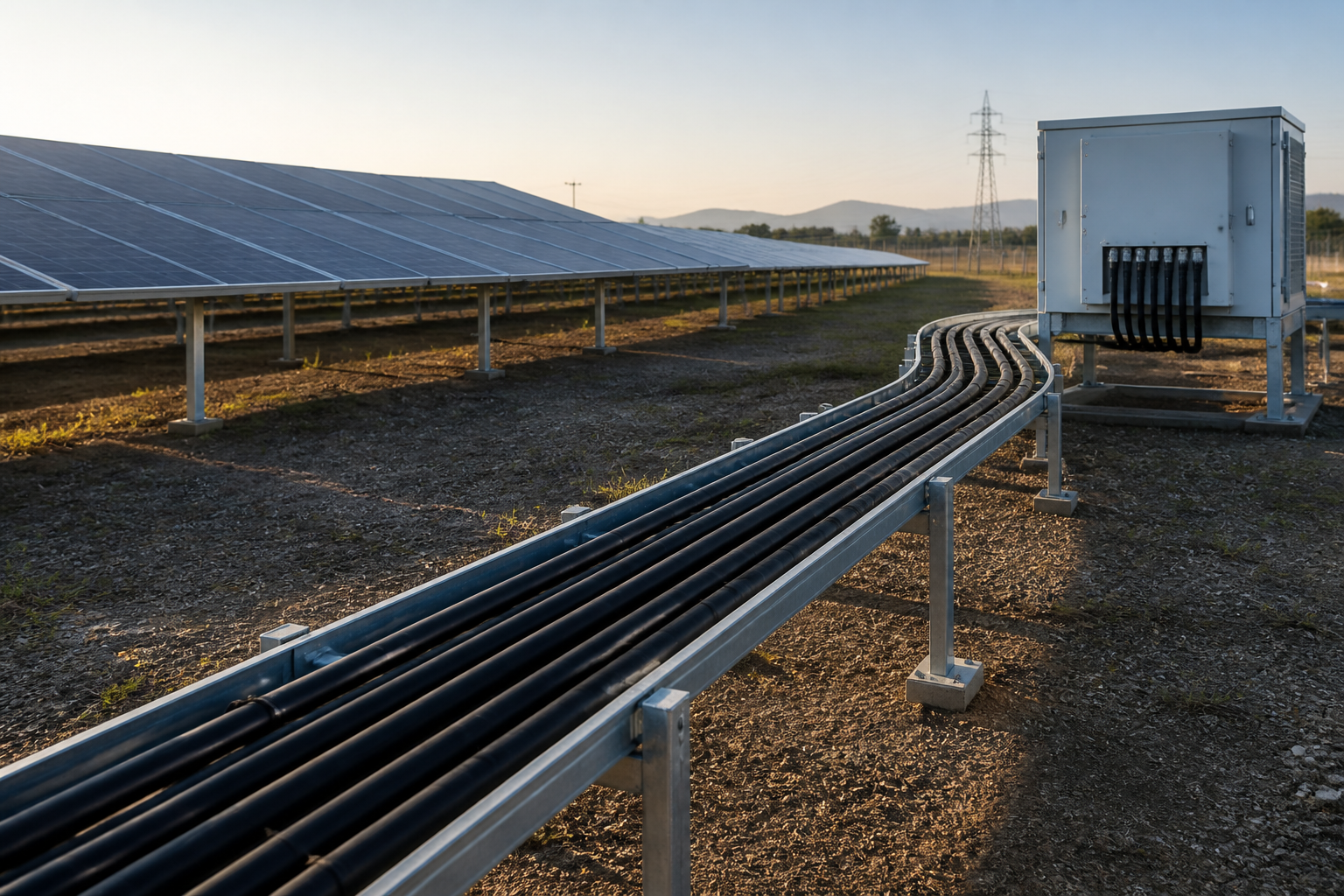
Length and system voltage interplay
The same cable run looks different at different system voltages because the 1% budget scales with voltage. A 1500V system tolerates a much larger absolute drop than a 600V residential system, so longer strings and longer runs are practical at the higher class. Always size against the actual system voltage, not a generic rule.
H1Z2Z2-K versus PV1-F
H1Z2Z2-K (EN 50618 / IEC 62930) is the current generation solar cable with XLPE insulation and a halogen-free sheath, rated for 90C conductor temperature. PV1-F is the superseded HD 605 type with a PVC sheath and 70C rating. New projects should specify H1Z2Z2-K.
String cable versus combiner output cable
String cable typically runs at 2.5-6mm2 depending on current and length. Combiner box output runs aggregate many strings and carry higher current, so 10mm2, 16mm2 and 25mm2 are common. Check the continuous current of the aggregated feed and the terminal capacity of the equipment at both ends before selecting.
Mechanical and environmental checks
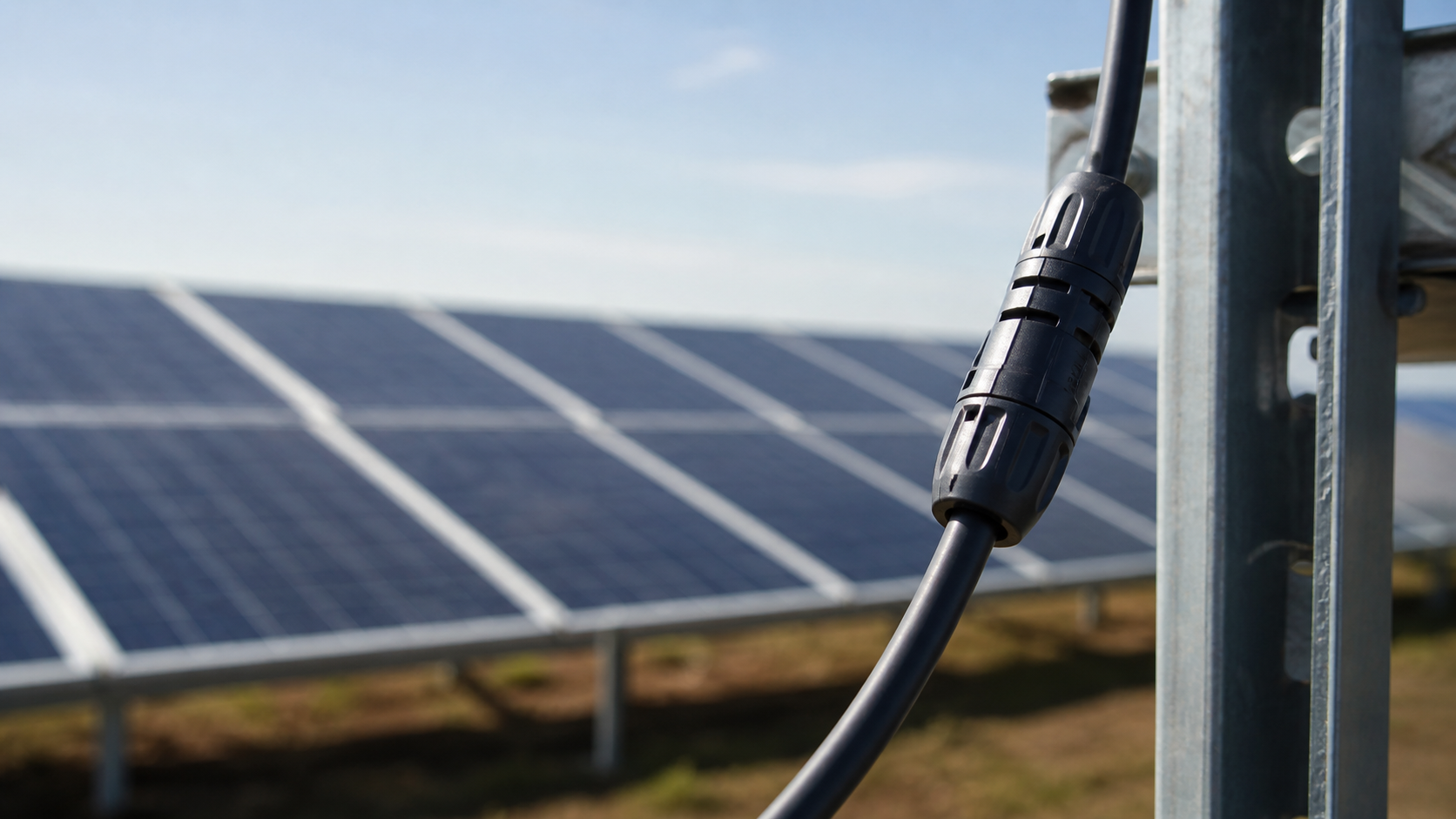
- UV resistance for exposed outdoor runs.
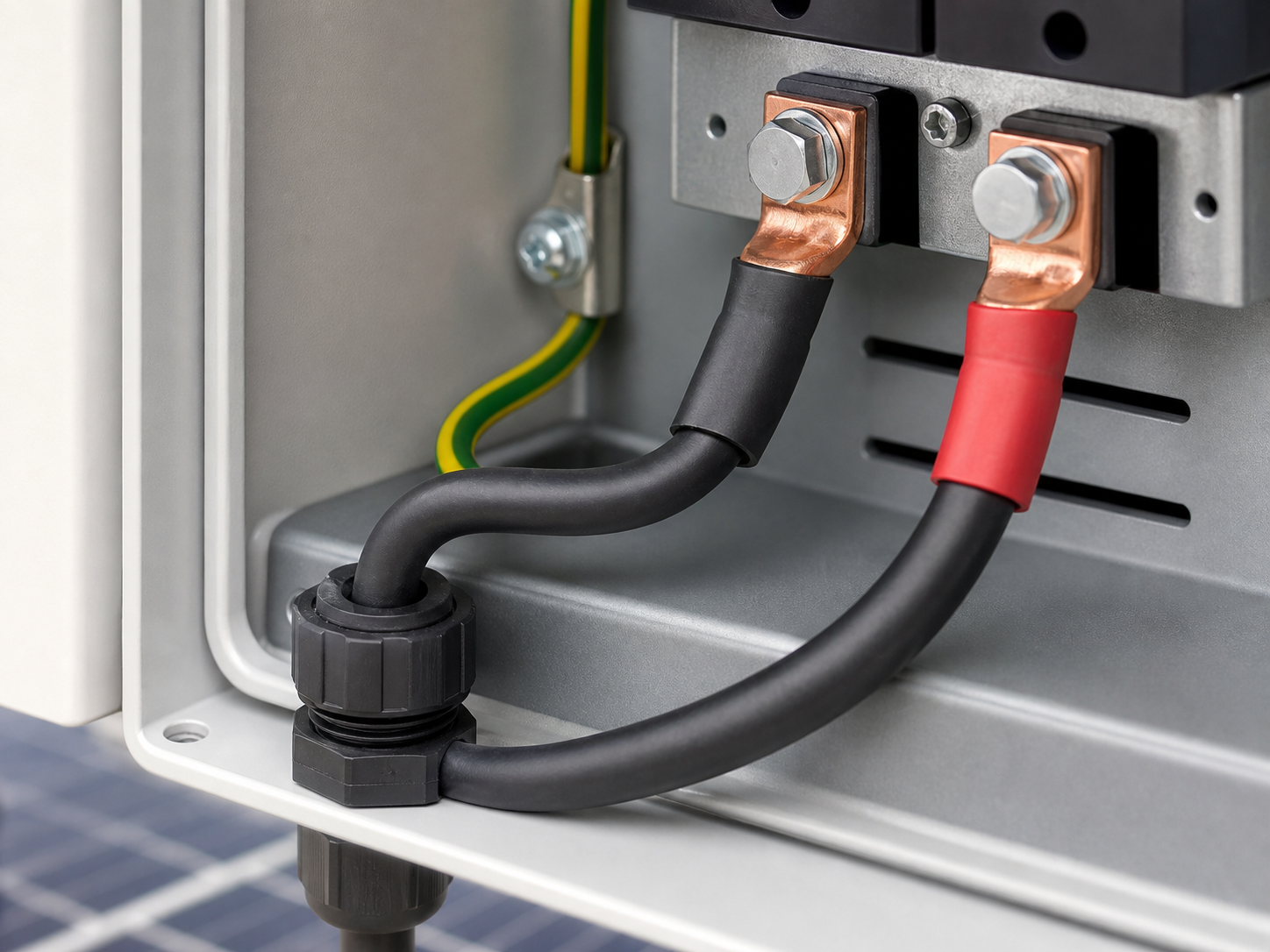
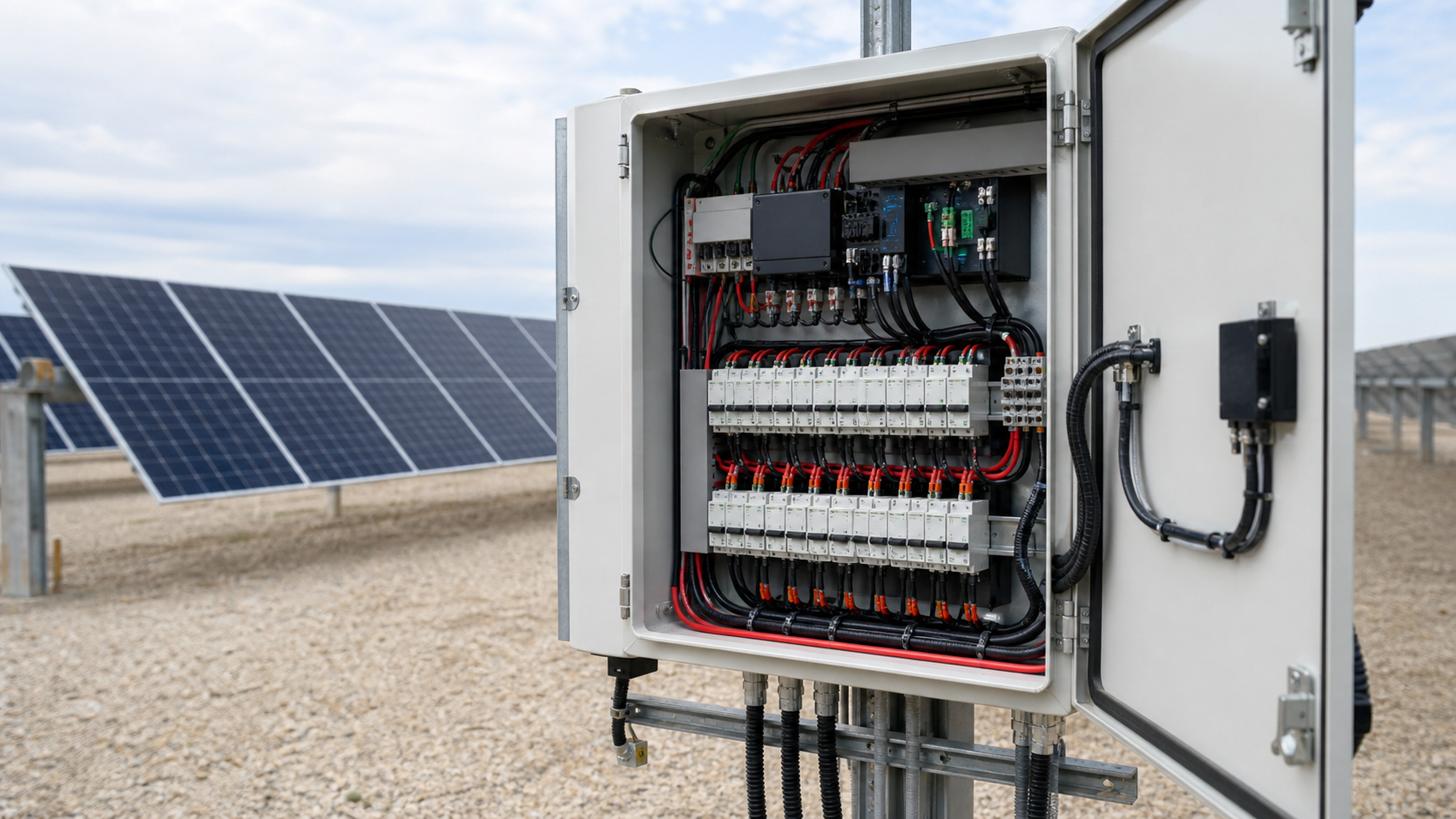
- Suitable cable glands and entry seals into combiner boxes and enclosures.
- Bend radius and pulling tension limits respected in tray and conduit.
- Compatibility of insulation with the operating temperature at the site.
RFQ checklist for cable
When requesting cable quotations, state the standard (EN 50618 or IEC 62930), cross-section, conductor material, colour, quantity in metres, and the derating assumptions used. The supplier should confirm ampacity and the exact resistivity used in any voltage drop calculation.
This guide supports an initial technical or commercial review. Final ratings, standards, shipping terms, documentation and configuration must be confirmed for the actual project requirement.
Frequently asked questions
What size PV cable do I need for a 10A string?
A 2.5mm2 H1Z2Z2-K cable rated about 26A covers a 10A string on ampacity, but voltage drop over the run may force a larger size. Calculate dV = (2 x L x I x rho) / A and keep the drop within 1% of system voltage.
Does higher system voltage allow thinner cable?
Yes, within reason. At higher system voltage the same percentage drop budget equals a larger absolute voltage, so longer runs and smaller cross-sections become acceptable. Confirm with the actual calculation rather than assuming.
Can I use AC cable for PV DC strings?
No. PV DC cable must meet solar-specific standards such as EN 50618 or IEC 62930 for UV, temperature and insulation performance in DC service. General-purpose AC cable is not qualified for outdoor DC strings.
What is the 1.25 x Isc rule for cable?
The string current used in sizing should be at least 1.25 times the module short-circuit current at STC to cover irradiance above standard test conditions. Apply the same factor used for fuse sizing to the conductor current comparison.
Bring the project inputs together
Use the checklist and technical inputs in this guide to prepare a clear project discussion.
Discuss a projectContinue learning
Explore related technical guidance in Solar PV.
Technical note: final ratings, standards, shipping terms, documentation and configuration remain subject to the agreed project requirement.