
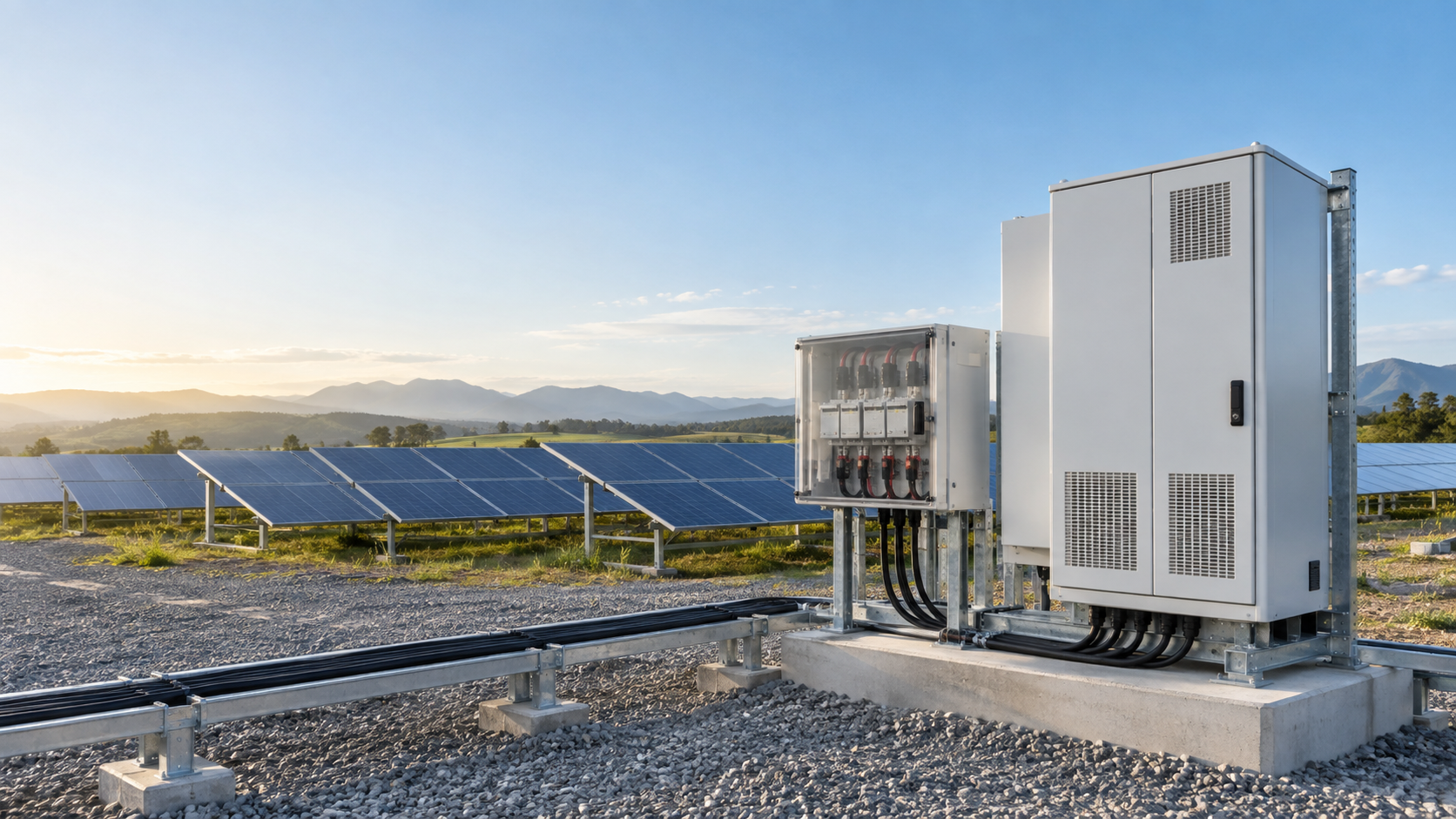
The inverter's job in the system
The inverter is the point where direct-current power from the PV array is converted for use or export. Everything upstream of it — the strings, the combiner box and the DC protection chain — must be coordinated with the inverter's electrical window, not designed in isolation.
From the balance-of-system viewpoint, the inverter defines four numbers that the rest of the electrical design must respect: maximum DC input voltage, maximum input current per tracker, the operating MPPT voltage band, and the rated AC output. NEUTRON's array-side equipment is selected to feed those limits cleanly and protect the wiring that reaches them.
Technical diagram shown at a readable responsive scale.
Voltage and current compatibility
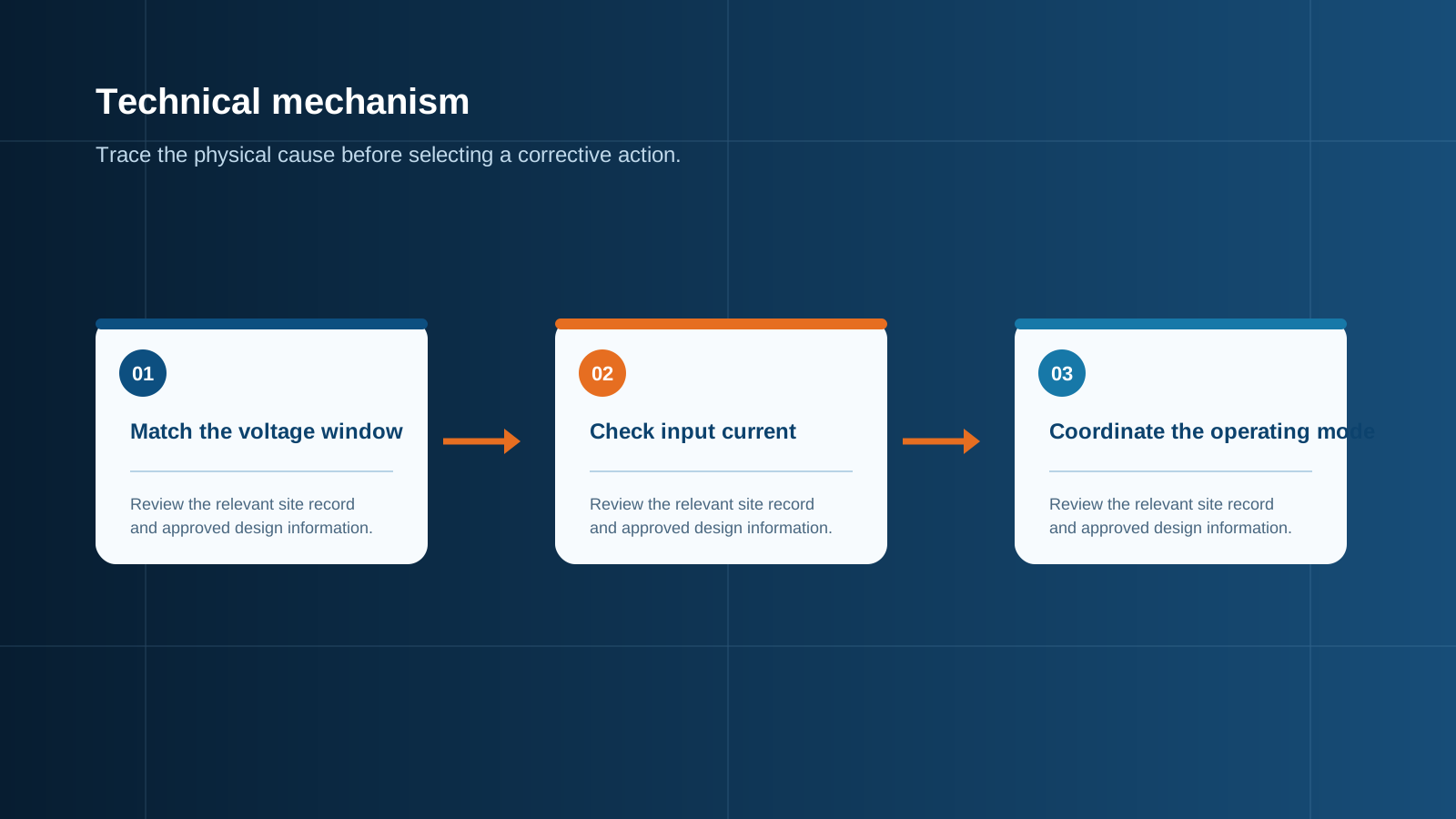
Every panel datasheet lists open-circuit voltage (Voc) and short-circuit current (Isc). The cold-weather Voc of the full string must stay under the inverter's maximum DC input voltage, with margin. At the same time, the string Isc must not exceed the input current limit of the tracker it feeds.
This is where the DC side gets interesting: the combiner box and its gPV fuses are sized to the string Isc, while the inverter input sets the ceiling the string is allowed to approach. Getting both directions right prevents both nuisance trips and unsafe overcurrent.
DC/AC ratio basics
The DC/AC ratio compares total panel nameplate power to inverter AC rating. A ratio around 1.2 to 1.4 lets the array reach the inverter's full output for more of the day, while excess production on bright midday is simply clipped.
Higher ratios raise yield per inverter dollar but also push more current through the array wiring and combiner box during peak sun. The BOS must be rated for the array's actual peak, not just the inverter's average throughput.
Technical diagram shown at a readable responsive scale.
MPPT count and sizing
Each maximum-power-point tracker handles one voltage window independently. Two trackers let you split an east-facing and a west-facing roof so each harvests at its own optimum instead of being dragged down by the weaker orientation.
When distributing strings, keep each tracker within its current and voltage envelope. NEUTRON combiner boxes can be arranged to land strings on the correct tracker group, and each string still gets its own fused protection before it reaches the inverter.
Battery and backup needs
If backup or self-consumption matters, the inverter choice expands to hybrid or off-grid architectures that coordinate with a battery. The DC control and protection layer then also serves the storage side, isolating and fusing the battery feed.
NEUTRON's energy-storage control equipment manages the DC coordination between array, battery and inverter, keeping protection consistent across the whole power path rather than leaving gaps at the battery interface.
A step-by-step selection checklist
Start from the array: count panels, note Voc, Vmp, Isc and the temperature coefficients. Sum string voltages for cold conditions and confirm they sit inside the inverter's MPPT range and below its maximum input voltage.
Then check current: per-string Isc and total input current per tracker. Choose the DC/AC ratio, decide tracker count for your roof orientations, and finally specify the combiner box, fuses and disconnects that sit between the array and the inverter.
Worked example
Suppose twelve 450 W panels, Voc 41 V, Isc 13.5 A, on a roof that sees -10 C winters. Two series strings of six panels give about 246 V cold Voc (using the coefficient) per string — comfortably inside a 600 V tracker window — while each string's 13.5 A Isc drives a 20 A gPV fuse.
Two strings feed one tracker of a ~5 kW inverter for a DC/AC ratio near 1.1. The combiner box collects both strings, fuses each, and delivers a single protected DC feed to the inverter input.
BOS and protection to pair with it
The inverter is only as safe as the equipment feeding it. Each string needs a gPV fuse and a disconnect; the combiner box aggregates them and provides a main DC isolation point; SPD staging guards against surges on the long DC runs.
NEUTRON supplies the combiner boxes, DC control and protection, and energy-storage control cabinets that turn an inverter specification into a complete, protected array. Choose the inverter for energy, and let the BOS carry and protect that energy safely.
This is general technical guidance. Confirm final ratings, protection coordination, installation and applicable local requirements against current standards, manufacturer documentation and the approved project design.
Frequently asked questions
How do I match an inverter to my panels?
Match the cold-weather string Voc to the inverter's maximum DC input voltage with margin, keep string Isc within the tracker's current limit, and place the string's operating voltage inside the MPPT window. The combiner box and fuses are then sized to that same string.
What DC/AC ratio should I pick?
A ratio of roughly 1.2 to 1.4 is common for grid-tied systems, trading a little clipped peak for more all-day harvest. Keep the BOS rated for the array's actual peak current, not just the inverter's AC rating.
How many MPPTs do I need?
One per distinct roof orientation or shading group you want to optimise independently. An east-west roof benefits from two trackers; a single unshaded plane can do well with one.
What protects the array side?
Each string is protected by a gPV fuse and a disconnect in the combiner box, with surge protection on the DC runs. NEUTRON provides these array-side combiner and DC protection assemblies.
Discuss your PV requirement
Share the system voltage, string arrangement, inverter interface and installation environment. NEUTRON can review the equipment configuration around your project documentation.
Discuss a projectContinue learning
Explore related technical guidance in Solar PV.


Published from the approved Period 06 source package. Technical values and final design decisions must be verified against the current applicable standard, manufacturer documentation and approved project design.