
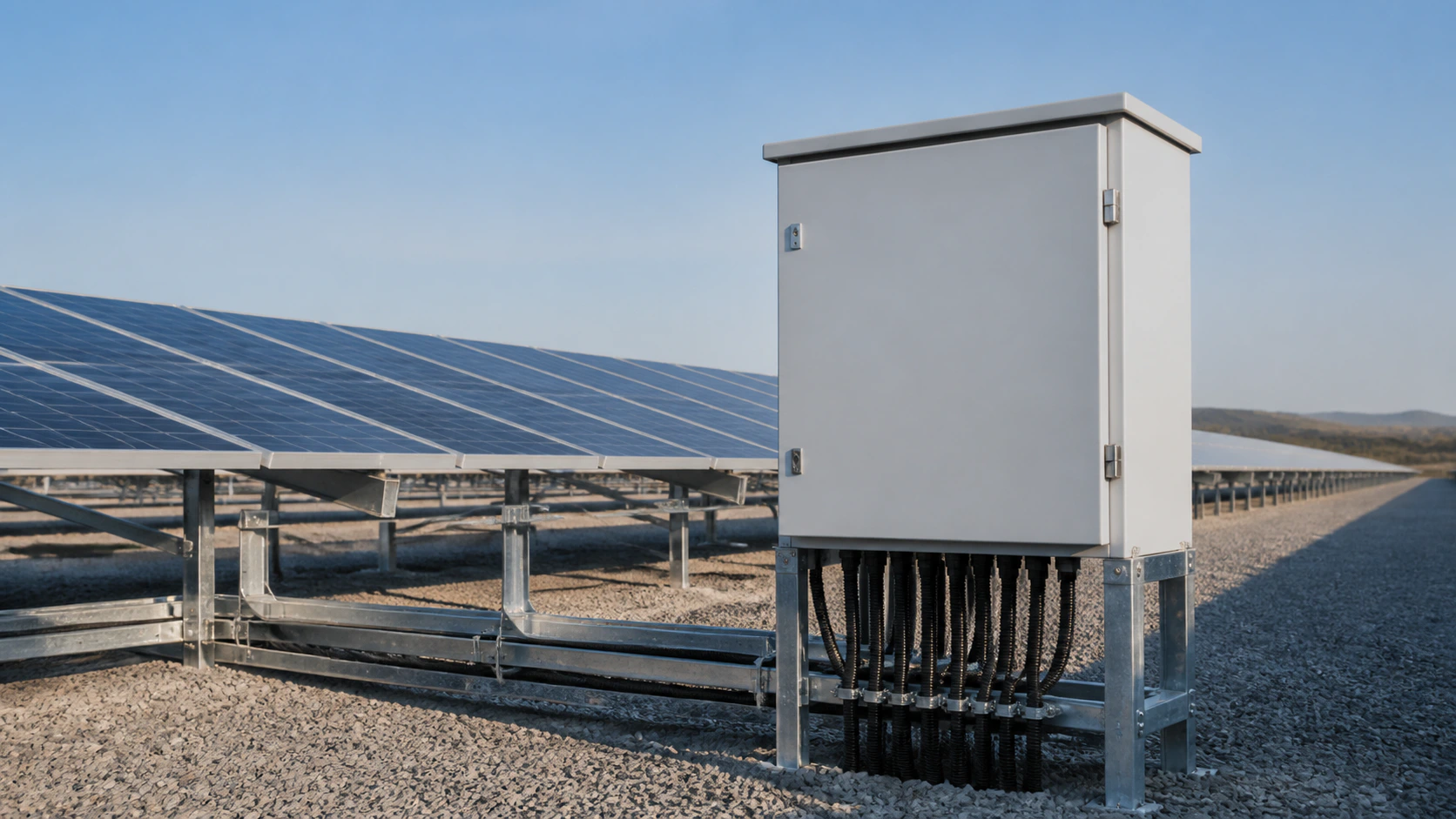
1. What a PV DC combiner box actually does
A PV DC combiner box sits between the array and the inverter. It parallels several PV strings onto one pair of DC busbars, protects each string individually, and gives the site a single point where DC power can be isolated, measured and shut down. Utility-scale plants use 8 to 24 strings per box; commercial rooftops typically 4 to 12.
Three functions decide whether the box is fit for purpose. String-level overcurrent protection stops a faulted string from being back-fed by the healthy strings in parallel. Surge diversion clamps lightning-induced transients before they reach the inverter DC input. Safe isolation lets a technician open the array without breaking current under load.
Specification errors are expensive because DC arcs do not self-extinguish at a current zero the way AC arcs do. A fuse holder rated for AC only, or a disconnect switch chosen on AC amps, fails in a way that damages the enclosure. Every rating in a PV DC box has to be a DC rating.
- Parallel connection of PV strings onto a common DC bus
- Per-string fuse protection, sized against array short-circuit current
- Type 2 surge protection referenced to both PV+ and PV-
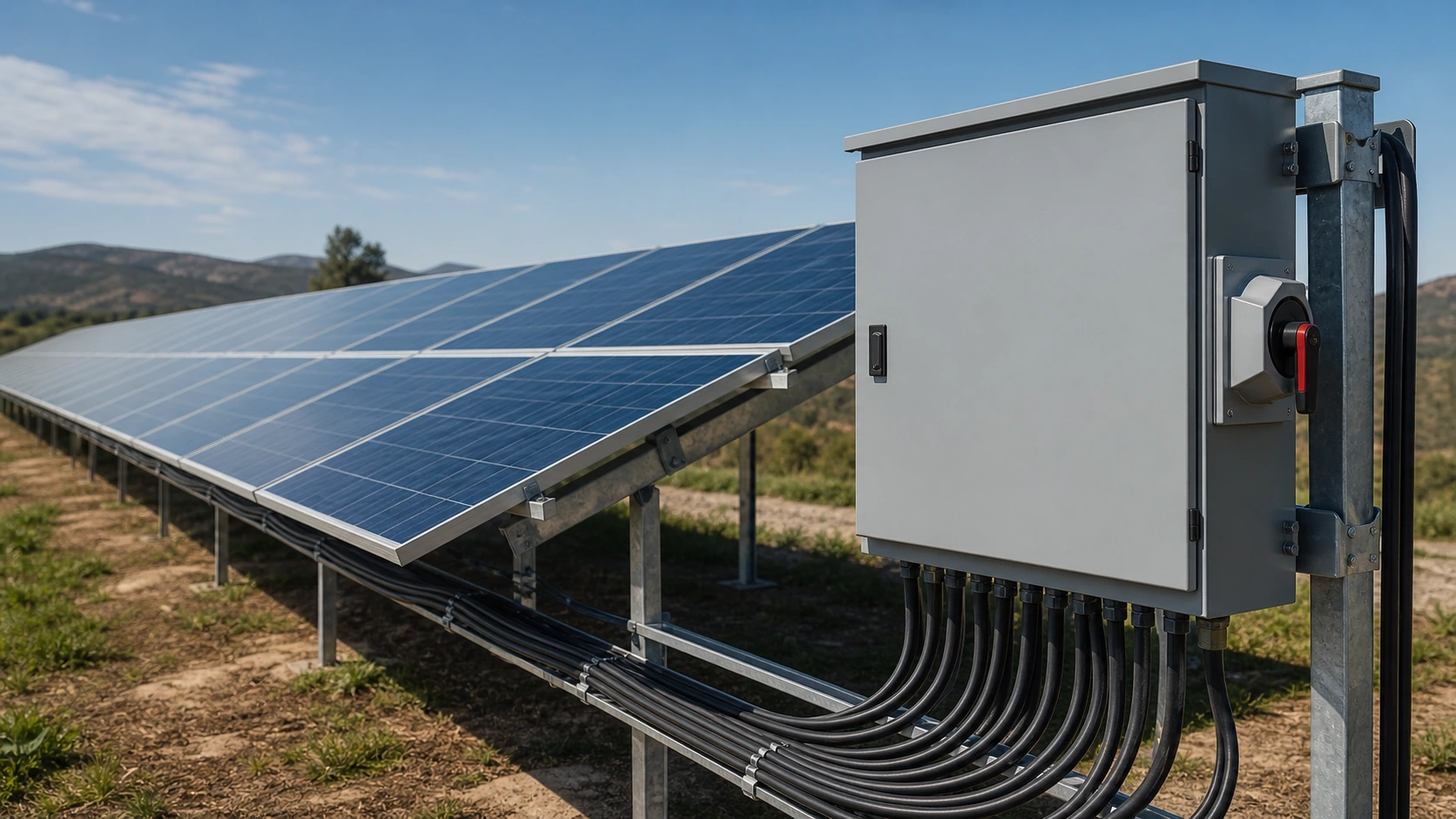
- Load-break DC isolator for safe maintenance access
- Optional string monitoring with RS485 / Modbus-RTU output

2. Step 1 — Fix the DC voltage class
The DC voltage class is the first filter and the one most often specified wrong. The number that matters is not the array's operating voltage but the open-circuit voltage (Uoc) at the lowest expected cell temperature, because Uoc rises as temperature falls. A string that measures 780 V on a warm afternoon can exceed 900 V on a cold, bright winter morning.
Three classes dominate the market. 600 V DC is now mostly limited to legacy North American residential work. 1000 V DC remains standard for commercial rooftops and for markets where local wiring rules cap the array voltage. 1500 V DC is the default for utility-scale ground-mount, because longer strings cut cable, trenching and combiner count per megawatt.
Never select a box whose rated DC voltage equals your calculated cold-temperature Uoc. Leave headroom, and confirm the rating applies to the whole assembly — enclosure, busbar clearance, fuse holders, isolator and surge protection — not to one component inside it.
3. Step 2 — Count strings and size the fuses
Input count drives enclosure size, busbar cross-section and cable gland layout. Order the box for the string count you will actually build, plus any documented expansion. Buying a 16-input box for a 9-string array wastes enclosure volume and leaves unused glands that become water ingress paths.
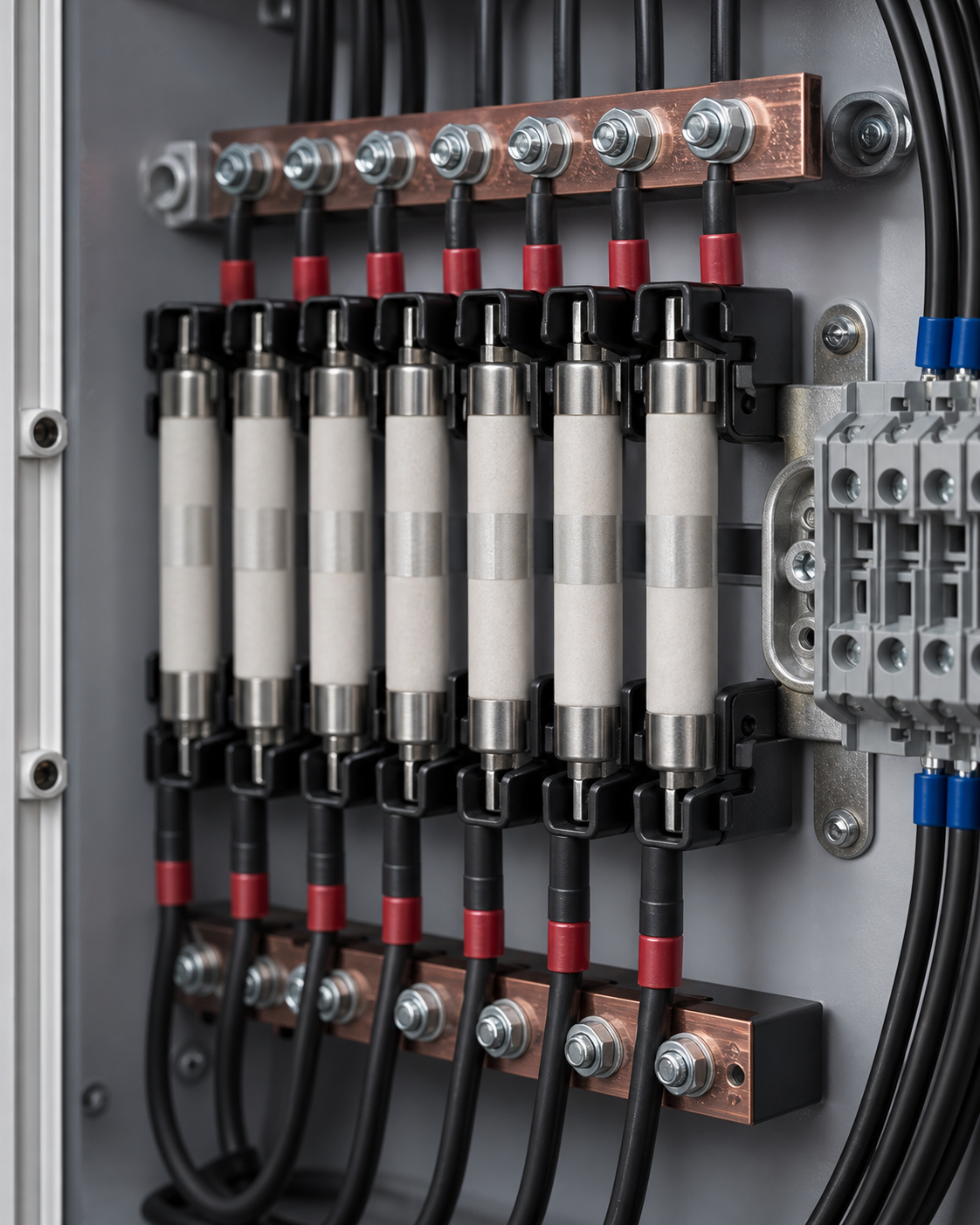
Fuse sizing follows a simple rule that is easy to audit at incoming inspection: rated fuse current must be at least 1.25 x Isc of the string, and the overall overcurrent protection capability of the assembly must meet the same 1.25 x Isc threshold. Both the incoming and outgoing terminations should carry DC fuse protection. Where blocking diodes are fitted, their reverse voltage rating should be at least 2 x Uoc at STC.
Check the physical detail as well as the number. Terminals must be permanently marked PV+, PV- and PE, the earth terminal marked in yellow-green, and the fuse area must carry a visible instruction against operating under load. These are the items an inspector checks first, and they form part of NEUTRON's factory inspection routine.
4. Step 3 — Specify surge protection correctly
Surge protection is where low-cost boxes are quietly de-specified. The output side of a PV combiner box should carry surge protective devices with a nominal discharge current In (8/20 us) of 10 kA or more, and protection must be present on both the positive and negative poles, not only on PV+ to earth.
The maximum continuous operating voltage of the surge device has to exceed the array's cold-condition open-circuit voltage with margin — a practical selection rule is Uc greater than 1.2 x Uoc at STC. Below that, the varistor sees continuous stress, ages early and eventually fails short.
Two features separate a serviceable design from a liability. The surge module must include an internal thermal disconnector so a failed varistor removes itself from the circuit instead of sustaining an arc, and it must provide visual fault indication — typically a green-to-red window — plus, where monitoring is fitted, a remote status contact. On plants with a SCADA link, that contact is what turns a silent failure into a work order.
5. Step 4 — Match the enclosure to the site
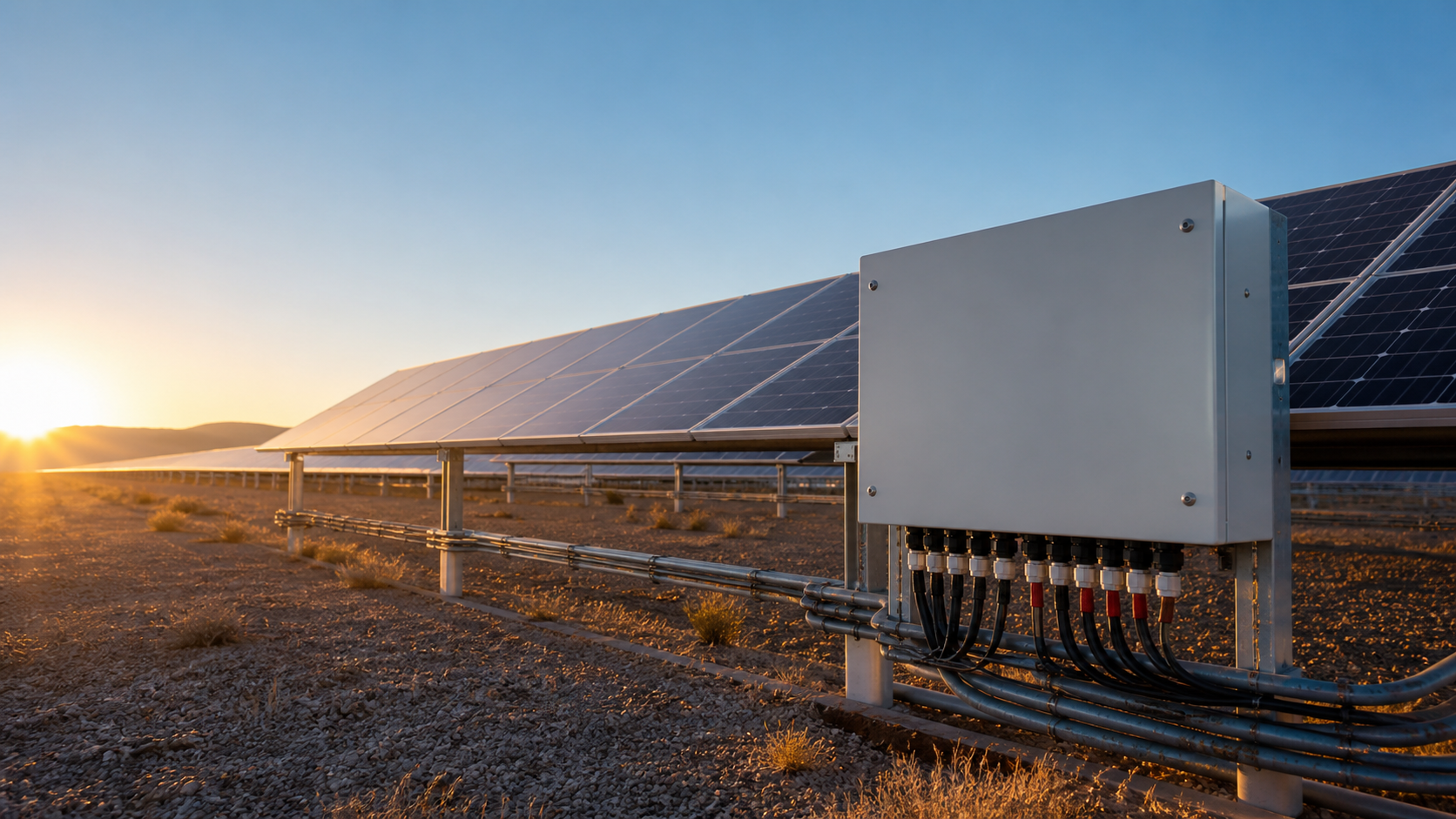
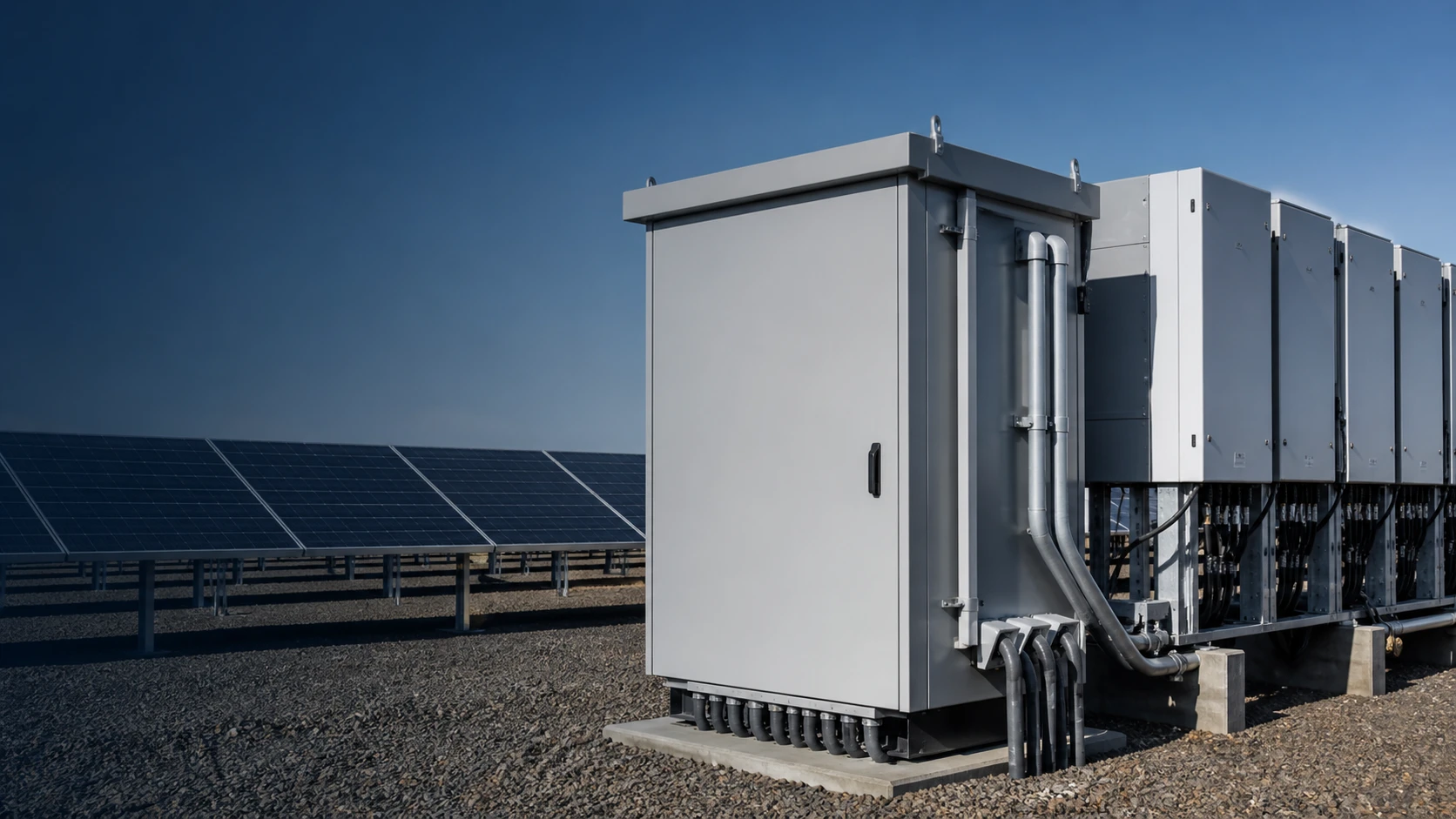
Protection class is chosen from the installation environment, not from a catalogue default. Indoor inverter rooms tolerate a lower class; anything mounted on a tracker table, a rooftop or a desert substation frame does not.
Protection class selection for PV DC combiner boxes by site condition.
Every cable entry should use a waterproof gland matched to the actual cable diameter, and unused entries must be blanked, not taped. Verify earth continuity of 0.1 ohm or less from any conductive part back to the main earth terminal, and confirm the main circuit insulation resistance is measured with a 500 V insulation tester — a healthy assembly reads 0.5 Mohm or better on the main circuit and 1 Mohm or better on secondary wiring.
6. Step 5 — Decide on monitoring, then insist on factory testing
String monitoring pays for itself on any plant above roughly 500 kW, because a single underperforming string is otherwise invisible until an annual inspection. Where a monitoring module is fitted, expect current and voltage acquisition accuracy within plus or minus 1 percent of full scale, RS485 with Modbus-RTU, local display of channel currents and bus voltage, and surge-device status alarming.
Factory testing is the part buyers most often skip and most often regret. Ask for a per-unit inspection record, not a type-test certificate for a different model. A credible report covers appearance and structure, nameplate content, warning marking, terminal and earthing marking, insulation resistance on main and secondary circuits, earth continuity, clearance and creepage, fuse and surge device verification, protection class, and packing completeness.
NEUTRON issues a factory inspection report against GB/T 34936 and GB/T 34933 for every DC combiner box shipped, and the assembly practice follows the same IEC 61439 discipline used across its low-voltage switchgear lines, with IEC 60529 governing protection class and IEC 60947 governing the switching devices inside.
7. Common specification mistakes and how to avoid them
Most combiner box failures trace back to a small number of repeated errors at the specification stage rather than to manufacturing defects.
- Rating the box on nominal array voltage instead of cold-temperature Uoc — always calculate the worst-case open-circuit condition.
- Under-sizing fuses at 1.0 x Isc to save cost — the 1.25 x Isc floor exists to survive irradiance overshoot.
- Fitting surge protection on PV+ only — negative-pole transients damage inverter input stages just as effectively.
- Choosing an AC-rated isolator for a DC circuit — DC arc interruption needs a DC-rated device.
- Specifying IP54 for a coastal or desert site — salt fog and fine dust demand IP65 and a corrosion-resistant finish.
- Ordering more inputs than the array uses — unused glands leak, and oversized enclosures cost freight.
- Accepting a type-test certificate as a unit test record — insist on the report for the serial numbers you are buying.
8. NEUTRON PV DC combiner box configuration
NEUTRON builds PV DC combiner boxes and PV grid-connection cabinets to project drawings rather than to a fixed catalogue list, which keeps input count, fuse rating and protection class aligned with the array instead of forcing the array to fit the box.
Configurable items include input string count and busbar rating, DC fuse rating selected against measured Isc, DC load-break isolator, output surge protection with thermal disconnector and status indication, optional blocking diodes, optional monitoring with RS485 Modbus-RTU, and enclosure class from IP20 indoor through IP65 for sand and coastal exposure. Enclosures are supplied in cold-rolled, galvanised or stainless steel with powder coating in RAL 7035 as standard.
The same factory produces NEUTRON's GGD and GCS low-voltage assemblies, XL-21 power distribution cabinets and PV grid-connection cabinets, so a combiner box, its downstream AC distribution and the grid-tie panel can be ordered as one coordinated package with a single set of drawings and one inspection regime.
9. Safety notes and destination-market limits
A combiner box is a component in a system, not a substitute for system design. Array earthing arrangement, DC cable routing, inverter input limits and any local rapid-shutdown obligation are decided by the project designer and by the wiring rules of the destination market. Where a market mandates a specific product listing, confirm it at tender stage, not after shipment.
Do not open a DC combiner box under load. Isolate at the inverter, open the DC isolator, verify absence of voltage, and only then remove fuses. Fuse holders in a live DC circuit are a common cause of arc injury on PV plants.
This is general technical guidance, not a substitute for local electrical code, the applicable standard, product datasheets or a qualified engineer's design review. Confirm ratings and final configurations against the actual project.
Frequently asked questions
How many strings should one PV combiner box handle?
Match the input count to the array you are actually building. Commercial rooftops commonly use 4 to 12 inputs per box; utility-scale ground-mount typically uses 8 to 24. Oversizing leaves unused cable entries that become water ingress points.
What fuse rating does a PV combiner box need?
At least 1.25 times the string short-circuit current (Isc), applied at both incoming and outgoing terminations. The overall overcurrent protection capability of the assembly should meet the same 1.25 x Isc threshold.
Is 1500 V DC always better than 1000 V DC?
Not always. 1500 V reduces combiner count, cabling and trenching per megawatt on large ground-mount plants, but many commercial rooftop markets cap array voltage at 1000 V. Choose the class your wiring rules and inverter input permit.
What IP rating do I need for an outdoor combiner box?
IP54 is the practical minimum for general outdoor mounting. Sandy, dusty, coastal or chemically corrosive sites need IP65 or better together with a corrosion-resistant enclosure finish.
Does a PV combiner box need surge protection on both poles?
Yes. Fit surge protective devices referenced to both PV+ and PV-, with a nominal discharge current In (8/20 us) of at least 10 kA and a maximum continuous operating voltage above 1.2 x Uoc at STC.
What test documentation should I ask for?
A per-unit factory inspection record covering insulation resistance, earth continuity, clearance and creepage, fuse and surge device verification, protection class and packing — not a type-test certificate for a different model.
Bring the project inputs to the first review.
NEUTRON can review the application context, electrical envelope, enclosure conditions and document requirements related to combiner box selection guide: how to choose the right pv dc box before quotation.
Discuss a technical requirementContinue learning
Explore related technical guidance in Solar PV.
Technical note: source article content is retained for educational use. Applicable standards, ratings, protection coordination and final configurations must be confirmed for the actual project and destination market.