
What a Combiner Box Does in a PV Array
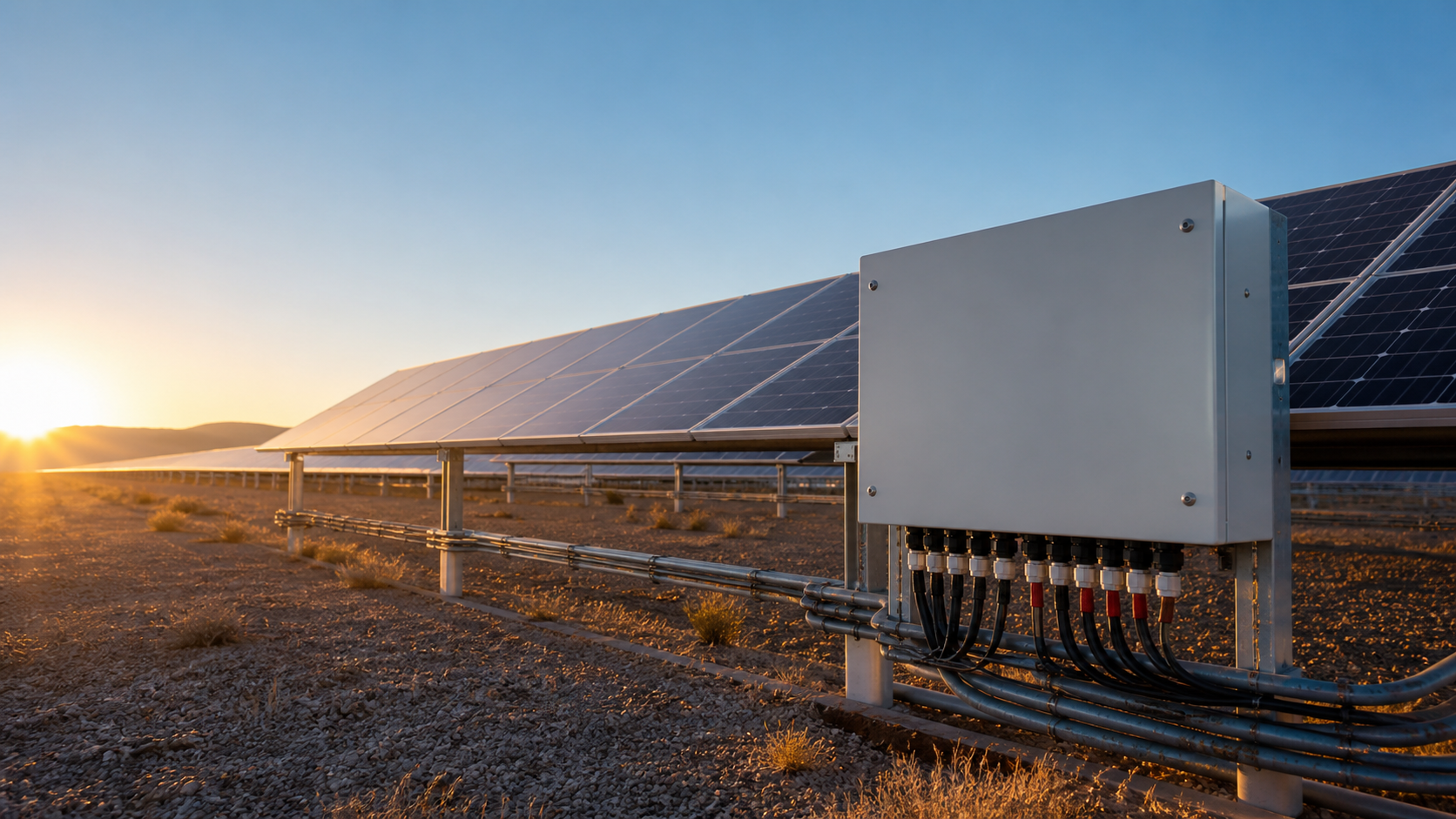
Photovoltaic modules are wired in series to form a string. A string produces useful voltage but modest current, and a single megawatt block can contain dozens of them. Running every string all the way back to the inverter would mean dozens of long cable runs, dozens of terminations at the inverter, and no practical way to isolate a single faulty string.
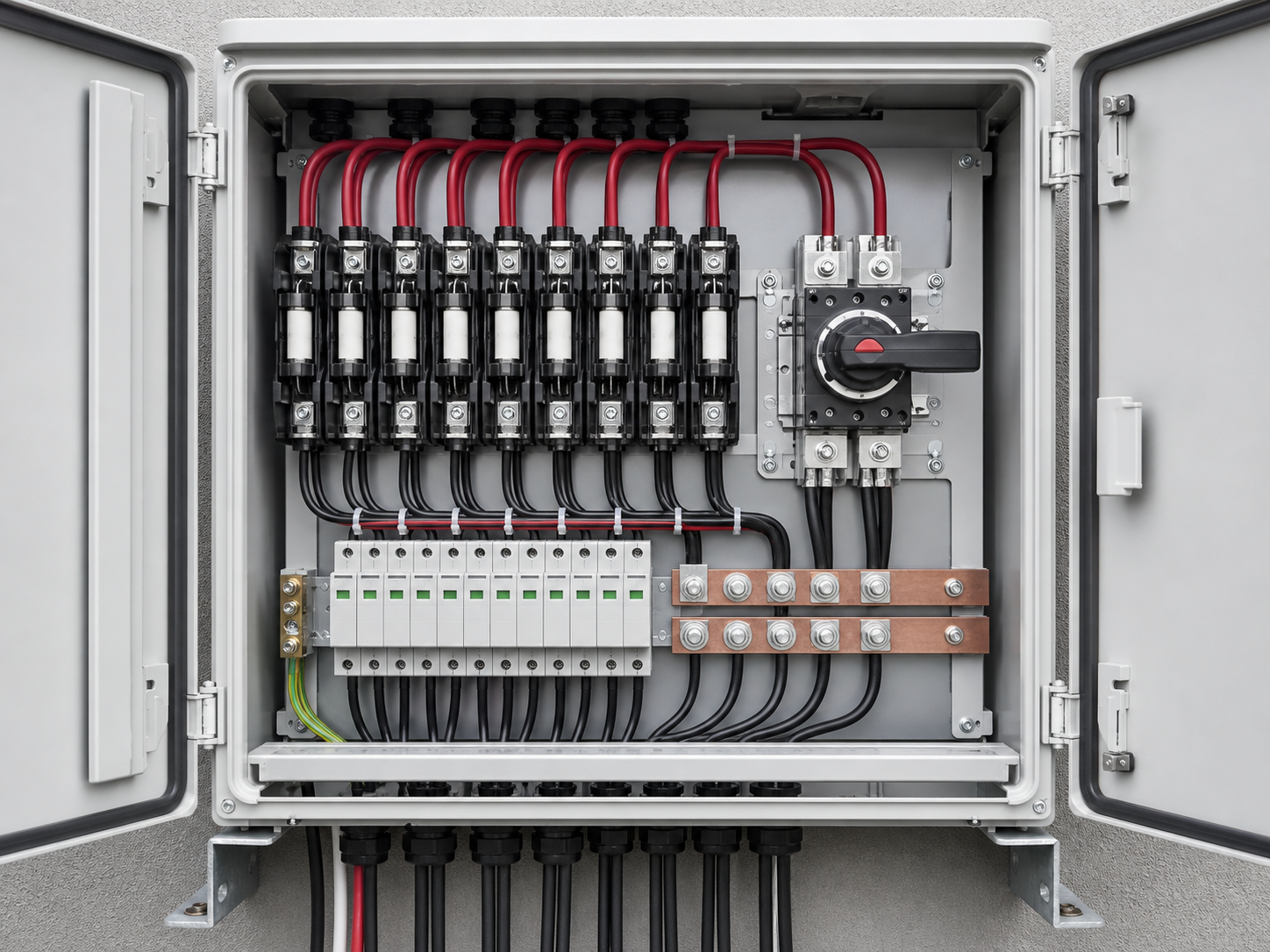
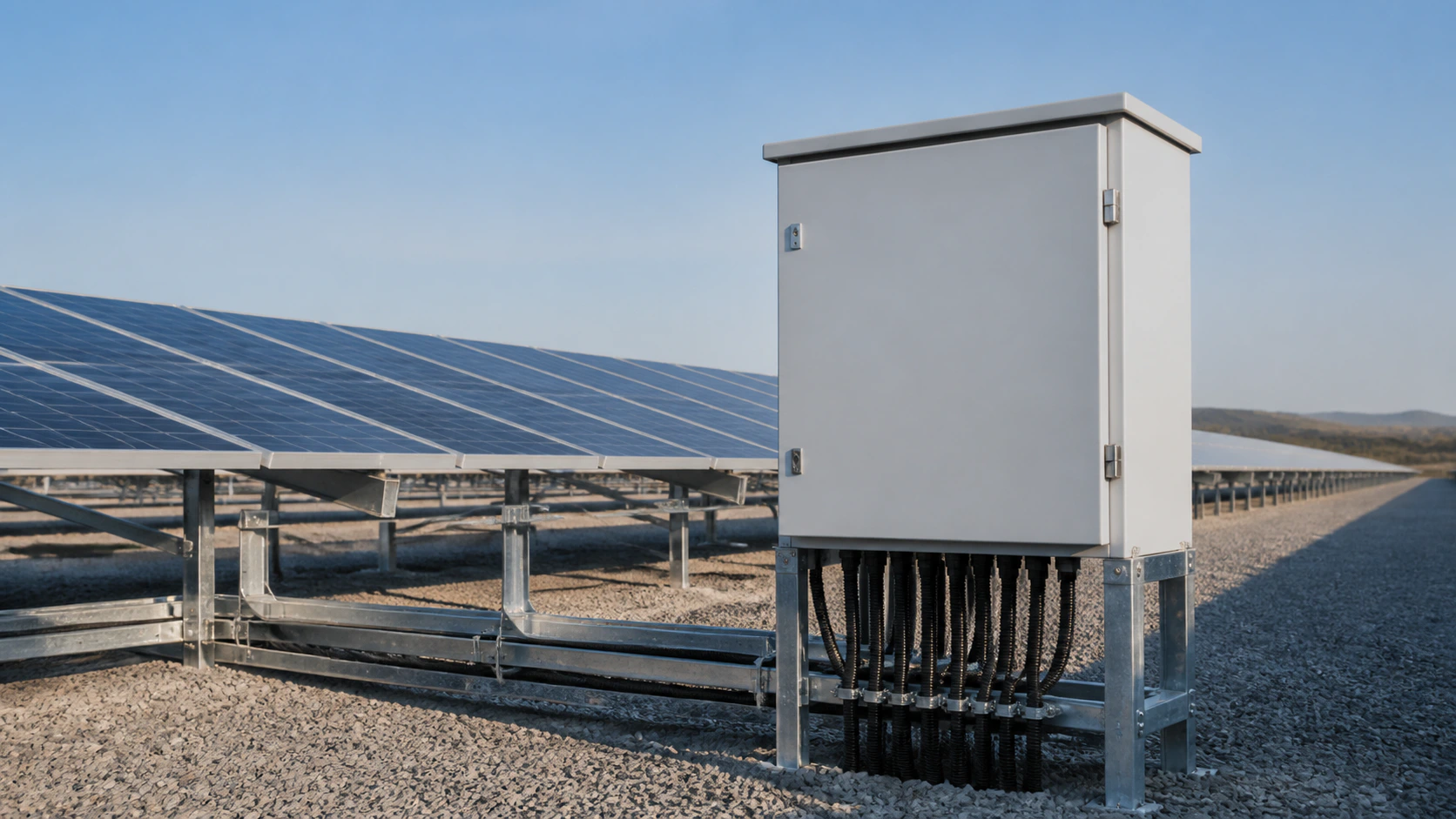
The combiner box solves that. Strings land in the box on individual **PV+ / PV-** terminals, each positive pole passes through its own **DC fuse**, and all outputs are paralleled onto a copper busbar. One larger cable then leaves the box for the inverter or for a recombiner. Current adds up; voltage does not. Ten 12 A strings in parallel produce roughly 120 A at the same string voltage — this is the single fact that governs every downstream rating.
Three functions sit on top of aggregation: **per-string overcurrent protection**, so one failed string cannot be back-fed by its neighbours; **surge protection**, because array wiring loops act as antennas for lightning-induced transients; and **safe isolation** before service.
Combiner Box vs Junction Box vs Recombiner
These three names are used loosely in tender documents, and the confusion has real cost. A **module junction box** is the small potted enclosure bonded to the back of the panel; it holds bypass diodes and the factory leads. It is part of the module, not part of the balance of system.
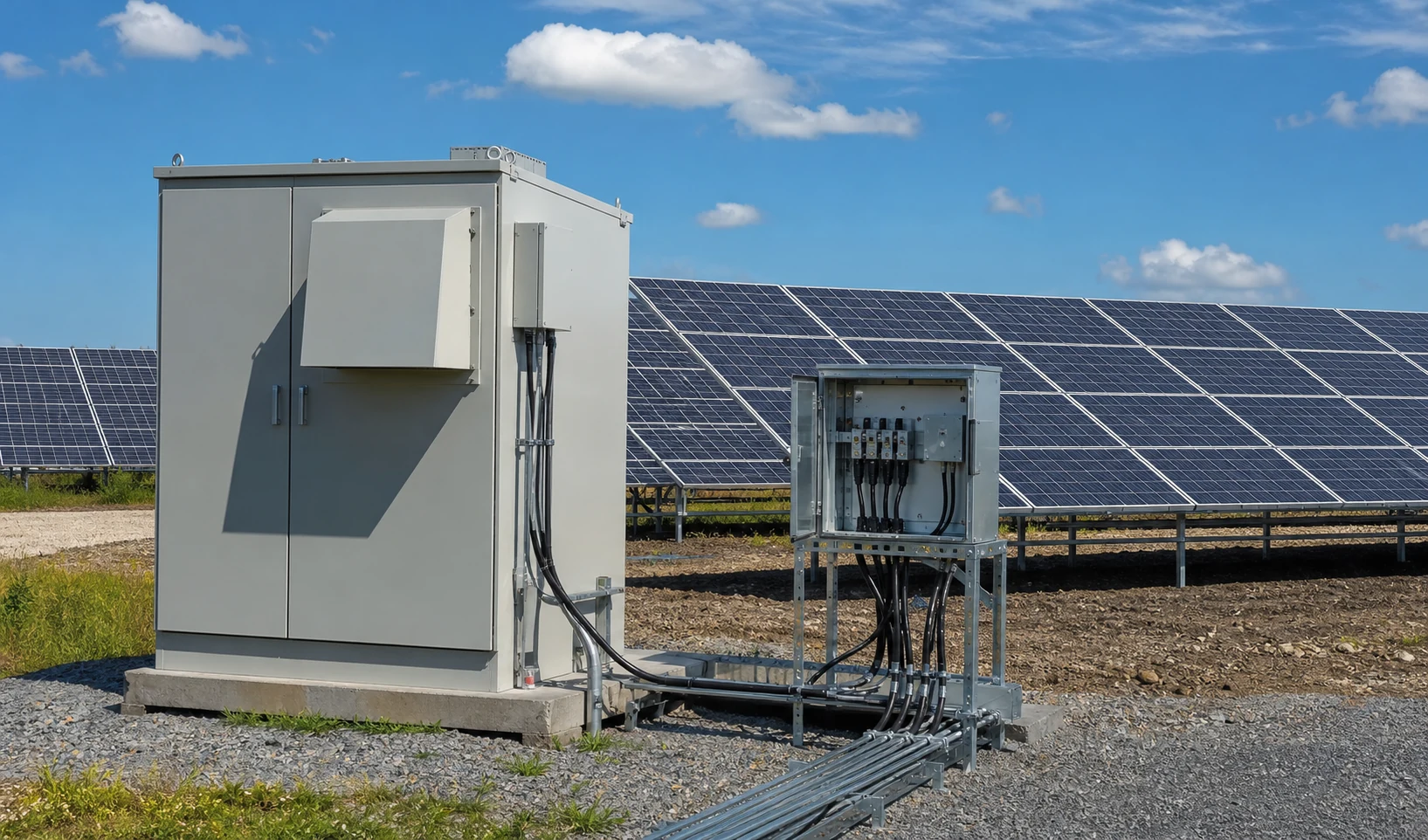
A **combiner box** is field equipment that parallels strings and protects them. A **recombiner box** — sometimes called an array box — sits one level higher and parallels the outputs of several combiner boxes before the central inverter. Electrically it is the same architecture at a larger current rating, typically 250 A to 630 A per input rather than 12 A to 20 A.
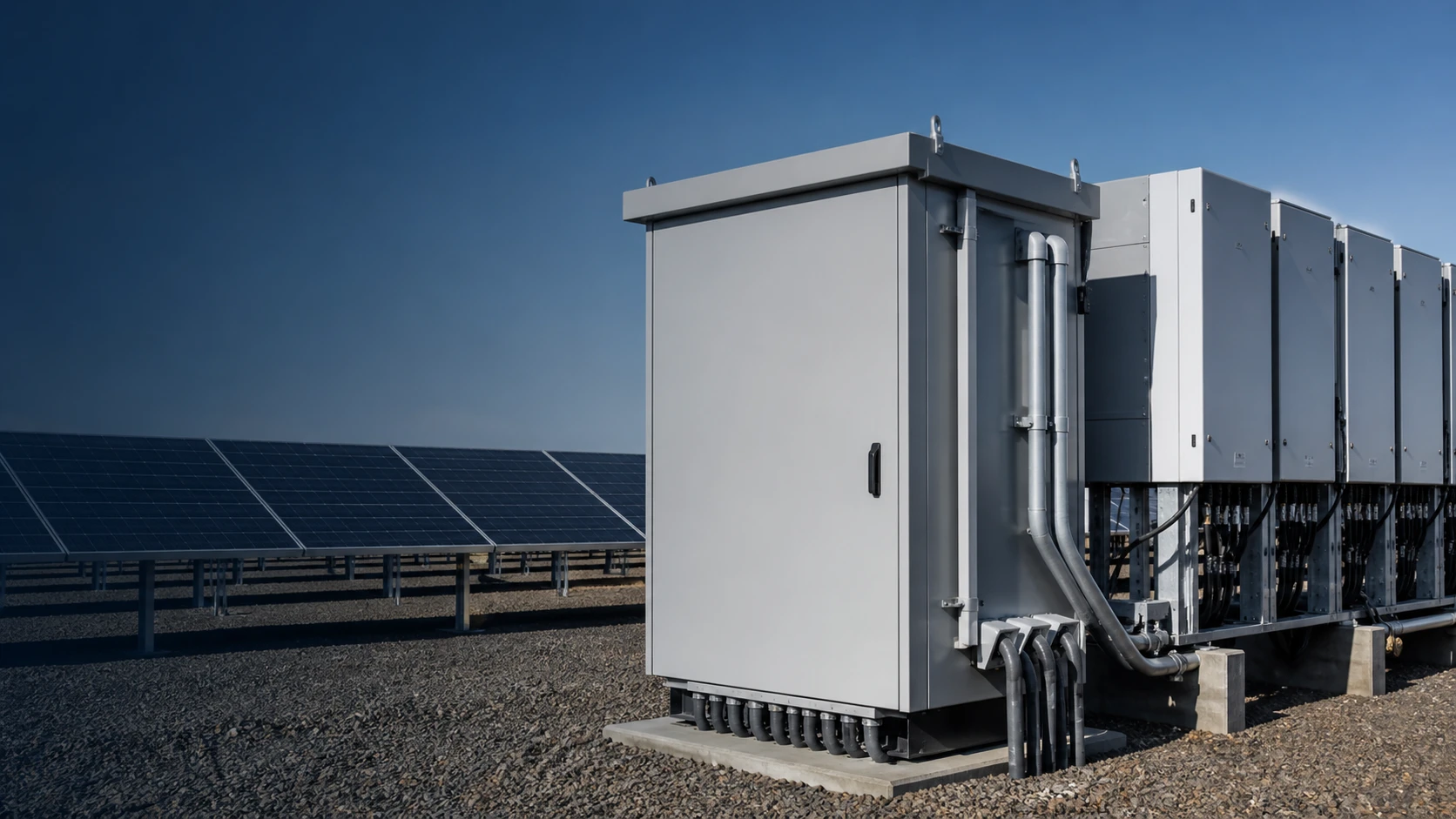
There is also the **AC combiner box**, which belongs after the inverters and groups their AC outputs at up to 690 V AC. Specifying a DC unit for an AC duty, or the reverse, is one of the more expensive procurement errors in solar, because DC arc energy does not self-extinguish at a zero crossing.
Inside a DC Combiner Box: The Protection Chain
NEUTRON builds PV DC combiner boxes as a fixed chain of components. Every element has a job that can be verified with a meter during factory inspection:
- **String fuses (gPV type, IEC 60269-6):** one per polarity per string, rated at no less than 1.25 × the module short-circuit current Isc. Fuse holders carry a permanent warning that they must never be pulled under load.
- **Blocking diodes (optional):** where the design calls for them, reverse voltage capability is at least 2 × Uoc(STC) so the diode survives full open-circuit array voltage.
- **DC surge protective device:** Type 2 to IEC 61643-31, fitted on both poles, nominal discharge current In (8/20 µs) of 10 kA or higher, with Uc greater than 1.2 × Uoc(STC). The SPD carries an internal disconnector and a visible status window.
- **Copper busbar:** sized for the summed array current with margin, keeping temperature rise and resistive loss low.
- **Output disconnect:** a DC-rated moulded case circuit breaker or load-break switch so the whole box can be isolated before service.
- **PE terminal:** every conductive part bonded, marked with the yellow-green PE symbol, with continuity of 0.1 Ω or less from any point in the earth path to the main earth terminal.
Sizing: Strings, Fuse Current and Output Rating
Sizing starts at the module datasheet, not at the box. Take Isc and Uoc at STC, apply the temperature correction for the coldest expected cell temperature on site, then work outward. Per-string fuses follow the 1.25 × Isc floor; the output device carries the summed string current with the same margin.
Table: Typical NEUTRON PV DC combiner box configurations
Voltage class follows the array design: 500 V DC for legacy and small rooftop work, 1000 V DC as the mainstream commercial standard, and 1500 V DC where the developer wants fewer, longer strings and lower balance-of-system cost per watt.
| Configuration | Typical array block | Per-string protection | Output device | Enclosure class |
|---|---|---|---|---|
| 1 in / 1 out | Small rooftop, single string | 2 fuses (PV+ / PV-) | 1 DC MCCB + 1 SPD | IP54 outdoor |
| 2 in / 1 out | Residential and light C&I | 4 fuses | 1 DC MCCB + 1 SPD | IP54 outdoor |
| 3 in / 1 out | C&I rooftop | 6 fuses | 1 DC MCCB + 1 SPD | IP54 / IP65 |
| 4 in / 1 out | C&I rooftop, string inverter | 8 fuses | 1 DC MCCB + 1 SPD | IP54 / IP65 |
| 8 in / 1 out | Ground mount, string inverter | 16 fuses | 1 DC MCCB + 1 SPD | IP65 |
| 16 in / 1 out | Utility block, central inverter | 32 fuses | 1 DC MCCB + SPD + monitoring | IP65 |
Enclosure, IP Rating and Outdoor Service Life
The enclosure is what turns a good schematic into equipment that survives twenty-five monsoon seasons. Ingress protection is defined by IEC 60529 and should be matched to the mounting position, not to the price list.
Material and finish matter as much as the digits. Cold-rolled or galvanised steel with phosphating and electrostatic powder coating is the standard NEUTRON build; stainless steel is available where coastal salt exposure is severe. Mount the box in shade where the layout allows, and remember that fuse ampacity derates with ambient temperature.
- **Indoor, inverter room, controlled environment:** IP20 is the practical minimum.
- **Outdoor, temperate rooftop or carport:** IP54 minimum — dust protected, splash proof from any direction.
- **Outdoor with wind-blown sand, salt mist or aggressive industrial air:** IP65 dust-tight and jet-proof.
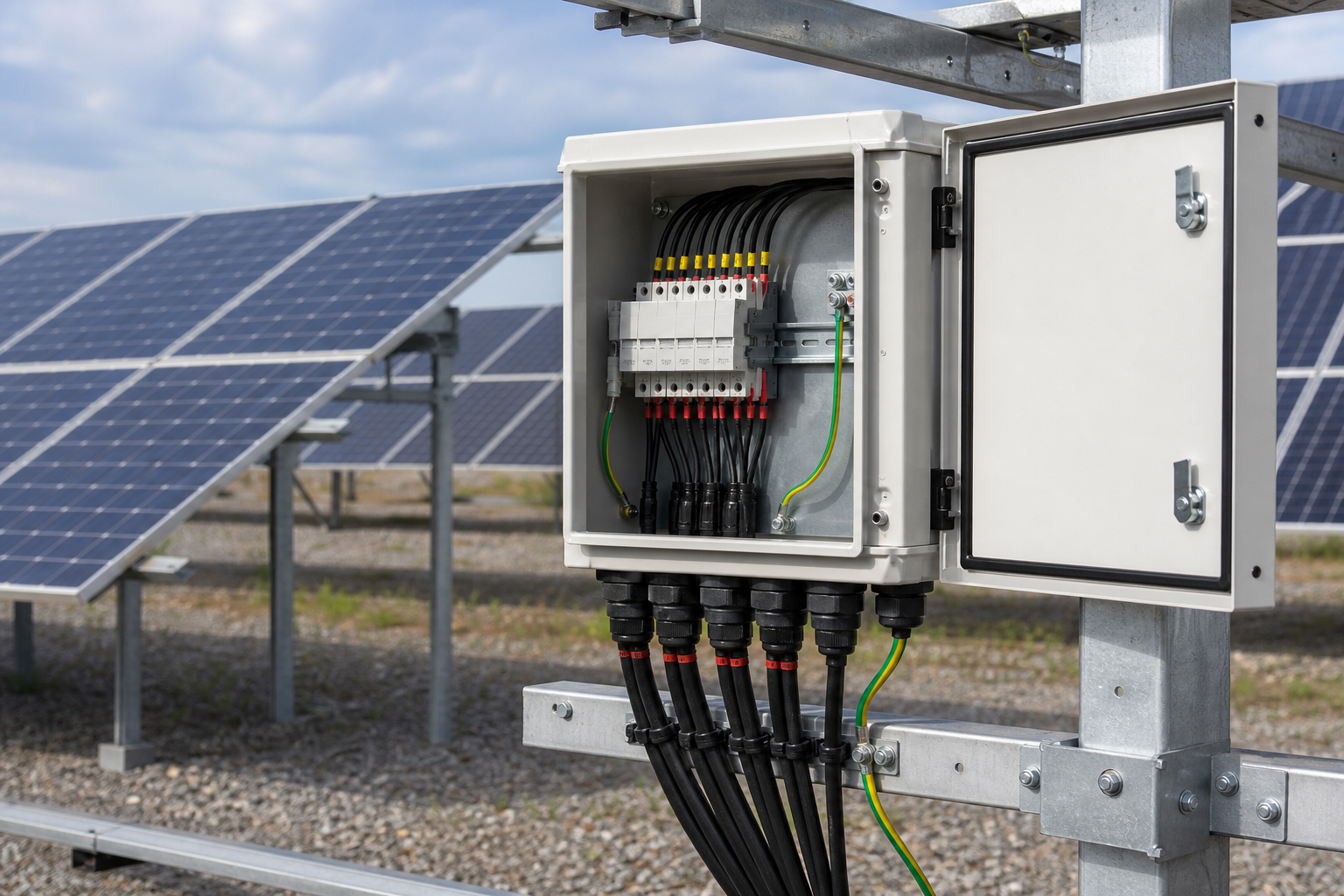
- **Every cable entry** must use a rated gland or MC4-style connector; an unglanded knockout defeats an IP65 body instantly.
Monitoring, Metering and Communication
String-level monitoring converts an invisible yield loss into a work order. A monitored NEUTRON combiner box measures per-channel DC current and busbar voltage to ±1 % of full scale, reports over **RS485 with Modbus RTU**, and can drive a local display.
Two alarms pay for the option on their own. The first is a **string current deviation** alarm: when one channel drifts below the average of its neighbours, the cause is usually soiling, shading, a cracked cell or a cleared fuse. The second is **SPD status monitoring**, which flags a surge protector whose disconnector has operated — without it, a plant can run for months believing it has lightning protection that no longer exists. Confirm the protocol and register map before ordering; retrofitting communication into an installed outdoor box is far more expensive than specifying it on day one.
Specification Mistakes That Cost Money on Site
- **Using AC-rated components on the DC side.** A DC arc has no natural current zero. Only DC-rated fuses, breakers and switch-disconnectors belong in the box.
- **Sizing fuses at nominal current instead of 1.25 × Isc.** The result is nuisance clearing on bright, cold, high-irradiance days — exactly when the plant should be earning.
- **Omitting the SPD to save budget.** One induced transient can destroy an inverter input stage.
- **Ignoring temperature correction on Uoc.** Cold mornings raise open-circuit voltage; a 1000 V array designed at STC can exceed the rating of a 1000 V box at −10 °C.
- **No spare ways.** Ordering exactly the string count in the current phase leaves no capacity for the extension that most owners request within three years.
Standards, Factory Testing and Export Readiness
For export projects the paperwork is part of the product. NEUTRON manufactures to the framework buyers audit against: **IEC 61439**, **IEC 60269-6** (PV fuses), **IEC 61643-31** (PV surge protective devices), **IEC 60529** and **IEC 62548**, with **CE**, **CB** and **ISO 9001** as the baseline credentials.
Every combiner box leaves the line with a routine test record: insulation resistance of the main circuit at 0.5 MΩ or better on a 500 V megger, 1 MΩ or better on secondary circuits, earth continuity at 0.1 Ω or less, verified clearance and creepage distances, correct PV+ / PV- / PE labelling, SPD nameplate parameters checked against the array data, and confirmation of the declared IP class. Ask any supplier for a sample routine test report before placing a first order — it separates real manufacturing from box assembly.
This is general technical guidance. Confirm final ratings, protection coordination, standards, documentation and configuration against the approved project design and applicable local requirements.
Frequently asked questions
What does a PV combiner box do?
It combines parallel PV strings and brings string protection, surge protection, isolation and output connections into a controlled DC enclosure before the inverter.
When is string fuse protection needed in a combiner box?
The need and rating depend on the number of parallel strings, module reverse-current capability, maximum system voltage and the approved PV design.
Which inputs are needed to specify a combiner box?
Provide maximum DC voltage, string count, string current, inverter interface, protection requirements, site environment, cable entry and documentation requirements.
Bring the project inputs to the first review.
NEUTRON manufactures PV DC combiner boxes from 500 V to 1500 V DC, AC combiner boxes to 690 V AC, grid-connected cabinets and the full low-voltage assembly range behind them. Send us your module datasheet, string count and site conditions, and our engineers will return a configured single-line diagram and pricing.
Request a quoteContinue learning
Explore related technical guidance in Solar PV.
Source article retained from the approved NEUTRON publishing file. Final ratings, standards, product documents and project configuration must be confirmed against the applicable requirements.