
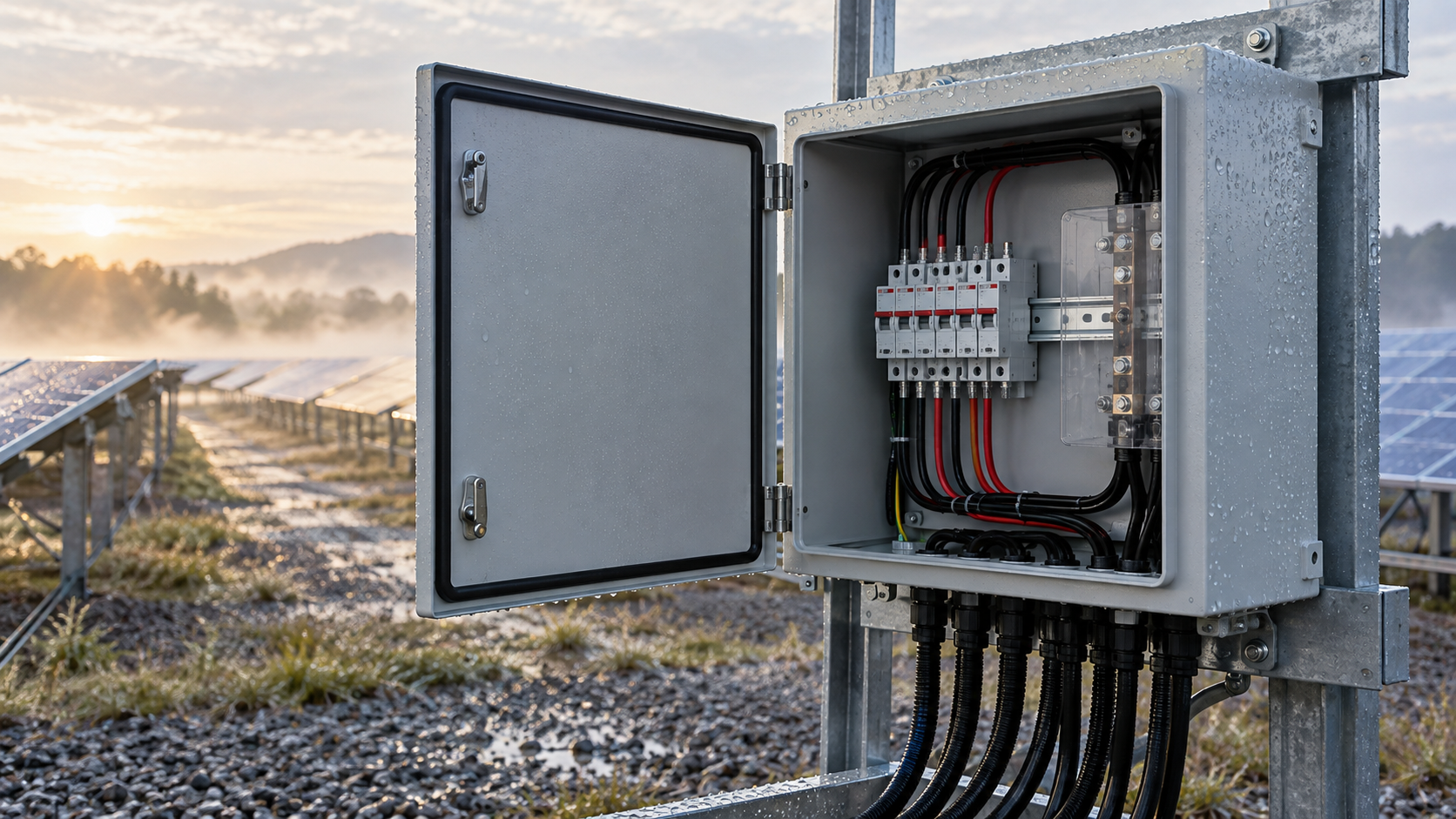
Why Condensation Forms Inside a Combiner Box
Condensation appears when warm, humid air inside the enclosure cools and the dew point is reached on cooler surfaces such as the metal backplate or busbar supports. The driving factor is the temperature delta between the internal air and the enclosure wall combined with high relative humidity. This is a humidity-and-thermal problem, not a single-component failure.
Breathing Membrane Is Not a One-Way Dehumidifier
A breathable membrane equalizes internal and external pressure and allows water-vapor diffusion through the microporous film. It is a pressure-equalization and diffusion element, not a one-way dehumidifier that actively removes moisture. The technical basis is a Gore-type breathable membrane: it balances pressure and permits water-vapor diffusion, but it does not pump water out of the cabinet. Relying on a vent alone to eliminate condensation is incorrect.

Humidity and Temperature-Delta Control
Effective condensation control combines several conditions: limiting the internal humidity load, reducing the temperature delta, and where the duty cycle allows, adding low-power heating or controlled dehumidification to keep surfaces above the dew point. The need for heating or active dehumidification depends on the climate, enclosure sealing, and internal heat generation; it is not assumed for every site.

Vent Valves, Desiccants, and Inspection Are Not Universal
Fitting a vent valve, adding desiccant packs, or scheduling quarterly checks are options that suit some designs and climates, but they are not universal rules for every combiner box. Specify them only where the enclosure concept, IP grade, and site humidity profile justify them, and verify the approach against the approved model datasheet. A generic instruction to always add desiccant is misleading.
Enclosure Sealing and IP Interaction
Condensation control and ingress protection are related but distinct. A high IP grade keeps liquid water out, yet it can also trap internally generated humidity if the enclosure is airtight without a managed ventilation path. The breathable membrane supports pressure balance while limiting direct water entry, but it does not set the humidity level by itself.
Treat sealing, ventilation, and active humidity control as one coordinated design choice. The correct balance depends on the declared IP grade, the internal heat load from devices, and the local climate, and must be confirmed against the approved model datasheet rather than copied from another site.
This article preserves the accepted technical guidance but is not a substitute for the applicable local code, approved model datasheet, test report or a qualified engineer's design review.
Frequently asked questions
Does a breathable membrane remove moisture?
No. It equalizes pressure and lets water vapor diffuse; it is not a one-way dehumidifier. Active moisture control needs heating or dehumidification where justified.
What mainly causes condensation?
A temperature delta between internal air and the enclosure wall plus high humidity. The dew point is reached on cooler surfaces, forming water.
Should I always add desiccant or a vent valve?
No. These are conditional options, not universal rules. Choose them based on IP grade, climate, and the approved model design.
Is quarterly inspection mandatory everywhere?
Not as a universal rule. Inspection frequency should follow the site condition and manufacturer guidance, not a fixed blanket schedule.
Bring the project inputs to the first review.
Share the array layout, ratings, site conditions and documentation requirements for a coordinated review.
Discuss a projectContinue learning
Explore related technical guidance in Solar PV.
Published from the accepted Period 13 manuscript (1.1); technical meaning and safety boundaries are retained from the approved source package.