
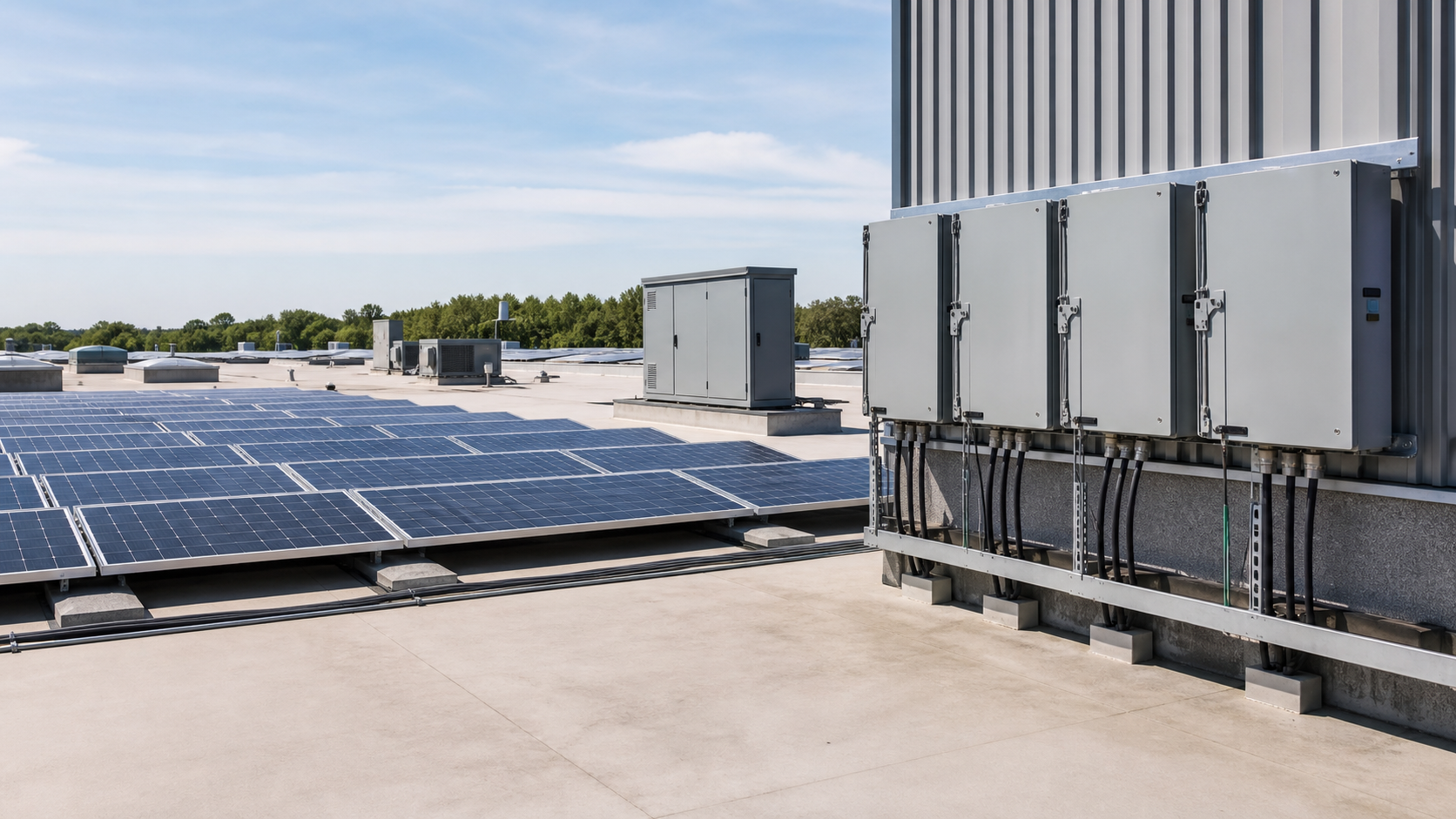
1. Why distributed PV changes combiner box design (rooftop/C&I vs utility scale)
Utility-scale arrays are engineered as one site with one design freeze, one string layout and a controlled environment. Distributed PV is the opposite: many small sites, mixed orientations, irregular roof geometries and owners who expect a long, maintenance-light service life. A combiner box that is fine on a fenced desert plant may be wrong on a warehouse roof in a coastal city. The design must absorb variation — in string count, in mounting exposure, in who services it — rather than assume a uniform plant.
For C&I and rooftop arrays this means the combiner box is no longer a passive junction; it becomes a distributed protection and monitoring node. The closer the box sits to occupied buildings and unskilled owners, the more the specification leans toward safety, sealing and remote visibility.
2. String count and current in rooftop vs C&I arrays
Residential rooftops typically present a small number of strings — often 2 to 6 — with modest aggregate current, so the combiner box can be compact, wall-mounted and fuse-light. C&I roofs tell a different story: a single factory roof can host 12 to 30+ strings, pushing output busbar current into the hundreds of amperes. The enclosure, busbar cross-section and terminal rating must be sized for the summed continuous current, not for a single string.
Per-string short-circuit current (Isc) still governs fuse selection. Each input needs its own gPV fuse rated to at least 1.25 × Isc, and the busbar must carry the total of all protected strings without exceeding its rated continuous current. A C&I enquiry that omits string count and Isc cannot be specified safely.
3. IP and environmental rating for rooftop mounting
A rooftop combiner box lives where the weather hits first. Dust, driving rain, condensation and thermal swing are daily realities, so enclosure sealing is not optional. For most rooftop and C&I mounting, IP65 is the pragmatic minimum: dust-tight and protected against low-pressure water jets from any direction. Coastal or highly polluted sites should consider upgraded corrosion protection and gasket materials suited to the environment.
Ventilation design matters too. Sealing the box raises internal temperature, so the layout must keep fuses and surge protective devices inside their rated temperature bands through passive cooling or sensible component spacing. A box that is sealed but thermally starved will age early.
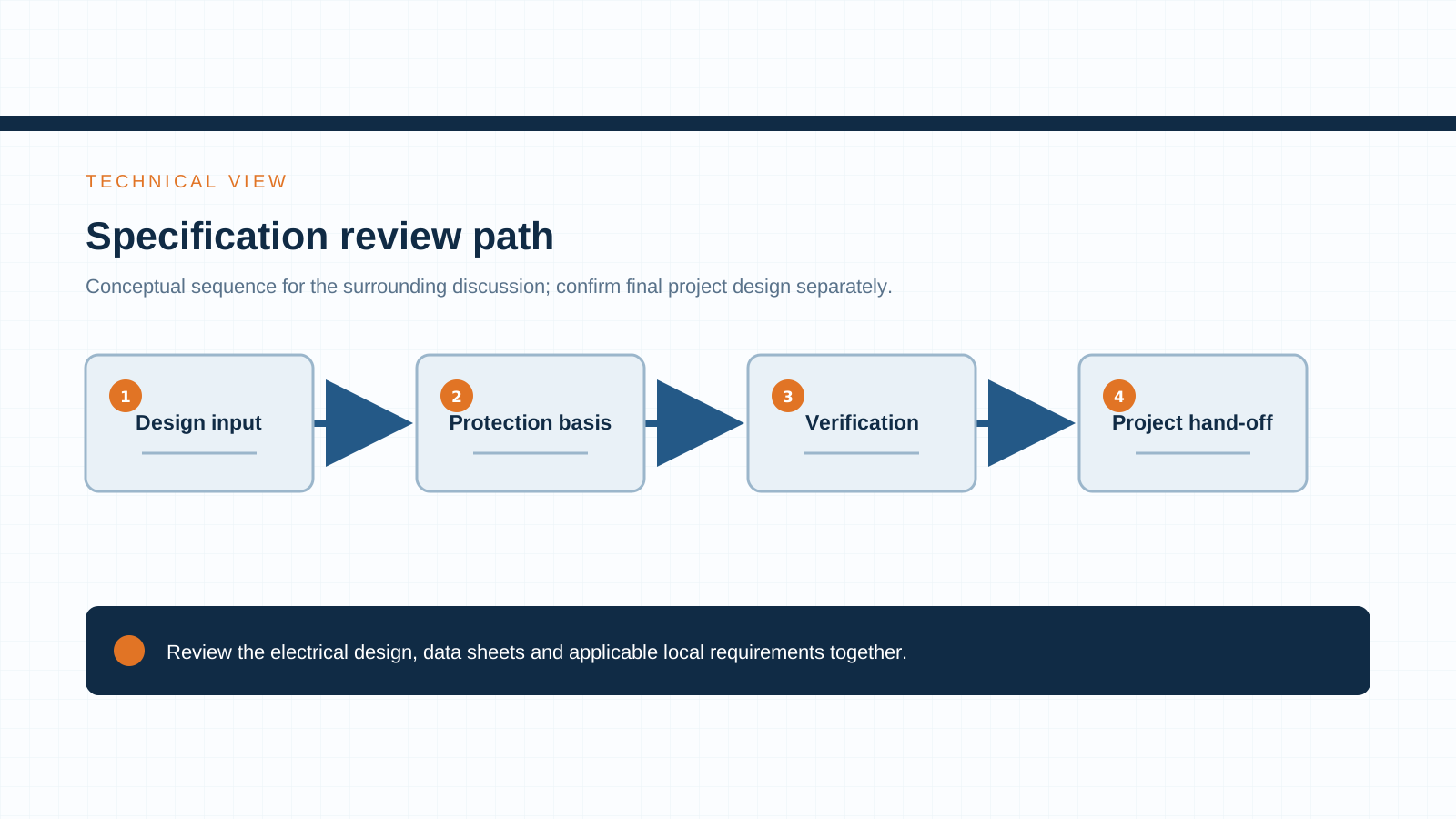
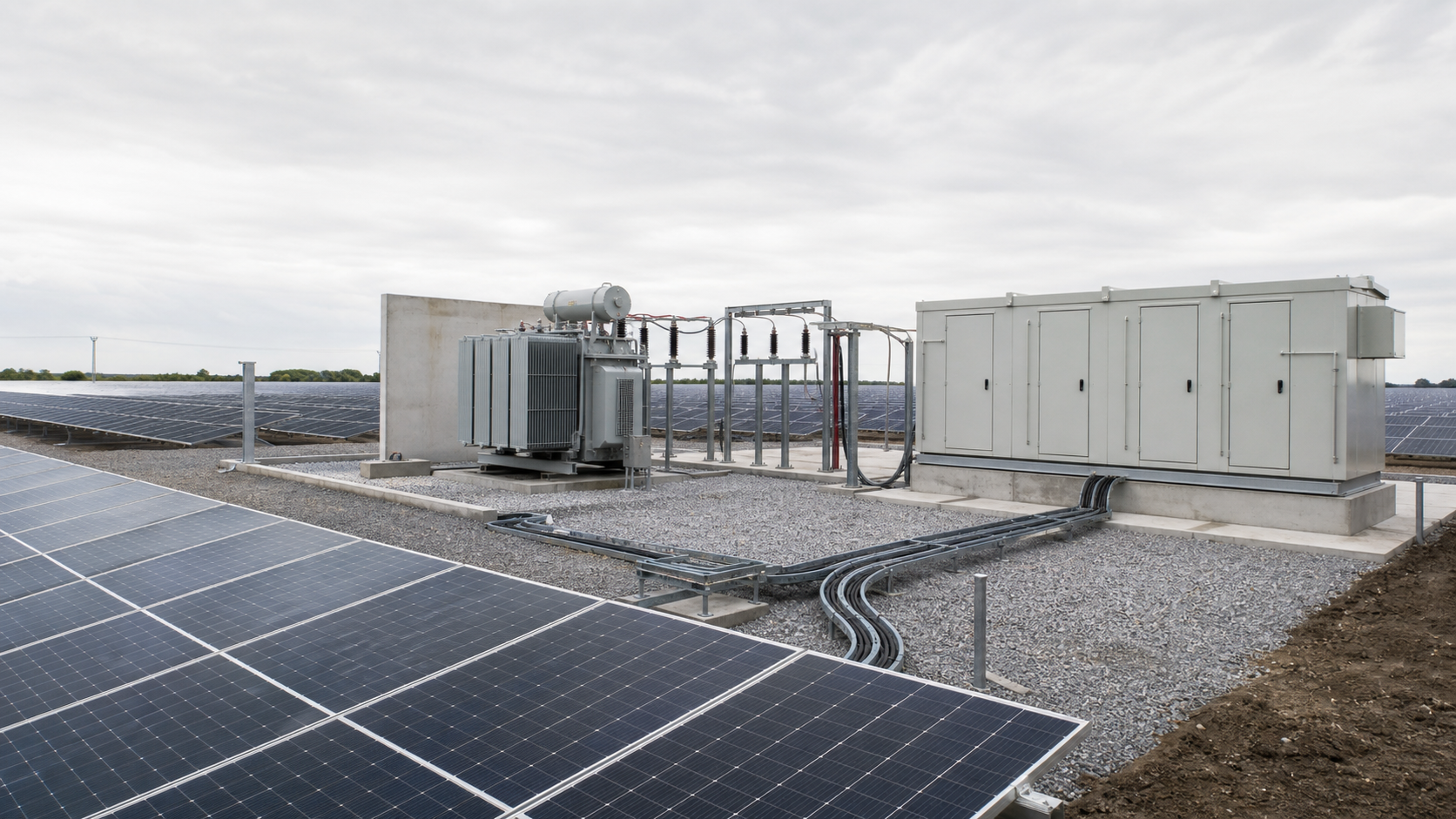
Technical diagram shown at a readable responsive scale.
4. DC disconnect and SPD for distributed arrays
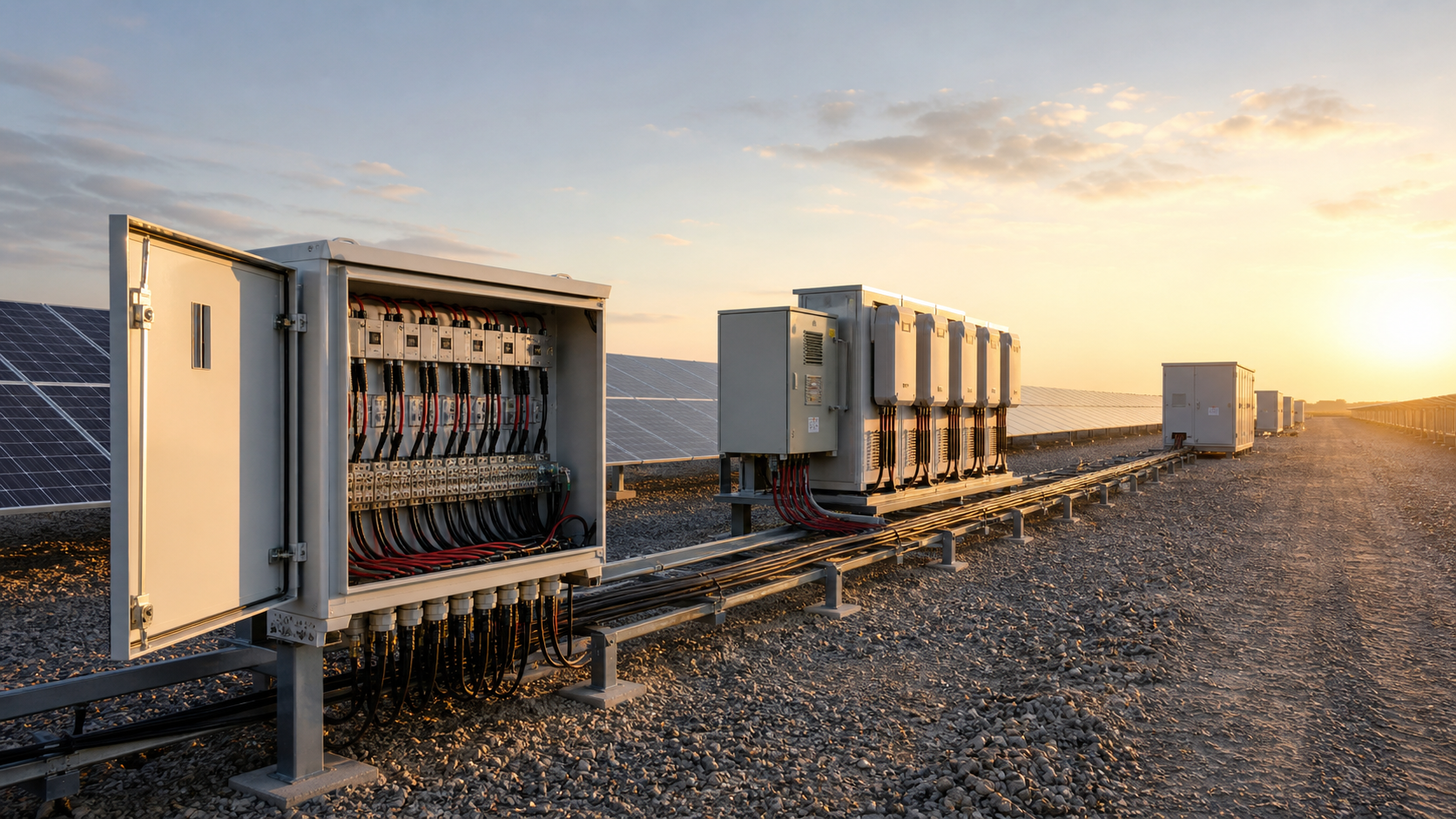
Every distributed-PV combiner box needs a reliable DC disconnect so firefighters and service staff can isolate the string feed safely. The switch must be rated for the system DC voltage and the aggregated current, with a clear visible break and adequate breaking capacity under fault conditions.
Surge protection is equally important because distributed arrays sit close to buildings and varied earthing. A Type 1+2 or Type 2 DC SPD (IEC 61643-31) sized to the system voltage and matched to the equipment voltage protection level (Up) protects both the inverter interface and the building wiring. Lightning-dense regions should treat coordinated SPD staging as a requirement, not an upgrade.
5. Grid-connected cabinet coordination (LV switchgear interface)
The combiner box does not stand alone — its DC output feeds the inverter and, on many C&I sites, a grid-connected cabinet that interfaces the LV switchgear. The two assemblies must be coordinated: continuous current rating, protective device selectivity, earthing scheme and cable entry must match end to end. A mismatch here shows up as nuisance tripping or, worse, an unprotected fault path.
NEUTRON treats the combiner box and the low-voltage switchgear as one coordinated system. Specifying the grid-connected cabinet together with the combiner box — rather than buying each from a separate vendor — keeps the interface continuous current, disconnection and earthing consistent.
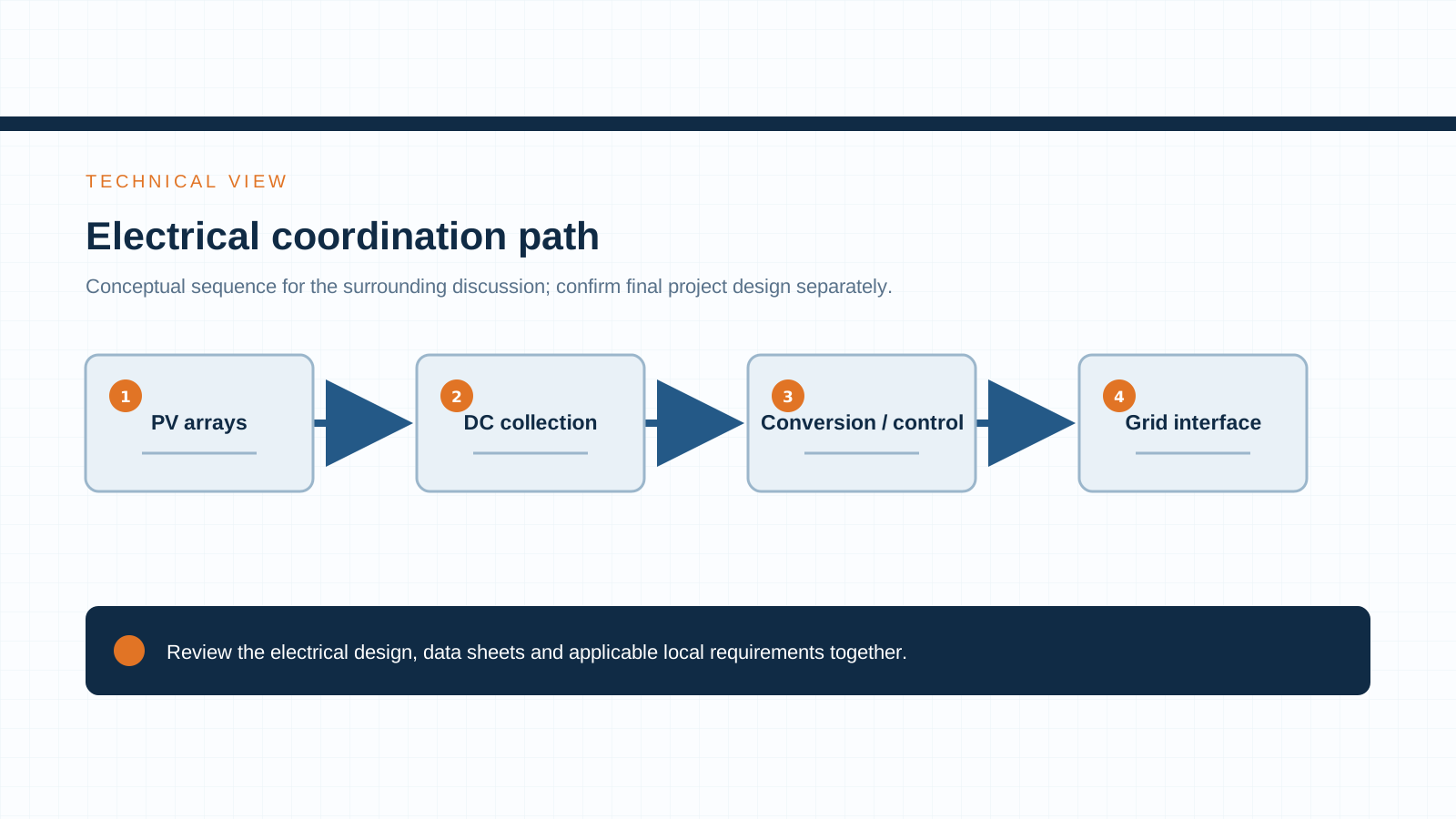
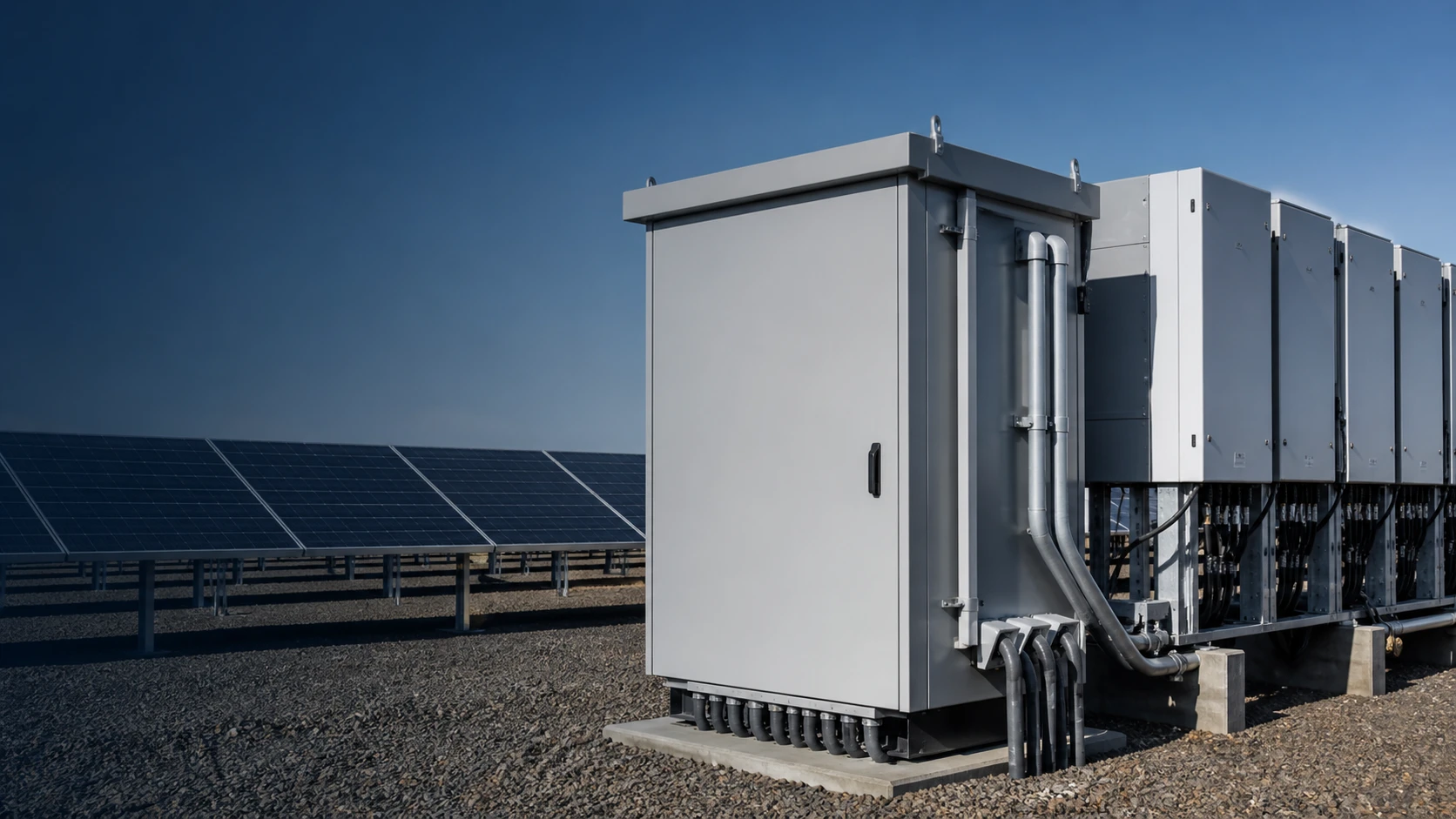
Technical diagram shown at a readable responsive scale.
6. Monitoring and rapid shutdown considerations
Distributed owners expect to see generation, not just harvest it. Modern combiner boxes support per-string monitoring — current, voltage and fault detection — so a single shaded or failed string is visible before it costs a season of yield. For larger C&I roofs, this data also feeds asset management and O&M scheduling.
Where local rules require it, rapid shutdown capability lets first responders bring the roof circuit to a safe voltage quickly. Even where not mandated, module-level or string-level shutdown is increasingly specified for residential and occupied-building roofs, and the combiner box is where that control is terminated.
7. Standards that govern distributed-PV combiner boxes
Specifying to these standards — and confirming them on the datasheet — is what separates a compliant distributed-PV assembly from a generic enclosure sold on price alone.
- IEC 61439-8 — assemblies for use in photovoltaic installations.
- IEC 62109 — safety of power converters for use in photovoltaic power systems.
- IEC 61439 — low-voltage switchgear and controlgear assemblies (covers the grid-connected cabinet).
- IEC 61643-31 — surge protective devices for PV systems.
8. A practical specification checklist for a rooftop/C&I enquiry
When you issue a distributed-PV combiner box enquiry, give the supplier the numbers that decide the design. A complete brief contains: maximum system DC voltage (1000 V or 1500 V); number of input strings and per-string Isc; site IP and corrosion class; DC disconnect and SPD requirements; monitoring or rapid-shutdown needs; and the LV switchgear interface for the grid-connected cabinet.
With those inputs, NEUTRON can configure a combiner box and grid-connected cabinet that fit the roof you are actually building — not a utility-scale layout trimmed to size. See the Solar PV product range for combiner equipment rated for distributed and C&I arrays.
This is general technical guidance. Final ratings, standard editions, protection coordination and compliance evidence must be confirmed for the actual project and applicable local requirements.
Frequently asked questions
How is a distributed-PV combiner box different from a utility one?
A utility combiner box is built for one large, uniform plant with a controlled environment. A distributed-PV box serves many rooftops and C&I sites with mixed orientations, harsher exposure and owners who expect sealed, monitored, low-maintenance nodes — so it leans toward higher IP, built-in monitoring and safer DC isolation close to occupied buildings.
How many strings fit in a rooftop combiner box?
Residential roofs commonly use 2 to 6 strings in a compact wall-mounted box; C&I roofs can require 12 to 30 or more. The limit is the busbar and terminal current rating, so string count and per-string Isc must be stated in the enquiry.
What IP rating do rooftop combiner boxes need?
IP65 is the practical minimum for most rooftop and C&I mounting — dust-tight and protected against low-pressure water jets. Coastal or polluted sites should add corrosion-rated materials and gaskets suited to the environment.
Which standards apply to distributed PV combiner boxes?
IEC 61439-8 (assemblies for use in photovoltaic installations), IEC 62109 (converter safety), IEC 61439 (LV switchgear assemblies for the grid-connected cabinet) and IEC 61643-31 (PV surge protection).
Bring the project inputs to the first review.
NEUTRON reviews the application context and prepares a configuration discussion around project requirements and the applicable document package.
Discuss a projectContinue learning
Explore related technical guidance in Solar PV.
Technical note: confirm the applicable standard edition, project design basis, local requirements and evidence package before final equipment selection or release.