
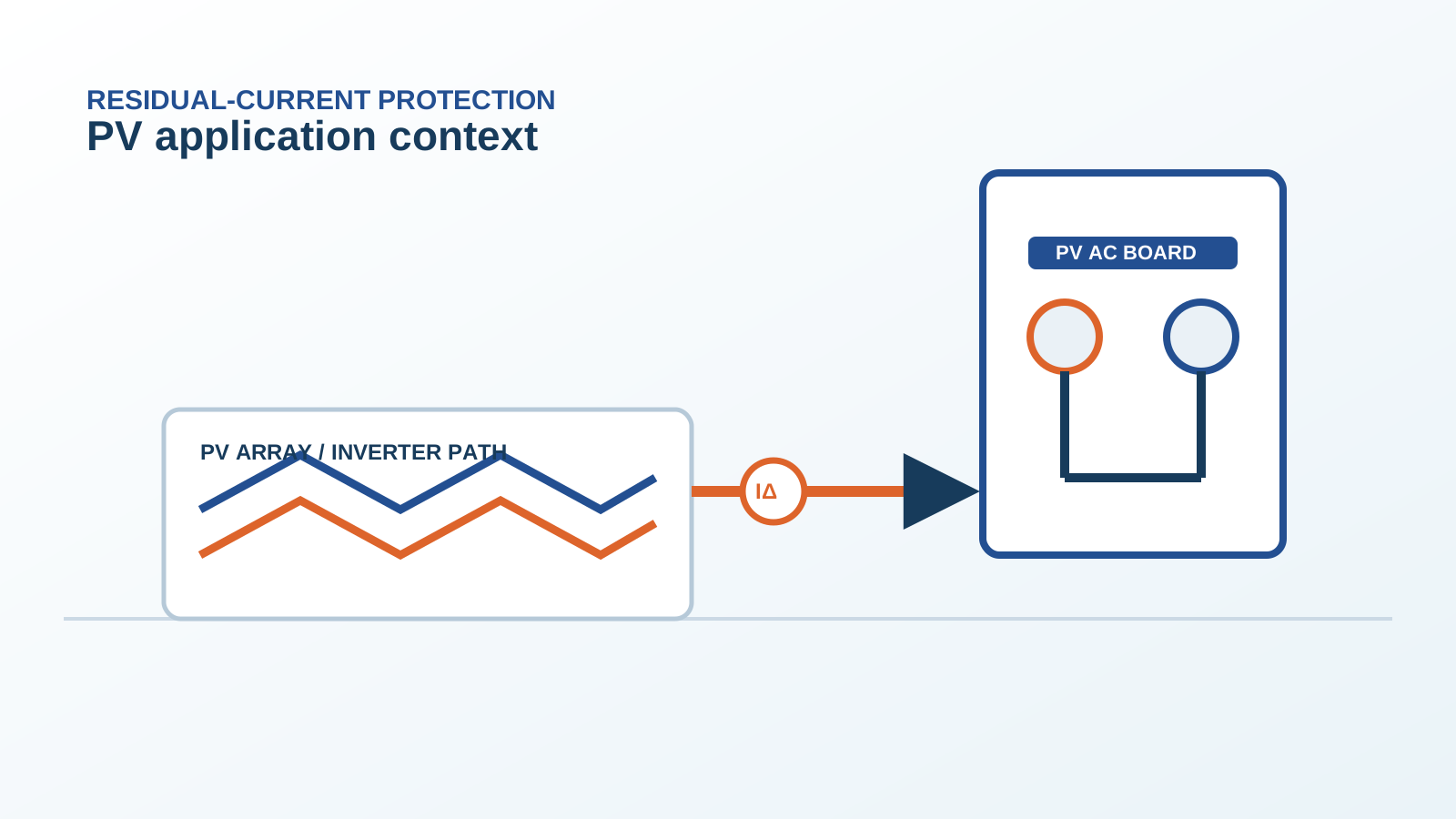
1. What all-current-sensitive actually means
A device is all-current-sensitive when it detects residual current of every waveform likely to occur in a low-voltage installation and retains its declared sensitivity while doing so. That means sinusoidal alternating current at mains frequency, pulsating direct current from half-controlled electronic loads, composite mixed-frequency current from switching converters, and — the decisive item — smooth direct current that is essentially constant. The final item is what separates the class from everything below it.
The phrase carries an implicit second requirement that is easy to overlook. Detecting all waveforms is not enough if detecting one destroys the ability to detect another. An all-current-sensitive device must keep its rated alternating-current sensitivity while a steady direct residual current is flowing, which is why the architecture separates the passive alternating-current sensing path from an actively driven measuring path for the direct component. A device that merely survives a direct offset without measuring it is not all-current-sensitive.
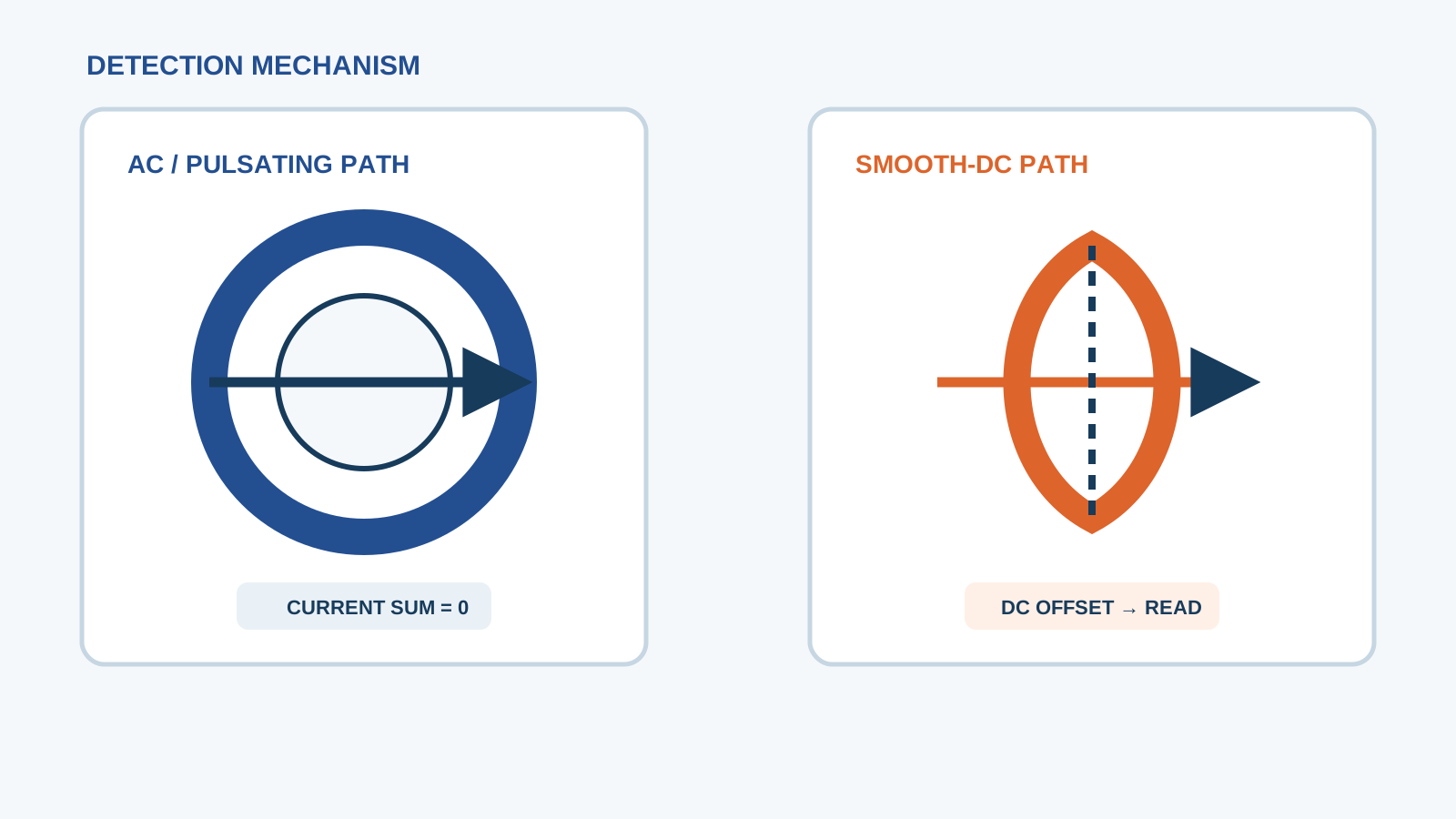
Technical diagram shown at a readable responsive scale.
2. The IEC 62423 type framework
IEC 62423 is the standard that defines the residual-current classes with direct-current capability. It sits above the RCCB and RCBO product standards IEC 61008 and IEC 61009, which cover construction and general verification, and it draws its common definitions from IEC 60755. The framework is a ladder of test waveforms rather than a ranking of quality: each class must pass the tests of the classes below it plus its own additional waveforms.
Type AC: sinusoidal alternating residual current only.
Type A: adds pulsating direct residual current, including half-wave shapes with a phase-angle delay.
Type F: adds composite mixed-frequency residual current and tolerance of a small superimposed smooth direct current, without measuring it.
Type B: adds measurement of smooth direct residual current while retaining alternating-current sensitivity — the all-current-sensitive class.
Type B+: extends the declared detection band substantially higher in frequency and bounds the threshold rise across that band.
3. Why PV needs ACS rather than AC-only detection
A transformerless inverter leaves no galvanic barrier between array and grid, so the array floats on the grid potential and the parasitic capacitance between cells and their earthed frames becomes a continuous path to earth. Bridge switching modulates that potential, and because the modulation is imperfectly balanced and the array polarity relative to earth is fixed, the leakage does not average to zero over a mains cycle. What remains is a steady direct residual current of a few milliamperes.
For an AC-only or Type A device that current is doubly damaging. It cannot be detected, because a constant flux induces no voltage in a sensing winding, and it biases the high-permeability core away from the linear region so that the alternating-current sensitivity the device is marked with is no longer the sensitivity it delivers. The device stays closed, the test button still works, and the protection has quietly degraded. Only an all-current-sensitive device avoids both failures.
4. Detection of pure smooth direct current
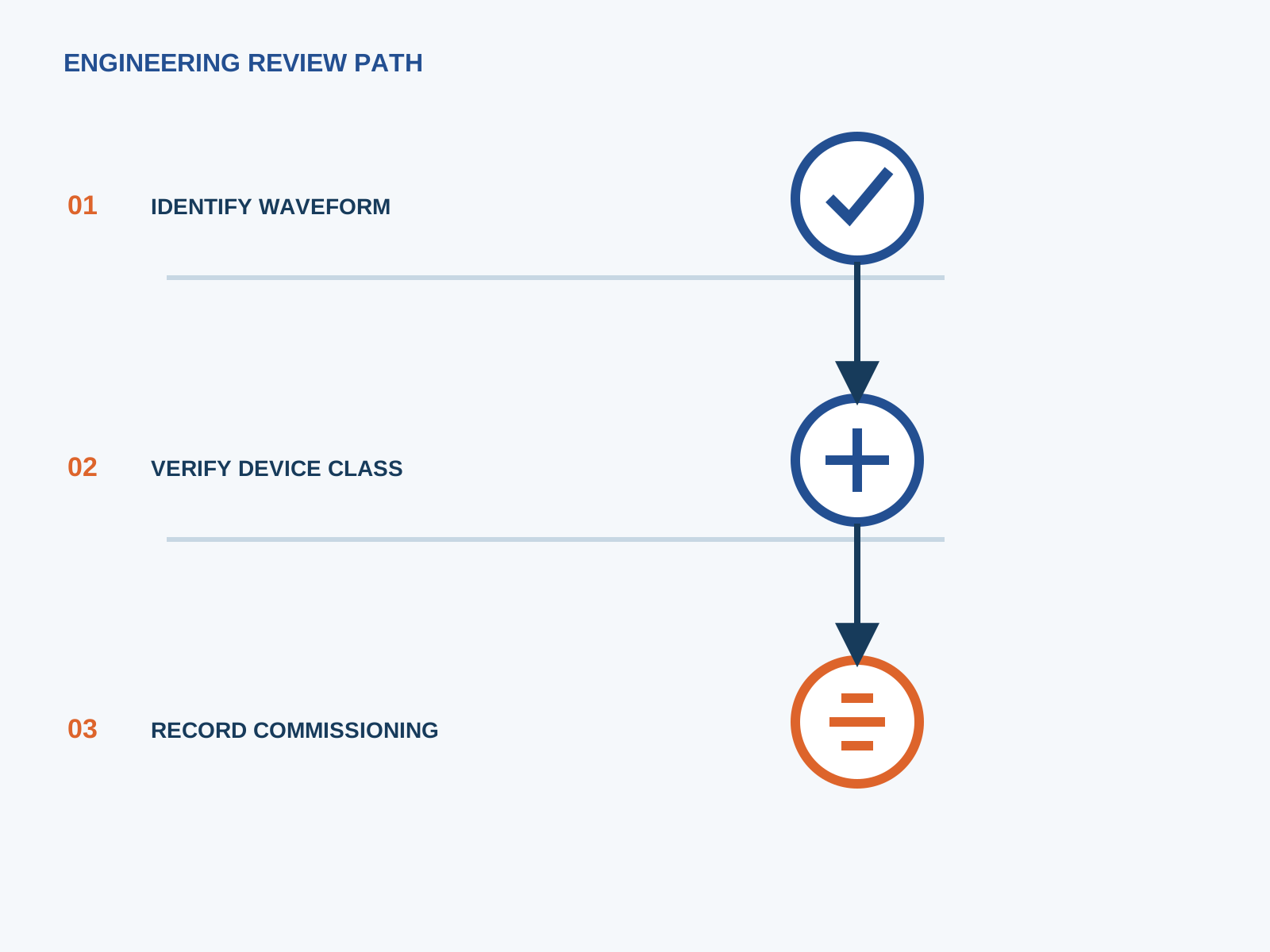
The measuring principle for the direct component is magnetic modulation. An oscillator drives a dedicated core repeatedly through its magnetisation curve while the primary conductors pass through it. With no direct residual current the positive and negative excursions of that sweep are symmetrical. A direct residual current imposes a flux offset that makes them asymmetrical, and the evaluation electronics convert the measured asymmetry into a direct-current value with a resolution of a few milliamperes.
Two practical consequences follow. First, the function requires electronics and therefore an energising supply, whereas the alternating-current path remains passive so that basic protection survives an electronics failure. Second, the direct-current measurement is genuinely quantitative, which is why many devices in this class can also report a measured value to a monitoring system rather than only opening a contact.
5. Selectivity with upstream protection
Placing an all-current-sensitive device in a hierarchy raises two coordination questions. The residual-current question is answered in the usual way: an upstream device should have both a higher residual sensitivity and a time delay, so that a downstream fault is cleared locally instead of dropping the whole board. A common arrangement puts a time-delayed 300 mA device on the incoming feeder and 30 mA instantaneous devices on the accessible final circuits.
The second question is specific to photovoltaic plants and is often missed. Standing leakage from array parasitic capacitance accumulates towards the upstream device, because every inverter circuit contributes to it. A 300 mA feeder device serving several inverters may therefore sit closer to its threshold than any individual circuit suggests. Selectivity must be checked against measured accumulated leakage, not against the nominal contribution of one unit.
6. Marking and certification
The type of a residual-current device is declared by graphical symbols on the front face rather than by words. A Type A device carries the sinusoidal wave symbol together with the half-wave pulsating symbol. A Type B device carries those plus a symbol representing smooth direct current, and the type letter itself is normally printed alongside. The relevant product standard references and the rated residual current appear on the same face, with the rated current, rated voltage and short-circuit withstand.
Check the type letter and the accompanying waveform symbols, not the marketing name.
Confirm the rated residual current and whether the device is instantaneous, selective or time-delayed.
Confirm the product standard references quoted on the device against those required by the project.
Check whether an energising supply is required for the electronics and how failure of that supply is indicated.
Obtain the type-test certificate and the tripping-threshold curve against frequency from the manufacturer as submitted documents.
7. Specifying ACS in PV procurement
Vague wording is the main cause of the wrong device arriving on site. Specifying "a suitable RCD for solar" or "DC-capable protection" invites substitution with a Type A device that tolerates a small offset. The specification should name the class, the standard and the verification evidence required.
Name the class explicitly as Type B to IEC 62423, or Type B+ where the frequency band has been justified by measurement.
State rated current, pole count, rated residual current and the tripping characteristic (instantaneous, selective or time-delayed).
State the short-circuit withstand required and the upstream device it must coordinate with.
Require the type-test certificate and the frequency-dependent tripping curve as submitted documents.
State the energising-supply arrangement and whether a status contact for plant monitoring is required.
State the available DIN-rail width, since an all-current-sensitive device is wider than the Type A it may replace.
8. Common misconceptions
Three beliefs cause most of the field problems. The first is that a Type A device is acceptable because the direct current involved is only a few milliamperes; the magnitude is small precisely because the mechanism is a bias effect rather than a fault current, and a few milliamperes is enough to degrade the sensitivity that matters. The second is that the inverter internal monitor makes an external device unnecessary; the monitor covers the conversion stage, not the cabling, busbar and auxiliary circuits where people work.
The third is that all-current-sensitive means unlimited frequency coverage. Every class has a declared band above which the tripping threshold rises, and above the Type B+ band no class offers declared protection — the correct response there is to limit emission at the converter through shielded cable practice and short earthing paths. NEUTRON supplies the DC protection assemblies and low-voltage switchgear that host these devices and can review a specification for internal consistency before it is issued.
This is general application guidance. Confirm final ratings, trip settings, standards, inverter instructions and local installation requirements against approved project documentation and a qualified engineer's review.
Frequently asked questions
What does all-current-sensitive mean?
It means the device detects every residual-current waveform likely to occur — sinusoidal alternating, pulsating direct, composite mixed-frequency and smooth direct — and retains its declared alternating-current sensitivity while a steady direct component is present. A device that merely tolerates a direct offset without measuring it does not qualify.
Does IEC 62423 mandate all-current-sensitive devices for PV?
The standard defines the classes and their test waveforms rather than assigning a class to an application. The requirement follows from the installation design: where a smooth direct residual current can occur, as it does by construction downstream of a transformerless inverter, the protective device must declare performance that covers it.
Is Type B the same as all-current-sensitive?
In practice yes — Type B is the class that adds measurement of smooth direct residual current while retaining alternating-current sensitivity, which is exactly the definition. Type B+ is an extension of the same class with a substantially wider declared frequency band and bounded threshold rise across it.
How do I read an RCD label to confirm it suits PV?
Look for the type letter B together with the waveform symbols for sinusoidal, pulsating and smooth direct current on the front face, then confirm the rated residual current, the tripping characteristic, the short-circuit withstand and the quoted product standard references. Ask the manufacturer for the type-test certificate and the tripping-threshold curve against frequency.
Bring the protection inputs to the first review.
{ "@context": "https://schema.org", "@type": "Article", "headline": "All-Current-Sensitive (ACS) RCD for PV per IEC 62423", "description": "What all-current-sensitive means, how the IEC 62423 type framework applies to PV, and how to read the label and write the procurement wording correctly.", "author": { "@type": "Organization", "name": "NEUTRON LLC" }, "publisher": { "@type": "Organization", "name": "NEUTRON LLC", "logo": { "@type": "ImageObject", "url": "https://www.neutronele.com/logo.png" } }, "datePublished": "2026-09-03", "dateModified": "2026-09-03", "mainEntityOfPage": "https://www.neutronele.com/insights/all-current-sensitive-rcd-pv-iec-62423", "image": "https://www.neutronele.com/insights/img/all-current-sensitive-rcd-pv-iec-62423-hero.jpg", "articleSection": "Electrical Protection", "keywords": "all-current-sensitive RCD PV IEC 62423, ACS RCD, IEC 62423, Type B, smooth DC, residual current, PV inverter", "inLanguage": "en" }
Discuss a project requirementContinue learning
Explore related technical guidance in Electrical Protection.
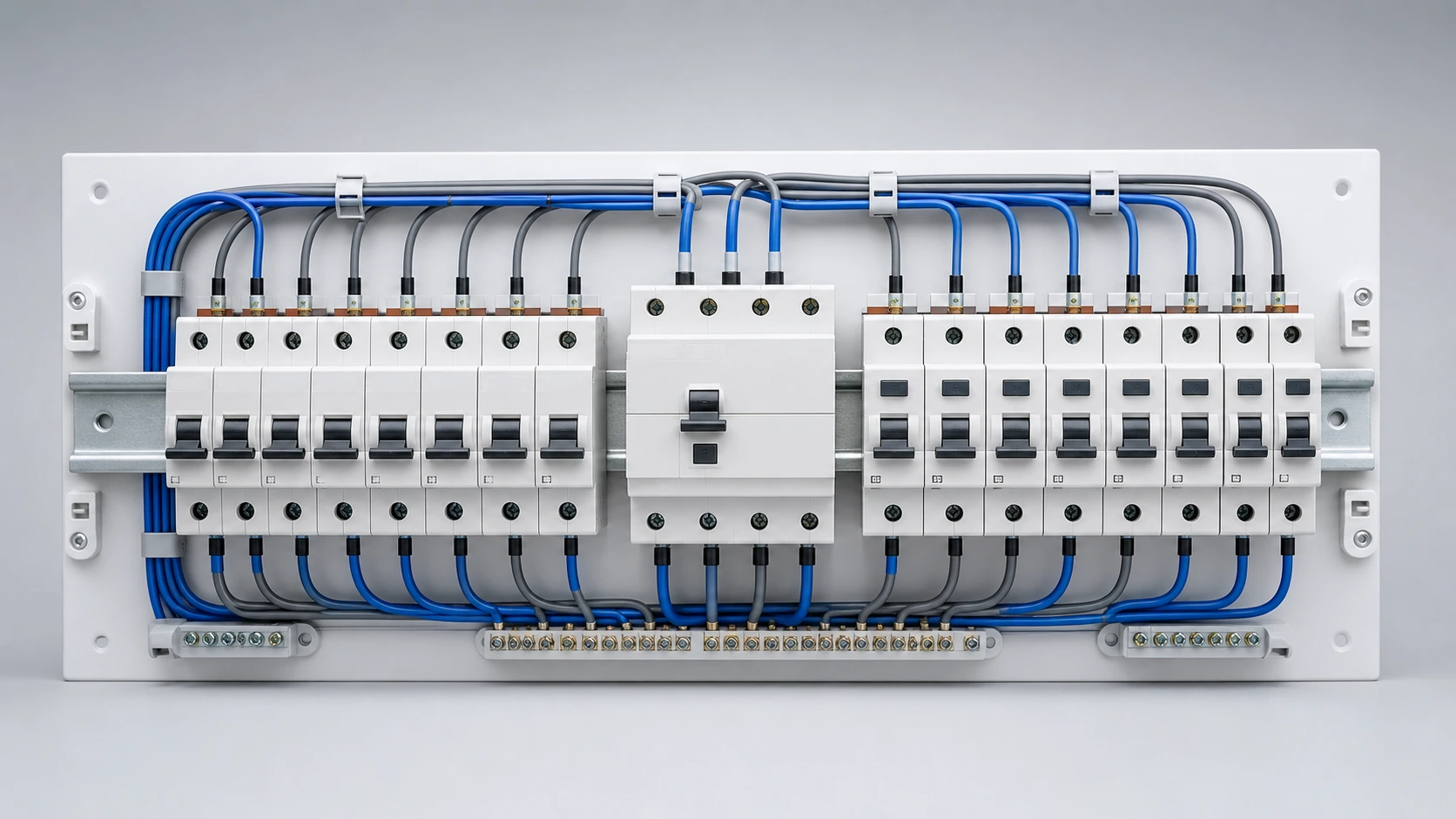
Published from the approved period 10 source package; technical claims and source wording are retained for review.