
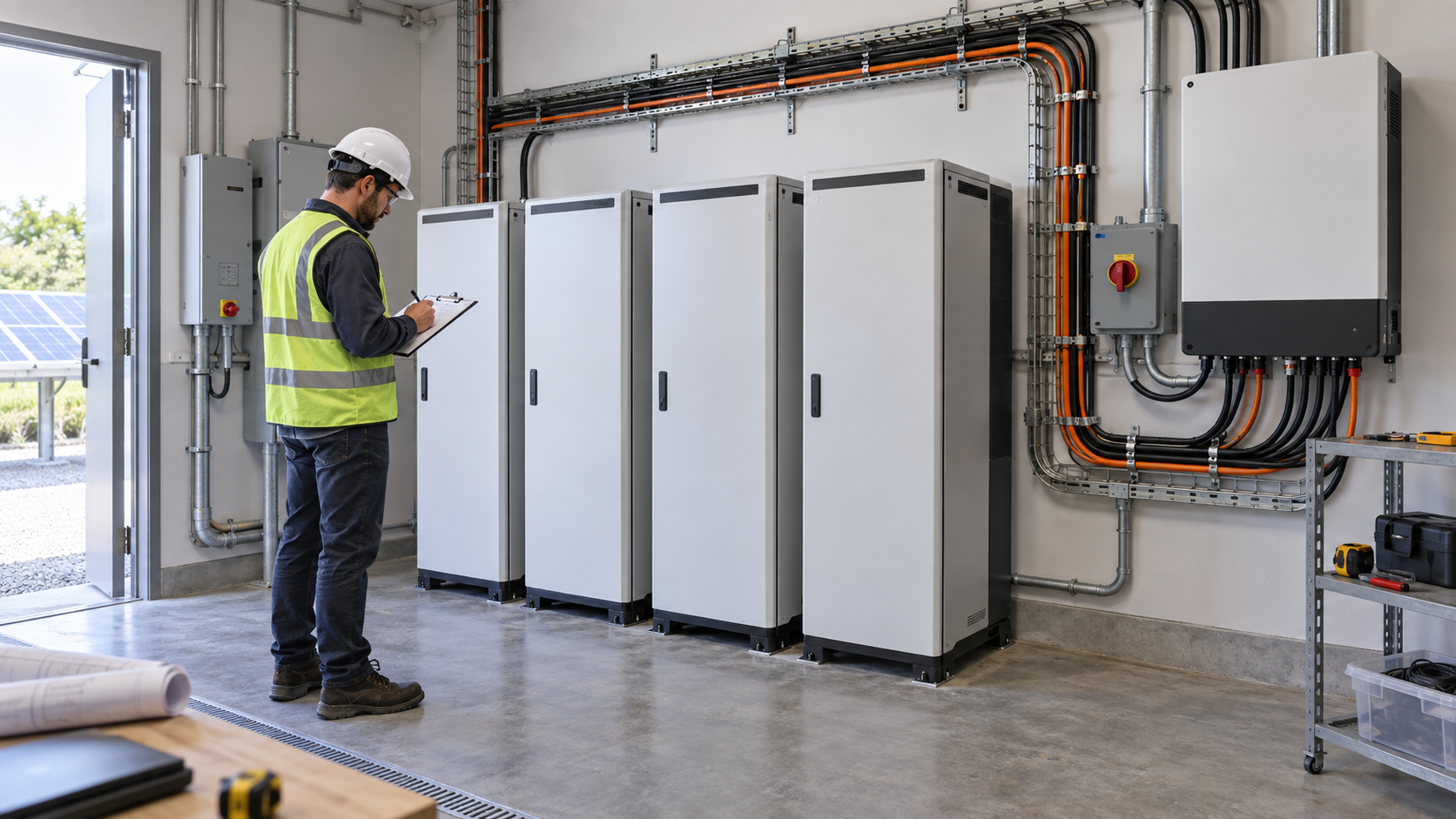
What battery size actually depends on
Usable energy, not nominal capacity, is what a household or a plant consumes. Getting from one to the other requires four inputs, and every one of them has to be established before a capacity figure means anything.
Two further factors modify the answer: the peak power the bank must deliver, which may demand more capacity than the energy calculation alone, and the low-temperature behaviour of the chemistry, since lithium iron phosphate cells must not be charged below freezing without heating.
- The daily energy that must be served from storage, in kilowatt-hours, rather than total site consumption.
- The permitted depth of discharge for the chosen chemistry and warranty terms.
- The number of days of autonomy required with little or no generation.
- Round-trip efficiency and conversion losses between the battery and the load.
Technical diagram shown at a readable responsive scale.
Load audit: the starting point
Build the audit from measurements where possible and from nameplate data where not. List every load that storage must support, its power draw, and the hours per day it runs during the period being covered. Multiply and sum to obtain daily energy in kilowatt-hours.
Three details separate a useful audit from an optimistic one. Standby and parasitic loads — routers, controls, pumps cycling overnight — often total more than expected and run every hour. Motor loads such as compressors and well pumps draw a heavy starting current that sets the discharge power rating, not the energy rating. And seasonal peaks matter more than annual averages, because the bank must cover the worst week rather than a typical day.
Depth of discharge arithmetic
Depth of discharge is the fraction of nominal capacity that may be withdrawn in normal operation. Lithium iron phosphate systems commonly permit 80% to 90%, while lead-acid chemistries are usually held to 50% or less to preserve cycle life. Required nominal capacity is therefore daily energy divided by permitted depth of discharge, then divided again by round-trip efficiency.
Worked example: a household needs 8 kWh from storage each evening, uses a lithium iron phosphate bank at 85% depth of discharge, and loses about 10% round trip. Dividing 8 by 0.85 gives 9.4 kWh, and dividing by 0.90 gives roughly 10.5 kWh of nominal capacity — so a 10 kWh nameplate bank is marginal and a 13 kWh bank is comfortable. Note also that a nominal 48 V bank of 10.5 kWh implies about 220 Ah, which is the figure that actually sizes the conductors and protection.
Technical diagram shown at a readable responsive scale.
Days of autonomy for off-grid
A standalone system has no fallback, so capacity must cover consecutive low-generation days. Two days of autonomy is a common minimum for a well-sited installation with a generously sized array; three to five days suits cloudy winter climates or sites where a service visit is difficult.
Continuing the example above, 9.4 kWh of usable energy per day across three days of autonomy requires about 28 kWh usable, or roughly 33 kWh nominal at 85% depth of discharge. Autonomy is expensive, which is why many standalone designs pair a smaller bank with a backup generator and an automatic transfer arrangement instead of paying for five days of storage that is fully used only a few times a year.
Hybrid versus off-grid sizing differences
A grid-connected hybrid system is sized around a purpose rather than around survival. Self-consumption shifting typically needs only the evening and overnight energy, often 5 kWh to 15 kWh for a household. Tariff arbitrage needs whatever can be charged and discharged inside the price window. Backup duty needs the essential-loads energy for the expected outage duration.
The practical consequence is that hybrid banks are far smaller for the same house, because the grid provides unlimited autonomy. The design attention moves from capacity to the changeover arrangement: which circuits are backed up, how the transition is made, and how the installation is isolated from the network during island operation.
Inverter and charge controller pairing
Capacity must be matched to power. Check that the continuous and surge discharge ratings of the bank cover the largest simultaneous load including motor starting, that the charge current the array can deliver stays inside the maximum charge rate of the bank, and that the bank voltage window sits inside the input range of the third-party conversion equipment across the full state-of-charge range.
Also confirm that the battery management system can communicate with the conversion equipment. Without a working link, charge termination and low-voltage disconnect fall back to fixed voltage thresholds, which shortens bank life. NEUTRON does not supply conversion units or cells, but the control cabinet between them must accommodate the communication routing and the isolation both sides require.
Protection and isolation for storage
A battery bank behaves differently from a photovoltaic array under fault. An array is current-limited by physics; a bank can deliver thousands of amperes into a short circuit for as long as the fault persists. Protection selection must respect that, and reusing alternating-current device ratings on the direct-current side is a serious error.
- Overcurrent protection with a genuine direct-current breaking capacity that exceeds the prospective fault current of the bank.
- A direct-current isolator rated for the bank voltage, located so the bank can be separated from the installation for maintenance.
- Conductors and busbar sized for the continuous discharge current with temperature-rise margin, since bank currents are high at relatively low voltage.
- Surge protection on conductors entering or leaving the enclosure, coordinated with the array-side stages.
- Where a generator provides backup, an automatic transfer switch with correct interlocking so the two supplies can never be paralleled inadvertently.
- Clear labelling and separated routing for management-system signal wiring, so no maintenance action can short a cell group through a sense lead.
The role of energy-storage control equipment
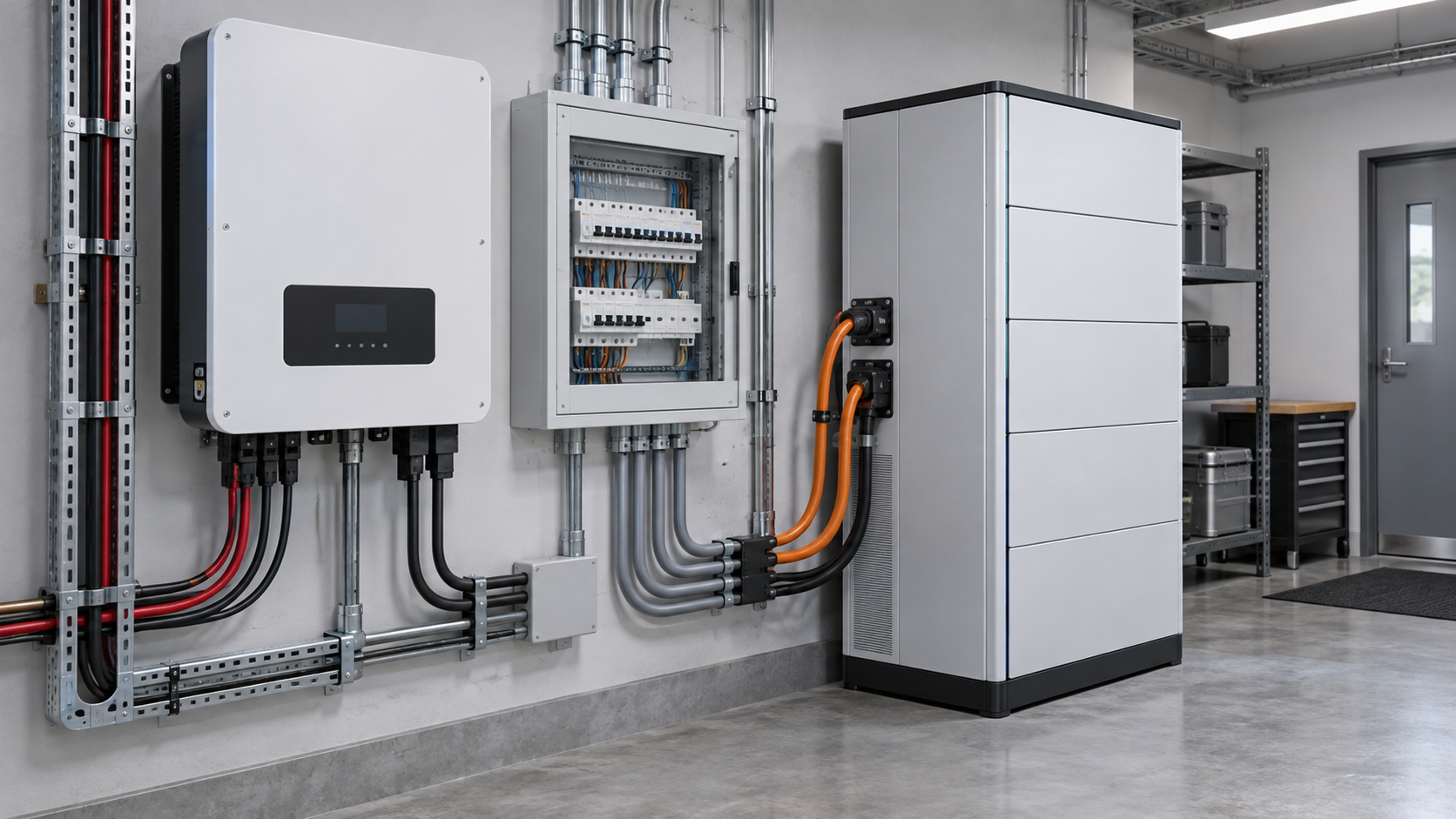
All of the functions above belong in one coordinated assembly rather than being scattered across the installation. An energy-storage control cabinet provides the switching, isolation, overcurrent and surge protection, metering and interface between the battery system, the array and the distribution board, in an enclosure rated for the site.
To specify it, four figures are needed: bank nominal and maximum voltage, continuous and peak discharge current, prospective fault current, and whether coupling occurs on the direct-current bus or on the alternating-current board. NEUTRON reviews those inputs and prepares a cabinet and busbar configuration to match the bank that the sizing calculation produced.
This is general technical guidance. Confirm final ratings, protection coordination, installation and applicable local requirements against current standards, manufacturer documentation and the approved project design.
Frequently asked questions
How do I size a backup battery?
Start with a load audit of only the circuits that must stay live, multiply each load power by its expected run hours during an outage, and sum to get the required usable energy. Divide that by the permitted depth of discharge and again by round-trip efficiency to obtain nominal capacity.
Off-grid versus hybrid battery size?
Standalone systems must cover consecutive low-generation days, so two to five days of autonomy is normal and banks are correspondingly large. Grid-connected hybrid systems only need the energy for evening shifting, a tariff window or an expected outage, so 5 kWh to 15 kWh is typical for a household.
Discuss your PV requirement
Share the system voltage, string arrangement, inverter interface and installation environment. NEUTRON can review the equipment configuration around your project documentation.
Discuss a projectContinue learning
Explore related technical guidance in Solar PV.

Published from the approved Period 06 source package. Technical values and final design decisions must be verified against the current applicable standard, manufacturer documentation and approved project design.