
Two architectures at a glance
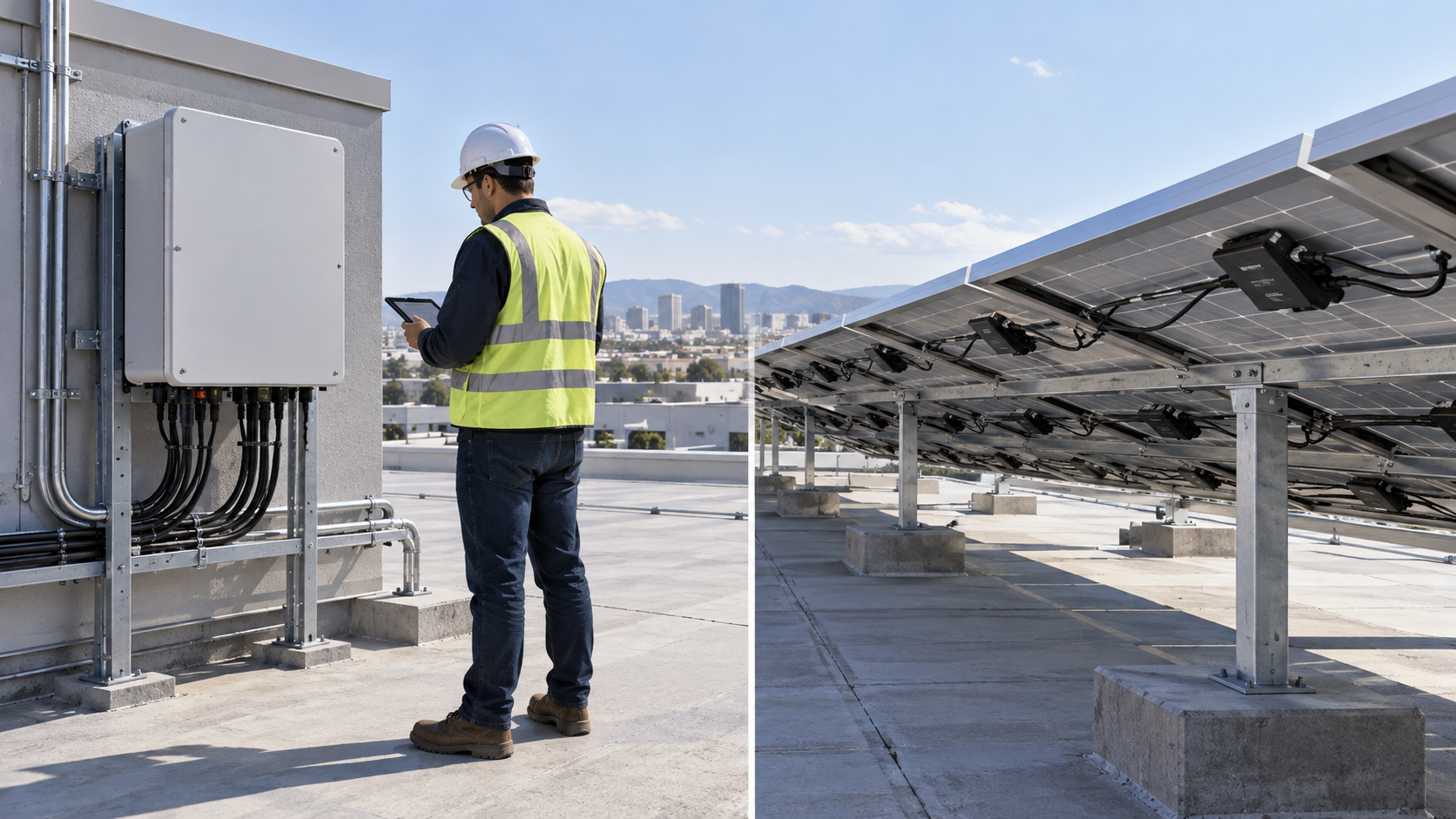
A string inverter accepts several modules wired in series, converts the combined direct current at one central point, and delivers alternating current to the distribution board. A microinverter converts at each module, so the roof carries alternating current from the first component onward and the modules are effectively wired in parallel on the alternating-current side.
That single distinction cascades through the whole design:
- String systems concentrate high-voltage direct current on the roof and in the cable run; module-level systems eliminate it almost entirely.
- String systems need direct-current collection, fusing and isolation; module-level systems need alternating-current branch protection and a collection board.
- String systems place one conversion unit at ground level for easy service; module-level systems place many units under the modules.
- String systems scale economically in large blocks; module-level systems scale smoothly in single-module increments.
Technical diagram shown at a readable responsive scale.
Cost per watt comparison
Module-level conversion still carries a premium on hardware. In 2026 the delivered cost per watt of a microinverter package typically runs somewhere between 20% and 40% above an equivalent string package once the conversion units, trunk cabling and alternating-current collection are counted together. The gap has narrowed but has not closed.
Installed cost tells a different story on small and awkward roofs. A microinverter system needs no direct-current string design, no string voltage calculation at the coldest expected temperature, and no direct-current combiner enclosure, which can offset part of the hardware premium on a six-kilowatt residential job. Above roughly 30 kW the string architecture almost always wins on total installed cost, because one conversion unit and one well-specified combiner box serve a large module population.
Shading and module-level power electronics
In a series string, the current through every module is limited by the weakest module. Bypass diodes contain the damage to a shaded sub-panel, but a chimney shadow crossing one module still drags the whole string below its potential. Module-level power electronics — whether a microinverter or a direct-current optimiser — break that dependency by giving each module its own operating point.
The benefit is real but often overstated. On an unshaded, uniformly oriented roof the harvest difference is usually within a couple of percent, and a well-planned string layout that groups similarly shaded modules recovers much of the rest. Where shading is heavy, scattered and unavoidable, or where several roof planes with different azimuths must share one system, module-level electronics earn their premium clearly.
Technical diagram shown at a readable responsive scale.
NEC 690.12 rapid shutdown
North American installations must limit the voltage inside the array boundary shortly after a shutdown command, which is the requirement commonly referenced as rapid shutdown. Microinverters satisfy it inherently, because there is no sustained high-voltage direct-current conductor on the roof to de-energise.
String architectures meet the same requirement by adding module-level shutdown devices or a compliant array-boundary arrangement, plus a clearly identified initiation device and labelling. The equipment cost of compliance narrows the price gap between the two approaches, so any cost comparison for a North American project must include it. Outside that jurisdiction, local rules on direct-current isolation and firefighter access vary, and the isolator specification in the combiner box follows whichever code applies.
Battery and hybrid readiness
Storage is where the architectures diverge most in 2026. A hybrid string inverter can charge a battery directly from the direct-current bus, avoiding one conversion step and keeping round-trip losses lower. Retrofitting storage to a module-level system normally means alternating-current coupling with a separate battery conversion unit, which is simple to add but less efficient.
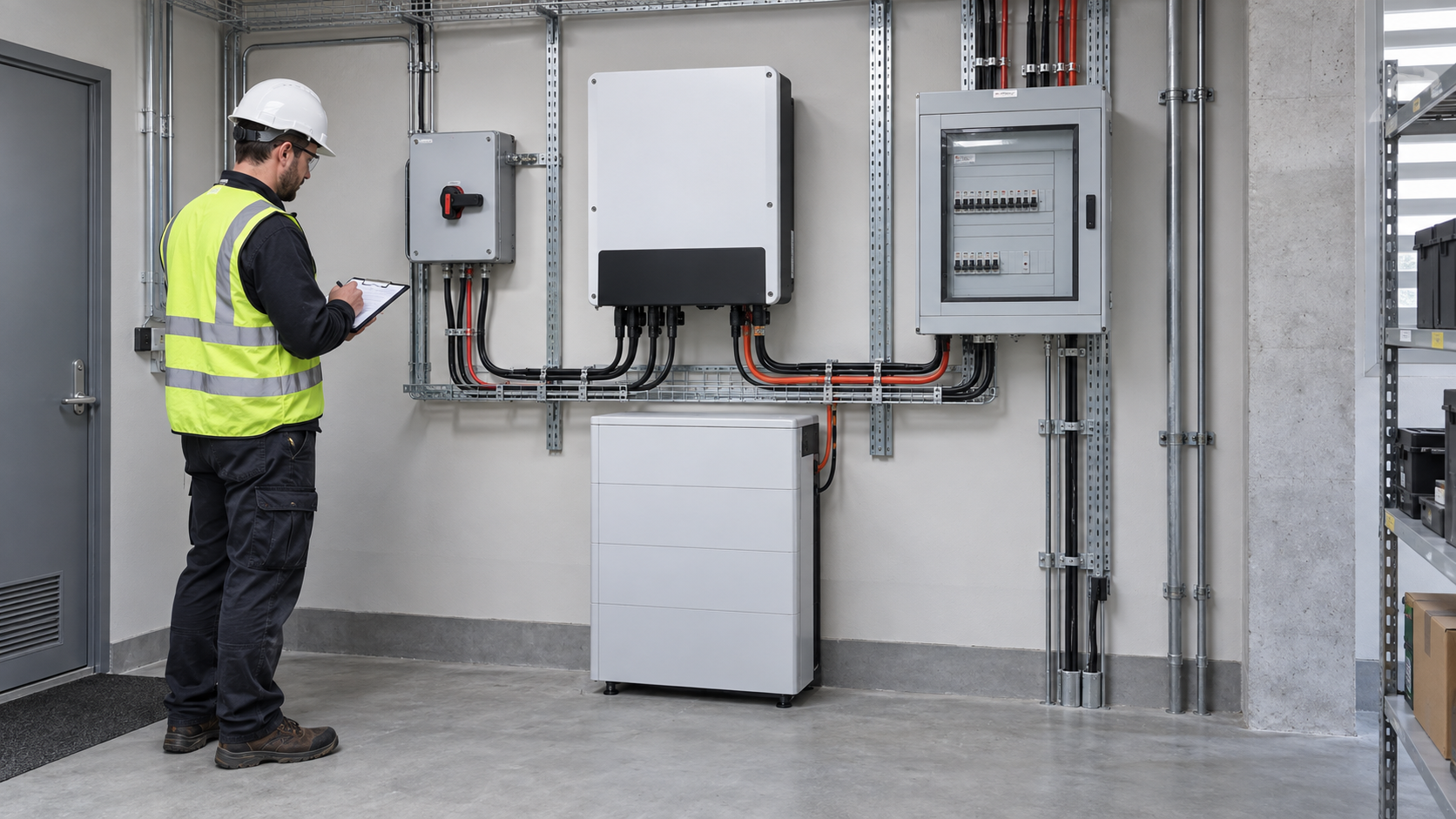
Either way the storage side needs its own protection and isolation boundary. An energy-storage control cabinet provides the switching, isolation and surge protection between the battery system and the rest of the installation, and its specification depends on whether the coupling happens on the direct-current bus or downstream on the alternating-current board.
Which roof fits which technology
Roof geometry is usually the deciding factor before economics enter the discussion.
- Complex residential roofs with several azimuths, dormers or persistent shade favour module-level conversion.
- Large clear commercial roofs, carports and ground-mounted arrays favour string conversion with a central combiner box.
- Very small systems, or systems expected to grow module by module, suit module-level conversion because expansion needs no string redesign.
- Sites with long cable runs to the plant room favour string conversion, since high-voltage direct current transmits the same power at lower current and smaller cross-section.
- High ambient temperature roofs deserve caution with module-level units, because the electronics live in the hottest part of the installation.
BOS and protection differences
This is the part of the comparison most buying guides skip. The two architectures need genuinely different equipment at the edge of the array, and getting it wrong is a safety issue rather than a yield issue.
A frequent field error is fitting a direct-current surge protective device on an alternating-current trunk, or an alternating-current unit on a 1000 V direct-current bus. The two device families behave differently under fault and are not interchangeable, so the protection schedule must follow the architecture rather than habit.
- String architecture: a direct-current combiner box collecting each string through a gPV fuse, a direct-current isolator with adequate breaking capacity, a direct-current surge protective device matched to the maximum system voltage, and a busbar rated for the summed string current.
- Module-level architecture: an alternating-current collection board with branch protection per trunk circuit, residual-current protection where required, an alternating-current surge protective device, and a main isolator ahead of the distribution board.
- Both architectures require correctly rated enclosures for outdoor duty, with ingress protection and corrosion class chosen for the site.
- Both require earthing and equipotential bonding of the array frame and enclosure, coordinated with the surge protection stages.
Making the choice
Decide on the roof first, then the wallet. If the array is shaded, split across orientations or likely to grow in small steps, module-level conversion is the straightforward answer. If the array is clear, sizeable and centrally cabled, a string architecture with a properly specified combiner box delivers a lower installed cost and simpler long-term service.
Whichever conversion technology is selected, specify the protection and collection equipment to match it explicitly. NEUTRON supplies direct-current combiner equipment and low-voltage switchgear for both architectures and reviews the protection schedule against the chosen layout before release.
This is general technical guidance. Confirm final ratings, protection coordination, installation and applicable local requirements against current standards, manufacturer documentation and the approved project design.
Frequently asked questions
Are microinverters better than string inverters?
Neither is universally better. Module-level conversion wins on shaded, multi-orientation and incrementally expanded roofs, and it satisfies rapid-shutdown requirements inherently. String conversion wins on clear, larger arrays through lower installed cost, simpler service access and easier direct-coupled storage.
Which is cheaper?
On hardware, string conversion is generally cheaper per watt, typically by 20% to 40% once trunk cabling and collection equipment are compared fairly. On very small or complex roofs the gap narrows because module-level systems avoid string design and the direct-current combiner enclosure.
Discuss your PV requirement
Share the system voltage, string arrangement, inverter interface and installation environment. NEUTRON can review the equipment configuration around your project documentation.
Discuss a projectContinue learning
Explore related technical guidance in Solar PV.

Published from the approved Period 06 source package. Technical values and final design decisions must be verified against the current applicable standard, manufacturer documentation and approved project design.