
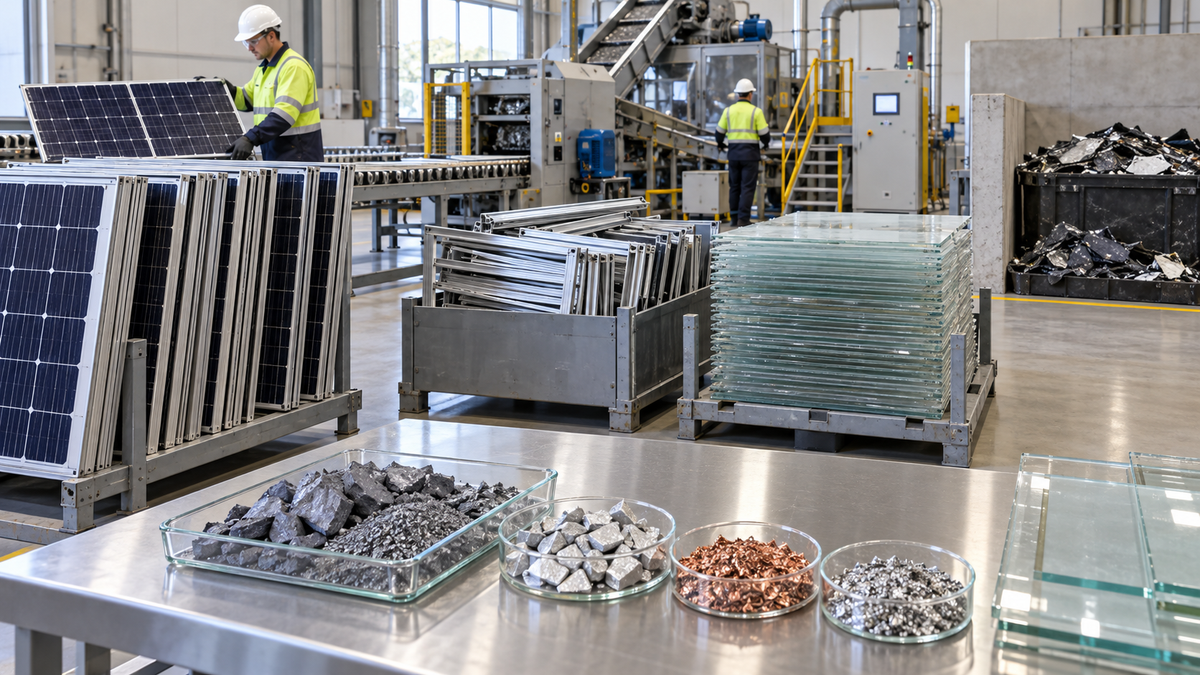
Start with the documented industry constraints
The IEA PVPS country-status report on module recycling describes the regulatory and industrial landscape in selected participating countries. Its public summary identifies limited waste volumes, logistics, available processes and undeveloped markets for recovered materials as economic constraints.
This is a country-based status assessment, not a current metal-price quotation or proof that every recycling line is profitable. Its findings are useful for deciding which inputs a project-specific recovery model must document.
Keep recovered mass and material purity separate
A recovery percentage needs a denominator: the incoming module mass, the amount of one element or another stated material fraction. The percentage of glass recovered cannot be used as a silver recovery rate.
Purity describes a different characteristic. Recovering silicon-containing material does not establish that it can return directly to solar-cell production. Record impurities, further treatment and the quality requirements of the intended buyer before assigning a sale value.
Define the processing boundary
Compare routes from receipt of the modules through separation, treatment and the sale or disposal of each output. Include sorting, damaged-module handling and consumables. A laboratory extraction result may omit collection and other costs required at an operating facility.
Characterize the incoming module mix because construction and condition affect processing. A result from one controlled sample should not be converted into a guaranteed recovery and purity combination for all end-of-life panels.
Calculate realizable value after costs
Use dated price assumptions and realistic offtake terms for each recovered fraction. Deduct transport, processing, refining and residual-waste costs. A high unit value for one metal does not establish its contribution without knowing the recoverable quantity.
Sensitivity analysis should show how throughput, contamination and buyer specifications affect the result. Keep a demonstrated pilot result separate from the capacity and yield assumed for a commercial facility.
Make the comparison auditable
A useful recycling update supplies a material balance, measured output quality and the process boundary. It should identify what was sold, what required further purification and what remained a waste stream.
This focus complements design-for-recycling work in manufacturing: it examines the downstream recovery account. It avoids universal silver-price, silicon-purity or return-on-investment claims that cannot be established from a general industry overview.
Frequently asked questions
Does a high total recycling rate prove high silver recovery?
No. Each percentage needs its own material and mass denominator.
Is recovered silicon automatically solar-grade feedstock?
No. Purity, contaminants and further processing determine the usable destination.
What establishes recycling profitability?
A defined throughput and material balance, realizable output values and all collection, processing and disposal costs.
Use the news as a project input, then verify the scope.
This News item is editorial context. Confirm the final datasheet, applicable standard, project conditions and acceptance evidence before changing a design or purchase decision.
Discuss a project implication