
A new inventory update rather than one universal rate
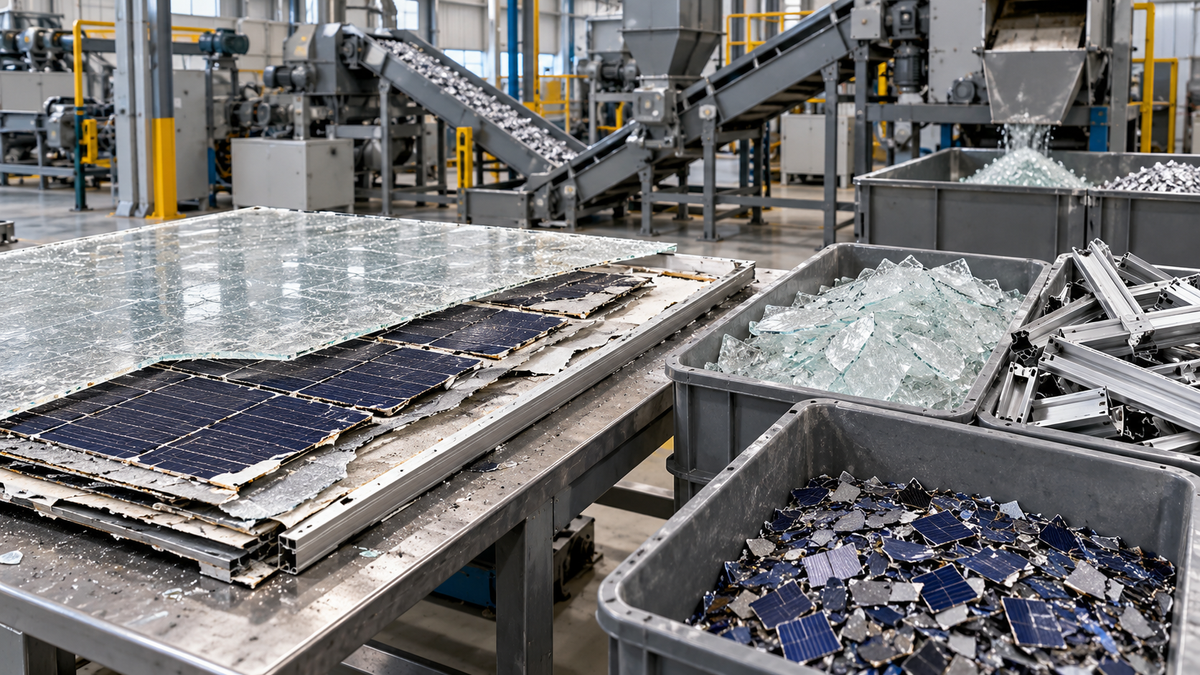
The April 2026 IEA PVPS Task 12 report updates empirical life cycle inventories for photovoltaic module recycling. Its overview covers crystalline-silicon and thin-film processes using commercial and pilot-scale information from the United States and Europe. It reports progress in recovery, process yield and output purity, while identifying remaining gaps in the data.
The update makes the evidence base more useful, but the process and output still matter. A recovery result for a particular facility or material stream is not one rate for all recyclers. It also does not establish that every recovered material meets the requirements for making a new solar cell or module.
Process route and material quality are separate decisions
The report identifies mechanical treatment as the dominant commercial route for crystalline-silicon modules. It also describes thermal and chemical combinations with potential for higher-purity recovery of silicon and metals. Compare the process, scale and output specification before treating two recovery percentages as equivalent.
A manufacturing team can ask what leaves each separation stage, how that stream is sampled, and what contaminants remain. Material recovery by mass and acceptance as a new manufacturing input answer different questions. Record both when assessing whether a proposed recycling route closes a useful material loop.
Specify the destination for recovered material
For a supply agreement, identify the receiving process and its quality limits. A glass stream intended for one application may need different controls from material intended for a PV manufacturing process. Silicon fragments likewise need a defined purification and qualification route before a buyer can accept them for a specific use.
Ask the supplier for sampling methods, lot consistency and rejection criteria. Define who bears the cost of nonconforming material and how its destination is documented. Those conditions make a circularity claim reviewable and prevent a high bulk-recovery figure from obscuring an unsuitable output stream.
Include the collection and processing boundary
The September 2025 IEA PVPS country survey describes economic challenges associated with collection volumes, logistics, technology and markets for recovered materials. Its overview also identifies impurities and additives as obstacles to higher-value reuse. These points help frame a manufacturing decision beyond the amount of material separated.
Prepare a comparison including transport, handling, energy, treatment and residue management. State which inputs and outputs belong to the calculation. A quoted recovered-material price is not enough to establish the profitability of a collection and recycling service; the actual cost boundary and reliable destination determine the result.
Make the recycling commitment measurable
An owner or manufacturer can request an auditable material balance and destination records for an agreed module stream. Include the treatment route, intended output quality and evidence that the receiving buyer accepted the recovered material. Keep pilot results separate from commercial service commitments.
The 2026 report supports better comparisons while explicitly retaining data limitations. The useful next evidence is a consistent record of inputs, energy use, residues and qualified outputs across comparable boundaries. This update does not assign a single silicon or silver recovery rate, purity level or financial return to the industry.
Frequently asked questions
Does high mass recovery prove solar-grade output?
No. The recovered stream must also satisfy the quality requirements of its intended receiving process.
Does the 2026 report describe only commercial facilities?
No. Its overview includes commercial and pilot-scale information; distinguish their scope.
What should a recycling agreement track?
The agreed input stream, treatment boundary, material balance, output quality, residues and documented destinations.
Use the news as a project input, then verify the scope.
This News item is editorial context. Confirm the final datasheet, applicable standard, project conditions and acceptance evidence before changing a design or purchase decision.
Discuss a project implication