
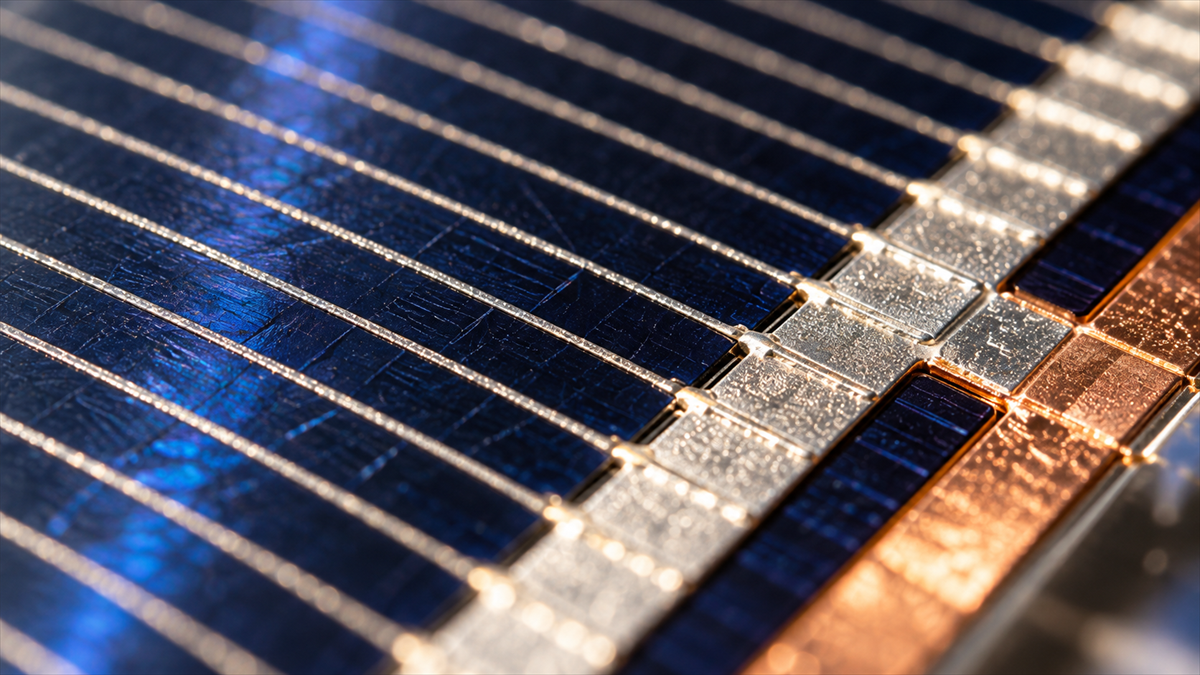
Why alternative metallization is being discussed
Silver-based pastes remain widely used for silicon-cell contacts, while higher material-price volatility has strengthened interest in reducing silver intensity. Recent cost analyses distinguish the cost of silver paste from the total cost of a cell or finished module; those denominators should not be mixed.
Two routes often discussed are silver-coated copper paste and copper electroplating. They are not the same process: one changes the conductive-paste composition, while the other deposits copper through a controlled plating sequence.
What research can—and cannot—establish
Fraunhofer ISE has published work on copper as an alternative to silver for silicon-cell metallization, including process status and remaining technical challenges. The research shows why contact resistivity, adhesion, oxidation control and compatibility with the cell stack matter alongside the raw-metal price.
A laboratory or pilot result does not prove that every cell line can switch without changes to equipment, process windows, yield control or reliability qualification. Any cost advantage depends on formulation, metal usage, process cost, throughput and the product architecture.
Reliability remains a release gate
Copper diffusion and oxidation, contact stability, adhesion and resistance to damp heat and thermal cycling are relevant validation topics. The cell, interconnect, encapsulant and module design should be tested as a system; data from one stack or process should not be generalized to another.
The editorial takeaway is not that silver has been displaced. It is that lower-silver pathways are being investigated and introduced in specific architectures, with deployment status varying by manufacturer and product.
Questions for procurement
Ask whether the offered cell uses standard silver paste, silver-coated copper, plated copper or a hybrid approach; request the relevant product datasheet and reliability reports. Ask for the measured metal loading and the comparison basis if a supplier states a cost reduction.
For module sourcing, focus on the certified finished product, production controls, warranty and traceability—not only on the metallization material described in a marketing summary.
What to watch next
The meaningful milestones are repeatable manufacturing data, transparent silver-use measurement, independent reliability evidence and a clear statement of which cell technology and product family use the process. These details will determine whether the change is a laboratory alternative, a pilot-line option or a qualified commercial route.
Frequently asked questions
Does copper electroplating mean silver is no longer used?
Not necessarily. Metallization routes can use pure copper, hybrid pastes, seed layers or other combinations. The exact bill of materials and cell architecture should be checked for the product being offered.
Why is silver-coated copper different from copper plating?
Silver-coated copper is a paste formulation using copper particles with a silver coating; copper plating deposits copper in a controlled process. Their equipment needs, contact structure and reliability questions differ.
What reliability evidence should a buyer request?
Request product-specific cell and module test reports covering the relevant environmental stresses, contact stability, adhesion and electrical performance, with sample details and acceptance criteria. A cost claim alone is not qualification evidence.
Use the news as a project input, then verify the scope.
This News item is editorial context. Confirm the final datasheet, applicable standard, project conditions and acceptance evidence before changing a design or purchase decision.
Discuss a project implication