
A material study sharpens the comparison
A study in the June 15, 2026 issue of Solar Energy Materials and Solar Cells examines four commercially available co-extruded EPE encapsulants. The authors report lower water-vapor transmission than EVA in their tested films, but also find meaningful differences in the inner polymer layer. Their conclusion leaves the long-term effect of the EVA interface under environmental exposure unresolved. This is evidence about specified materials, rather than proof that every EPE module will outlast every EVA module.
That distinction matters when a purchase specification uses only a family name such as POE or EPE. Two films sold under the same broad label can have different formulations and processing behavior. A buyer needs the exact film grade, module bill of materials and qualification record to connect a laboratory comparison with a production module.
The core layer changes the trade-off
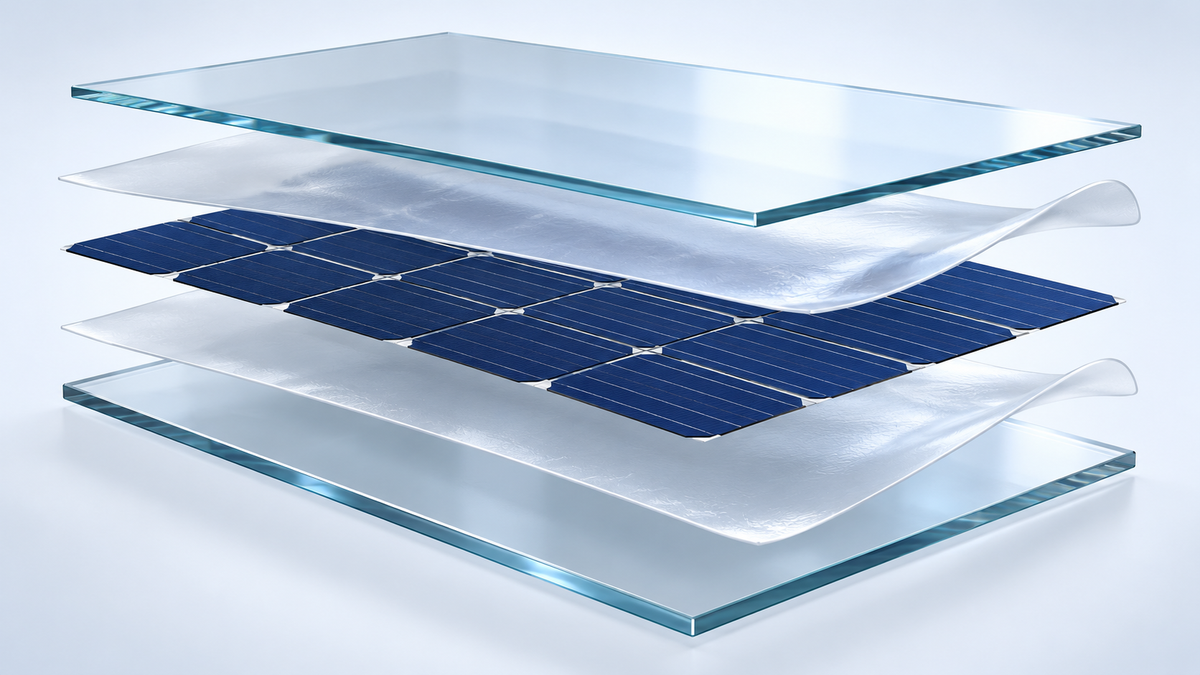
The study describes EPE as outer EVA layers surrounding an inner polyolefin layer. Across the samples, core chemistry and crosslinking behavior differed. One non-crosslinking core combined stronger moisture-barrier behavior with lower visible-light transmission and a thermal-shrinkage trade-off. The evidence supports examining several properties together instead of ranking films through moisture resistance alone.
For an engineering review, separate optical transmission, insulation, moisture transport, adhesion and dimensional stability. A favorable result in one test does not answer every question. Record specimen thickness, cure state and test conditions before comparing a result with another material. A material-level measurement and a finished-module qualification also have different scopes.
Supplier evidence needs a defined scope
Dow positions its ENGAGE PV polyolefin elastomers for module encapsulation and publishes comparative reliability evidence for selected constructions. That is useful supplier information, but the tested formulation and construction remain essential parts of the claim. It does not establish one reliability improvement for all climates, cell technologies or co-extruded films.
Ask for the film datasheet, lot traceability, process window and the module maker’s qualification report. If a supplier proposes a material change, request evidence for the changed construction instead of accepting an unchanged model name as proof of equivalence. Keep the proposed grade and its approval date in the purchasing record.
Film selection and lamination belong together
A film decision creates a manufacturing question: can the factory repeatedly produce the intended laminate with that material? Connect the film grade to the approved layup, storage conditions, lamination recipe and inspection criteria. Those records make substitutions visible and help a defect investigation distinguish material selection from process execution.
For acceptance, ask which evidence covers the delivered module rather than requesting a generic statement that the factory uses POE. The useful comparison is between documented constructions under comparable qualification conditions. This article assigns no universal service-life gain, film-line speed, inspection accuracy or cost saving to either POE or EPE.
Use the findings to improve the specification
A practical tender can identify the accepted module construction, require material-change notification and specify the reports a supplier must provide. For a site with demanding moisture conditions, map those conditions to the actual qualification evidence. An encapsulant label is one input to that review, not its conclusion.
The research gives buyers a reason to evaluate EPE formulations individually and question blanket reliability headlines. The next useful evidence would connect module-level environmental testing or field observations to a clearly named construction. That would allow a material finding to be compared with the behavior of a finished product.
Frequently asked questions
Did the study prove that EPE always lasts longer than EVA?
No. It found lower water-vapor transmission in tested films while leaving long-term behavior at the EVA interface under environmental exposure open.
Are all EPE films chemically identical?
No. The four commercial materials differed in their inner polymer layer and crosslinking behavior. Compare exact grades and test conditions.
What should a buyer request?
The approved bill of materials, film grade, material-change controls and qualification evidence for the delivered module construction.
Use the news as a project input, then verify the scope.
This News item is editorial context. Confirm the final datasheet, applicable standard, project conditions and acceptance evidence before changing a design or purchase decision.
Discuss a project implication