
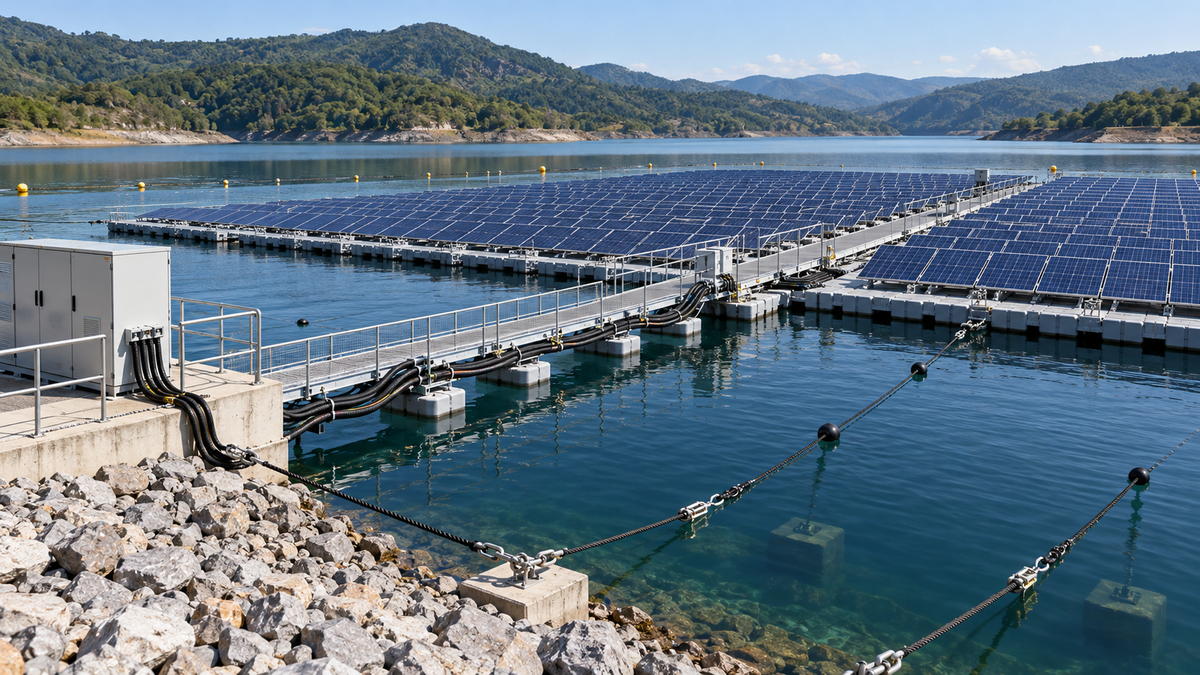
A research review with a defined application scope
The April 2025 IEA PVPS floating-PV review addresses energy yield, reliability and maintenance, with guidance for inland and nearshore installations. Its public summary identifies gaps in meteorological data, degradation knowledge and operational practice.
This provides a research basis for a 2026 project review. It does not establish a universal annual deployment rate, a fixed cost advantage or a blanket conclusion that existing module qualification addresses every floating-system duty.
Describe the water environment first
Begin with water-level variation, water chemistry, wind, waves and the restrictions on access. An inland reservoir and an exposed coastal site need different assumptions. A successful plant at one location does not qualify an identical layout for another exposure.
The site model should also identify the shoreline connection, anchoring zones and any competing uses of the water. Those boundaries affect both the physical design and the ability to inspect or repair it.
Review movement through the complete assembly
Assess floats, supports, mooring and anchoring as an interacting system. Changes in water level and platform motion can alter conductor movement, cable support and the loads at connections. Examine the actual routing rather than relying only on an enclosure rating.
Define isolation, bonding and maintenance access for the planned arrangement. A component qualification is useful evidence at its own boundary, but it cannot establish the behaviour of the assembled floating installation.
Measure the proposed energy benefit
Cooling, shading and reflected irradiance depend on the construction and local conditions. Water should not be assumed to provide a uniformly favourable rear-side resource for bifacial modules. Use measured or justified inputs for the actual array geometry.
Keep model uncertainty and operating availability visible in the energy assessment. A comparison with a ground-mounted plant needs consistent weather, capacity and loss assumptions before it can support an investment decision.
Include recovery time in the operating plan
Maintenance planning should account for weather windows, access equipment and safe recovery of damaged parts. A straightforward component replacement on land can require a different sequence on water. Agree who maintains shared walkways and shore connections.
The strongest next update would pair operating data with documented inspections and failures. That allows project teams to refine design and maintenance assumptions without turning deployment interest into an unsupported lifetime guarantee.
Frequently asked questions
Does a module certificate qualify a complete floating plant?
No. Floats, mooring, electrical routing and access require system-level assessment.
Is water reflection a guaranteed bifacial gain?
No. Reflection and rear irradiance depend on water conditions and installation geometry.
Can inland evidence be used unchanged offshore?
No. Compare the actual exposure, loading and maintenance conditions.
Use the news as a project input, then verify the scope.
This News item is editorial context. Confirm the final datasheet, applicable standard, project conditions and acceptance evidence before changing a design or purchase decision.
Discuss a project implication