
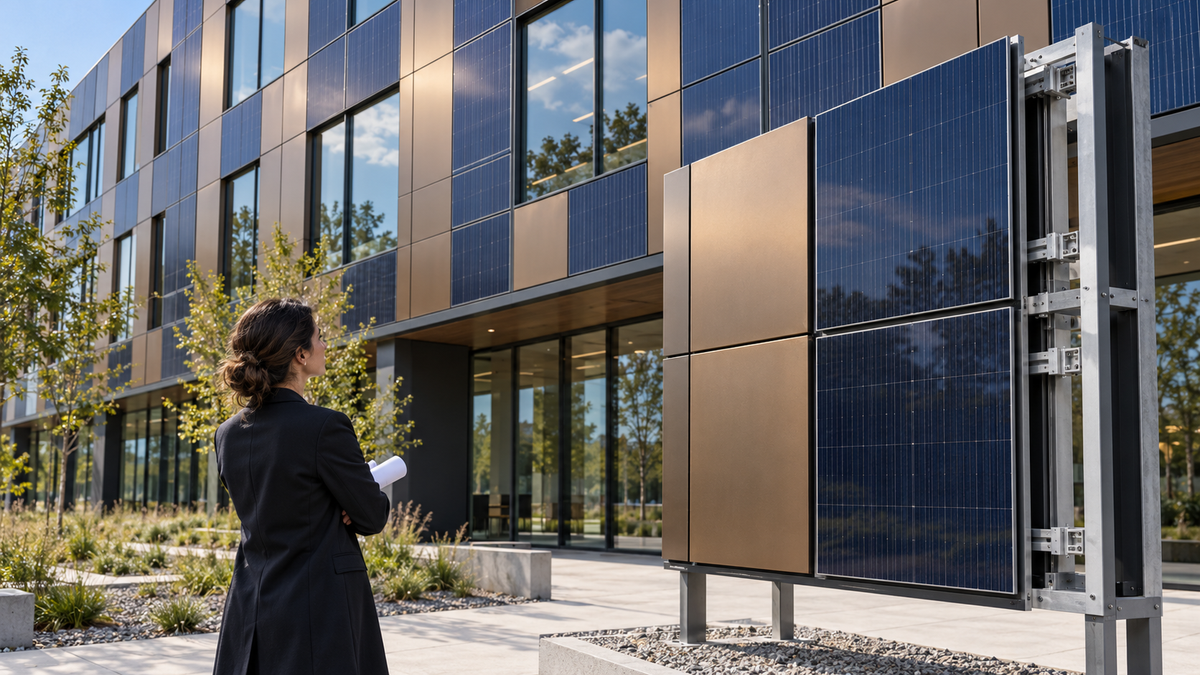
A building surface has more than one duty
The August 2026 IEA PVPS report on photovoltaic systems for different applications treats integrated PV as multifunctional infrastructure. Its public summary highlights building requirements and the limits of applying conventional PV assumptions to an integrated design.
For a facade, appearance is one part of that broader performance brief. A colour sample can support an architectural decision, but it cannot establish the electrical or building performance of the installed assembly.
Specify how the appearance will be assessed
Define the intended colour, gloss, texture and acceptable variation with a documented sample. Review the mock-up under relevant viewing and lighting conditions. A photograph taken from one angle does not describe every reflection seen from neighbouring buildings or public areas.
Ask how replacements will be matched later. Module availability and batch variation can affect a facade even where the replacement has the same nominal power and physical dimensions.
Compare the offered construction on a consistent area basis
Check the electrical data for the actual coloured or patterned construction rather than another module from the same supplier. Distinguish cell area, module area and the usable facade area when comparing efficiency or annual energy.
Orientation, shade and the layout of different module variants can change string design. Aesthetic uniformity does not establish electrical interchangeability, and there is no single efficiency penalty that applies to every colour technology.
Review the facade build-up and its interfaces
Assess the applicable structural, fire and weather requirements for the proposed combination of modules, fixings, cavities and substrate. A module certificate alone does not qualify every possible wall construction or replace local building approval.
Coordinate drainage, cable access and replacement procedures with the electrical design. The team should know how a failed unit can be isolated and removed while maintaining the required building functions.
Keep three acceptance records linked
Use an appearance record, an electrical specification and assembly-specific building evidence for the same delivered construction. Identify the revision and scope of each document so a substitution can be reviewed consistently.
This cladding-focused assessment complements research on transparent solar windows. It lets architects and engineers make the visual trade-offs explicit without assuming a universal material saving or treating every attractive PV surface as an approved facade product.
Frequently asked questions
Does a colour sample establish annual energy?
No. Energy depends on the offered module construction and its installed conditions.
Does a module certificate qualify the whole facade?
No. The applicable evidence must cover the relevant building assembly and requirements.
Is every colour treatment subject to one efficiency penalty?
No. Compare the actual products on a consistent area and measurement basis.
Use the news as a project input, then verify the scope.
This News item is editorial context. Confirm the final datasheet, applicable standard, project conditions and acceptance evidence before changing a design or purchase decision.
Discuss a project implication