
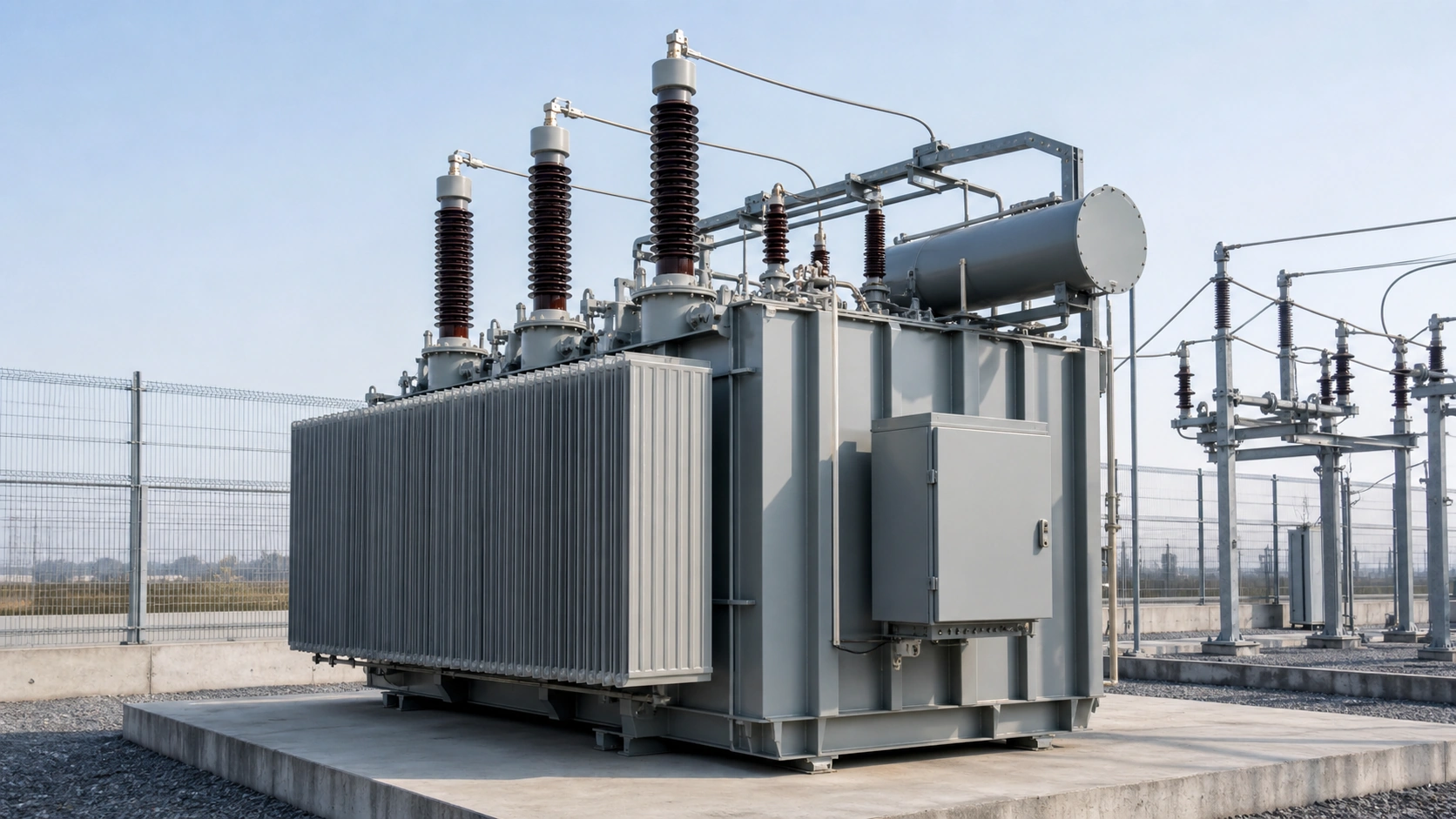
What Actually Sets the Invoice Price
A quotation is assembled from a stack of cost blocks rather than a single price per kVA. Winding conductor, core steel, oil and insulation, tank and fittings, bushings and tap changer, labour, testing, overhead and margin each contribute.
Only some blocks are genuinely negotiable. A large discount can represent a different conductor material, lower loss class, thinner tank or reduced test scope rather than a like-for-like saving.
| Cost block | Typical share | Negotiable? |
|---|---|---|
| Winding conductor | 25–35% | Only via conductor material choice |
| Core steel | 20–30% | Mainly via loss-class choice |
| Oil and insulation | 6–10% | Limited |
| Tank, radiators and fittings | 10–15% | Limited |
| Bushings, tap changer and protection | 6–12% | Specification dependent |
| Labour, testing and overhead | 8–12% | Volume dependent |
Raw Material Exposure: Copper, Silicon Steel and Oil
Copper is a major line item in a copper-wound unit and is exchange-traded, so quotation validity often reflects metal-market movement. Grain-oriented silicon steel sets no-load loss; higher grades and domain-refined material carry a premium. Mineral oil pricing follows crude and refining conditions, while ester fluids for fire-safety or environmental duty can change both cost and tank design.
Aluminium reduces conductor cost but needs a larger cross-section for the same current density, which can enlarge the core window, tank, oil volume and shipping weight. Net savings are smaller than the raw metal price gap suggests, and load losses are usually higher.
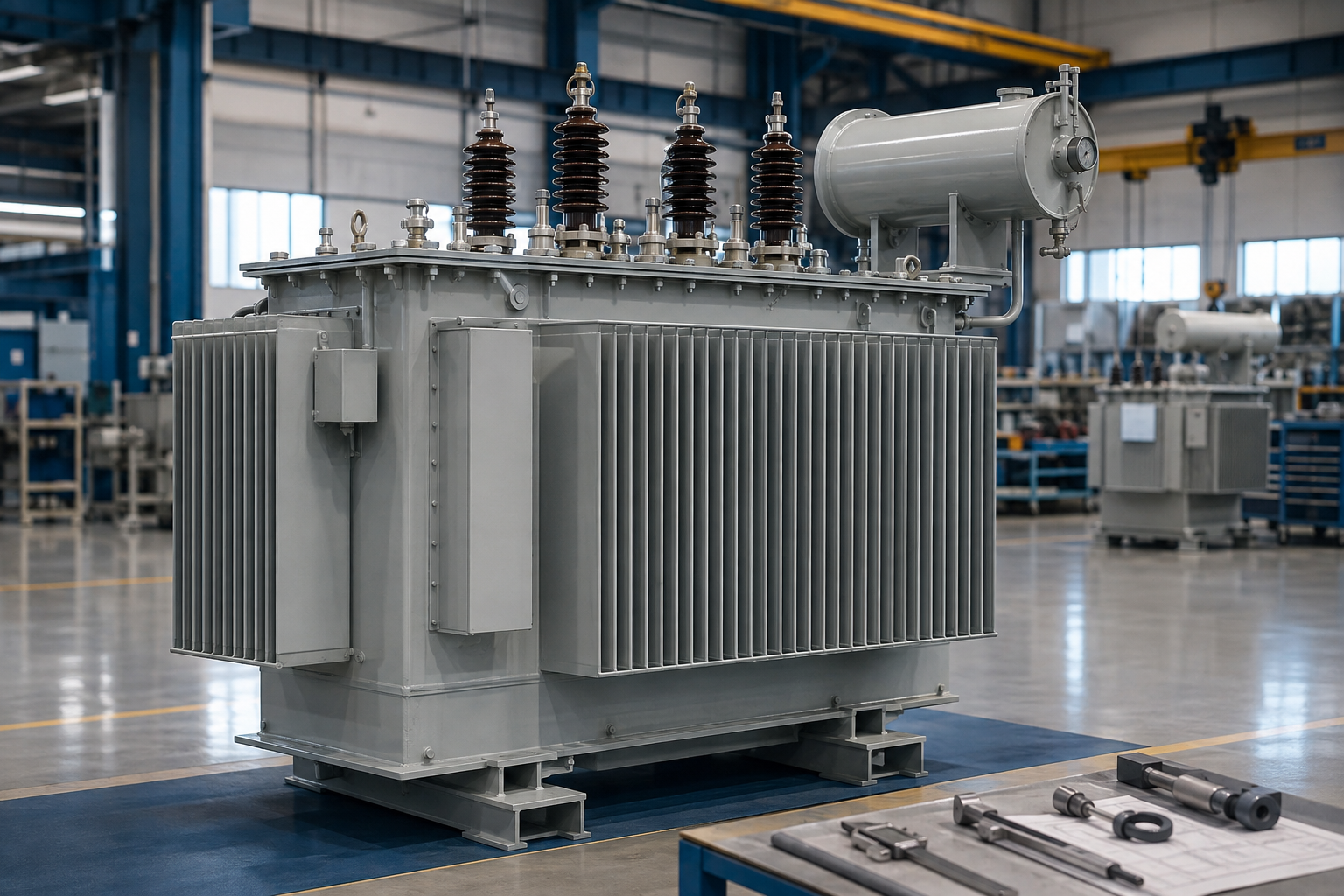
10 kV Distribution Transformer Cost Bands
10 kV and equivalent 11 kV oil-immersed distribution transformers are a high-volume class, commonly specified to IEC 60076 with standard vector groups such as Dyn11. The source table presents relative cost indices for planning rather than binding prices; final pricing depends on the metal price and specification at order confirmation.
| Rating | Relative cost index | Pattern |
|---|---|---|
| 100 kVA | 1.0 | Highest cost per kVA; fixed costs dominate |
| 250 kVA | 1.9 | Falling per kVA |
| 500 kVA | 3.1 | Common C&I value bracket |
| 1000 kVA | 5.2 | Volume sweet spot in the source comparison |
| 1600 kVA | 7.6 | Industrial and PV step-up duty |
| 2000 kVA | 9.1 | Upper distribution range |
35 kV Power and Substation Transformer Costs
At 35 kV, insulation clearances grow, bushings become more expensive and tap-changer requirements are more common. Ratings are often quoted in MVA, and renewable projects may buy the transformer as part of a PV step-up compact substation rather than as a bare tank.
- Higher insulation cost increases clearances, oil volume, tank size and core steel.
- 35 kV bushings can be a major cost and lead-time constraint.
- An on-load tap changer can add materially to price and maintenance scope compared with an off-circuit tap changer.
- ONAN is a common base cooling arrangement; ONAF adds fans, controls and auxiliary supply.
- Routine tests may be included, while type or special tests can be chargeable extras.
Sealed vs Conservator Type: Cost-Benefit
For distribution-class ratings, the source analysis describes a hermetically sealed corrugated-tank design as commonly lower in purchase and ownership cost. The case for a conservator is routine oil access for sampling and dissolved-gas-analysis programmes, especially for larger or condition-monitored fleets.
| Factor | Sealed corrugated tank | Conservator type |
|---|---|---|
| Oil contact with air | None | Via breather |
| Oil maintenance | Low for the design life | Periodic testing and breather service |
| Oil sampling | Not practical | Straightforward |
| Best fit | Distribution and remote low-maintenance duty | Large or condition-monitored assets |
Loss Classes and the Efficiency Tightening
Markets are tightening transformer loss limits through frameworks such as European Ecodesign tiers and China's GB 20052 energy-efficiency grades. Higher-efficiency units cost more at manufacture because they require better core steel and more conductor, but no-load loss continues for every energised hour.
Specify no-load loss P0 and load loss Pk limits in watts rather than relying only on a marketing grade name. Loss class is fixed at manufacture, so it is a one-time procurement decision with a long operating consequence.
- The source analysis gives a typical premium of 8–20% for a higher-efficiency unit at the same rating.
- It describes a 3–7 year payback pattern for continuously energised distribution duty, subject to the actual energy and loading profile.
- Intermittent standby, seasonal or temporary duty can change the payback calculation.
Total Cost of Ownership: Capitalising Losses
Loss capitalisation assigns a monetary value to each watt of no-load and load loss, applies the operating and present-value assumptions, and adds the capitalised figure to the purchase price. Compare options on the same energy price, evaluation period and loading profile.
A premium-efficiency 1000 kVA unit can cost more initially yet have a lower 25-year total cost when it saves no-load and load losses on a continuously energised feeder. The calculation should be project-specific rather than treated as a guaranteed payback.
Logistics, Packing and Destination Compliance
Transformers are dense and heavy. Freight and compliance can add materially to landed cost, so declare weight, dimensions, lifting access, oil-shipping requirements, packing, documentation, ambient temperature and altitude at enquiry stage.
- Confirm crane capacity and site access for heavy-lift ratings.
- Check whether the route requires oil-drained and nitrogen-filled shipment.
- Specify seaworthy packing, moisture control and shock indicators for long ocean transit.
- Request routine test certificates, conformity documentation and any market-specific paperwork.
- Declare ambient temperature and altitude because derating may be required.
When a Compact Substation Changes the Maths
A bare transformer can look cheaper until civil works, MV switchgear, LV panels, cabling, enclosure and site labour are included. A factory-assembled package can reduce interface risk and compress the site programme when the project needs a tested system rather than a single tank.
The source brief positions package substations and PV step-up compact substations alongside downstream low-voltage incomer, busbar, feeder, capacitor, metering and grid-connected cabinets.
Procurement Mistakes That Inflate the Final Cost
- Comparing quotations without stated P0 and Pk limits.
- Ignoring quotation validity while metal prices move.
- Oversizing for an uncertain future and paying no-load loss on unused capacity.
- Failing to declare ambient, altitude, pollution or tap-changer requirements.
- Omitting type-test costs, spare parts and oil or containment allowances.
Engineering decision map
Use this compact sequence to review the approved guidance in order. Confirm actual ratings, interfaces, applicable standard editions and selected equipment documentation before final specification or release.
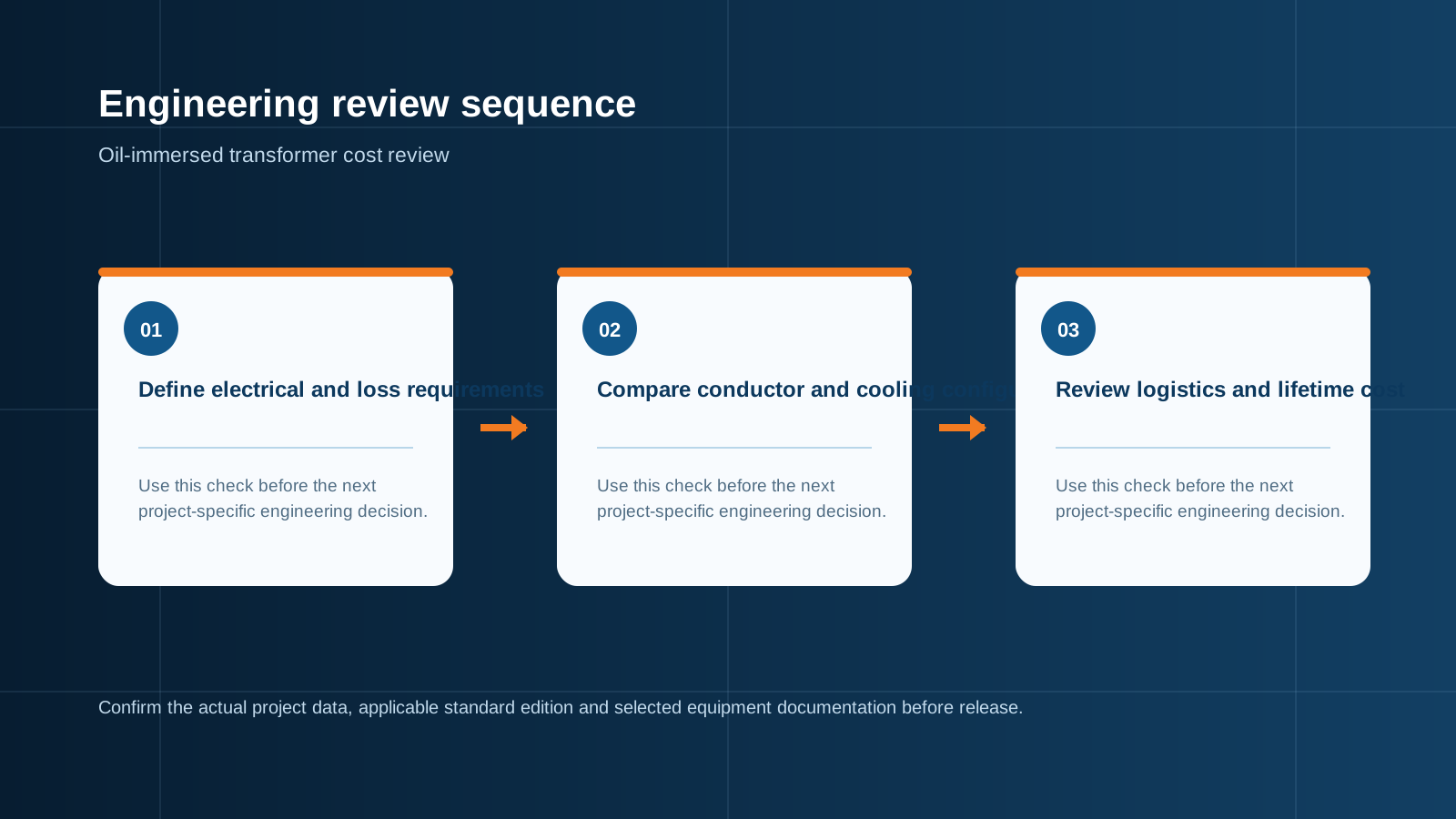
Technical diagram shown at a readable responsive scale.
The price bands and percentages are source-provided planning guidance, not a live quotation or market index. Binding price depends on rating, voltages, loss limits, materials, tests, Incoterms, site conditions and destination documentation. Oil-immersed equipment also requires local fire and environmental containment review.
Frequently asked questions
Why do transformer quotations expire so quickly?
The source analysis attributes a large share of cost to commodity metals such as copper and grain-oriented silicon steel, so manufacturers commonly hold quotations for a limited period and reprice after that.
Is aluminium winding cheaper than copper?
The conductor itself is cheaper, but aluminium needs more cross-sectional area and can increase the core window, tank, oil volume and shipping weight. Net savings and losses must be compared for the actual design.
How much more does a low-loss transformer cost?
The source analysis gives a typical 8–20% premium at the same rating, driven mainly by core steel and conductor. Payback depends on energisation hours, loading, energy price and the evaluation method.
Should I buy a sealed or conservator-type transformer?
For many distribution ratings, a sealed corrugated-tank unit is lower-maintenance. A conservator design is useful when routine oil sampling and condition monitoring are required or when the rating exceeds the sealed-design range.
What information is needed for an accurate transformer quotation?
Provide rating, primary and secondary voltage, vector group, frequency, tap range and changer type, P0 and Pk limits, cooling type, ambient, altitude, protection scope and destination market.
Is a package substation cheaper than a separate transformer and switchgear?
It can be after civil works, MV switchgear, LV panels, cabling and site labour are included. Compare the complete installed scope and interface risk rather than the transformer tank price alone.
Budget the Complete Operating Cost
Send the rating, voltages, loss limits, site ambient and altitude, tap-changer scope and destination market for a specification and costed proposal.
Request a quoteContinue learning
Explore related technical guidance in Power Distribution.
Converted from NEUTRON_PUBLISH_wholesale-oil-immersed-transformer-price-analysis_v1.0.docx. Source cost ranges are preserved as indicative planning guidance and are not presented as current market quotes.