
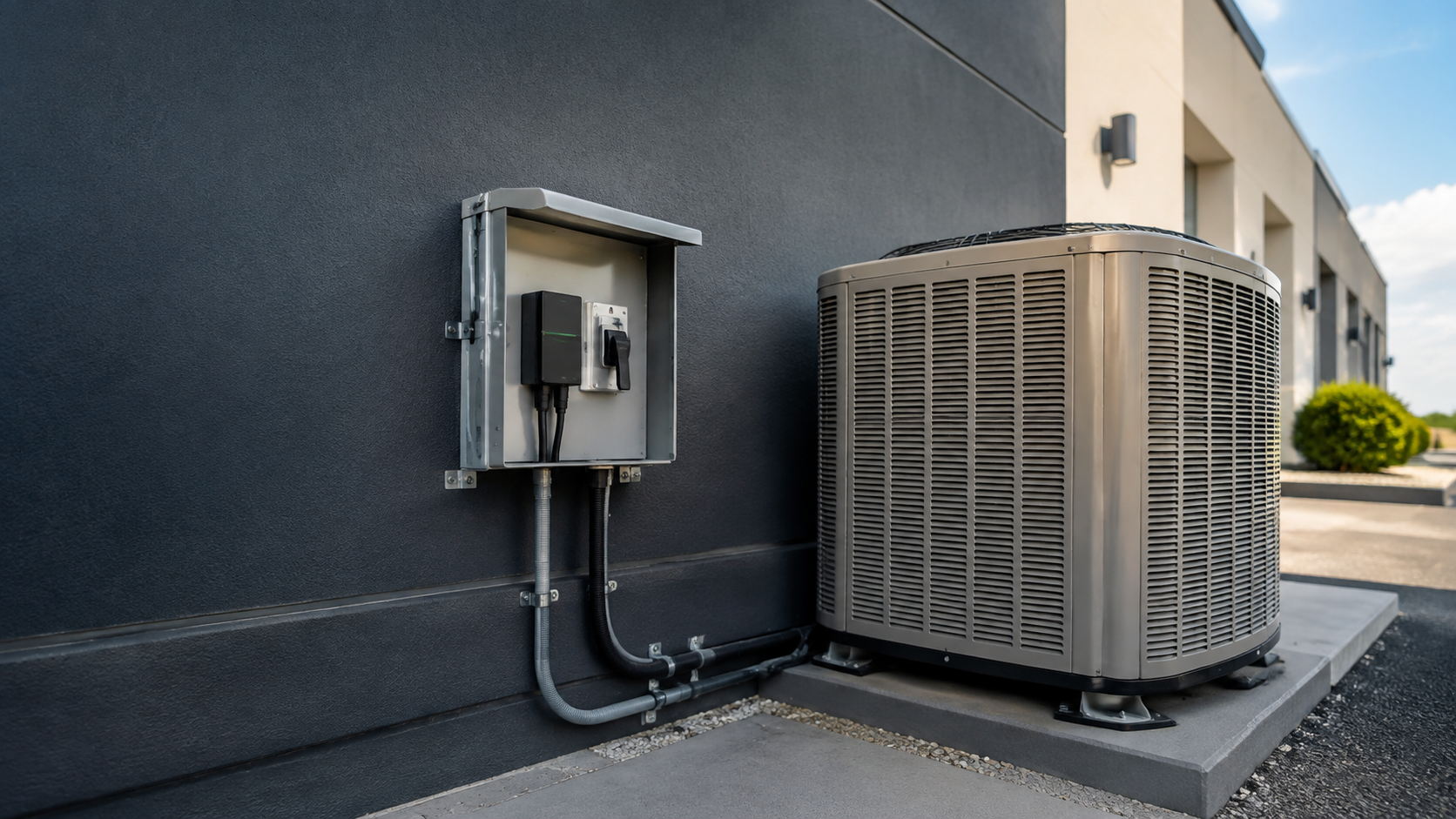
1. Why modern HVAC plant is unusually exposed
A 20-year-old air conditioner was mostly a motor, a contactor and a thermostat, and tolerated transients because there was little in it to damage. Contemporary equipment is different: inverter-driven compressors, electronically commutated fan motors, variable-speed drives and microprocessor control boards all sit directly on the supply.
Those electronics operate at low logic voltages behind switch-mode power supplies. A transient of a few kilovolts lasting microseconds can puncture a semiconductor junction or degrade a capacitor. The failure is often delayed — repeated small transients age components until a board fails months later, and the fault is blamed on the board rather than on the electrical environment.
Two categories matter. External surges come from lightning: direct strikes are rare, but induced surges on overhead supply and long control runs are common. Internal surges are generated on site whenever an inductive load switches — compressor contactors, lift motors, welding plant, power factor correction. Internal transients are smaller but far more frequent, and cause most cumulative damage.
2. Understanding SPD Types 1, 2 and 3
Surge protective devices are classified by where they belong in the installation and by the test waveform they are qualified against. Fitting the wrong class in the wrong place is the most common design error.
Surge protective device classes and their placement in an HVAC protection scheme.
A Type 3 device fitted alone at the air handler is not protection — it has nowhere near the energy capacity to survive an incoming surge without an upstream stage. Conversely, a Type 2 device at the panel alone leaves a let-through voltage that a sensitive control board may not tolerate. Cascaded protection means each stage reduces the energy the next stage has to handle.
| Field | Value | Chars |
|---|---|---|
| Title tag | Where to Install an HVAC Surge Protector: 3 Points | 50 |
| Meta description | Three locations protect an HVAC system: outdoor disconnect, main panel and air handler board. SPD Type 1/2/3, In ratings, lead length and earthing. | 147 |
| Slug | where-to-install-an-hvac-surge-protector | |
| Primary keyword | where to install an hvac surge protector | |
| Search intent | Informational and transactional — contractor, facility engineer or distributor planning surge protection for HVAC plant | |
| Schema type | Article + FAQPage + BreadcrumbList | |
| Canonical path | /insights/where-to-install-an-hvac-surge-protector |
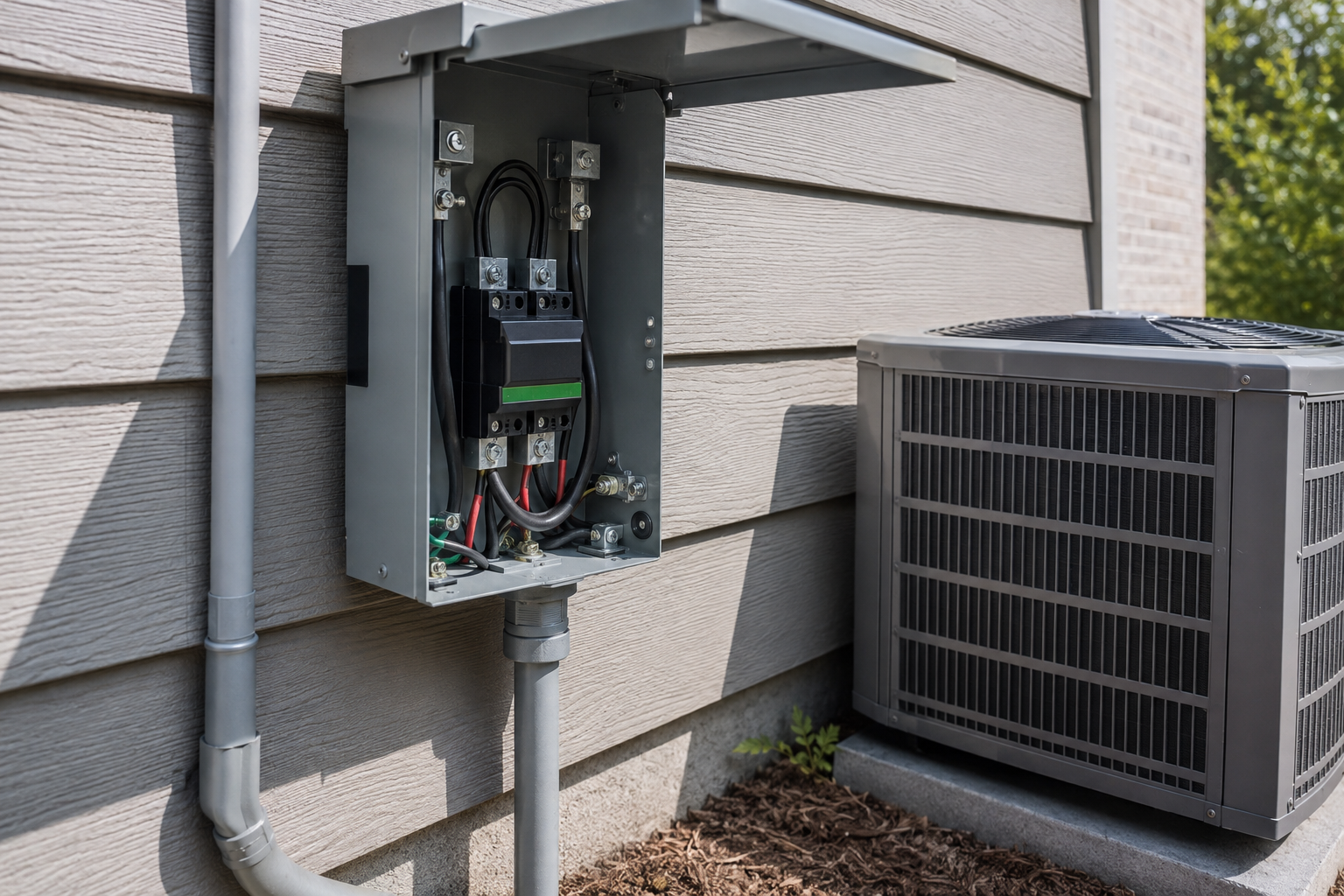
3. Key point 1 — the outdoor condenser disconnect
The outdoor unit contains the most expensive components in the system: the compressor and, on inverter machines, its drive board. It is also the most exposed, sitting outside on a long supply run, frequently on a roof or a hard standing away from the building's electrical core.
Fit a Type 2 device inside or immediately adjacent to the condenser disconnect enclosure. Connect it on the line side of the disconnect switch where the local wiring rules permit, so the device remains energised and protecting even when the disconnect is opened for service. Where the rules require load-side connection, accept it — a protected unit with the disconnect closed is still far better than no local protection.
The physical detail decides whether the installation works. Surge protection performance degrades rapidly with lead length because the inductive voltage drop along the conductor adds directly to the let-through voltage. Keep the total length of the connecting and earthing conductors below 500 mm, use short straight runs with no coils or sharp bends, and bond to the local earth terminal rather than running a long conductor back to the panel. NEUTRON's WCU8 modules mount on standard 35 mm rail, accept copper conductors of 2.5 to 35 mm2, and require an earth conductor of 4 mm2 or larger.
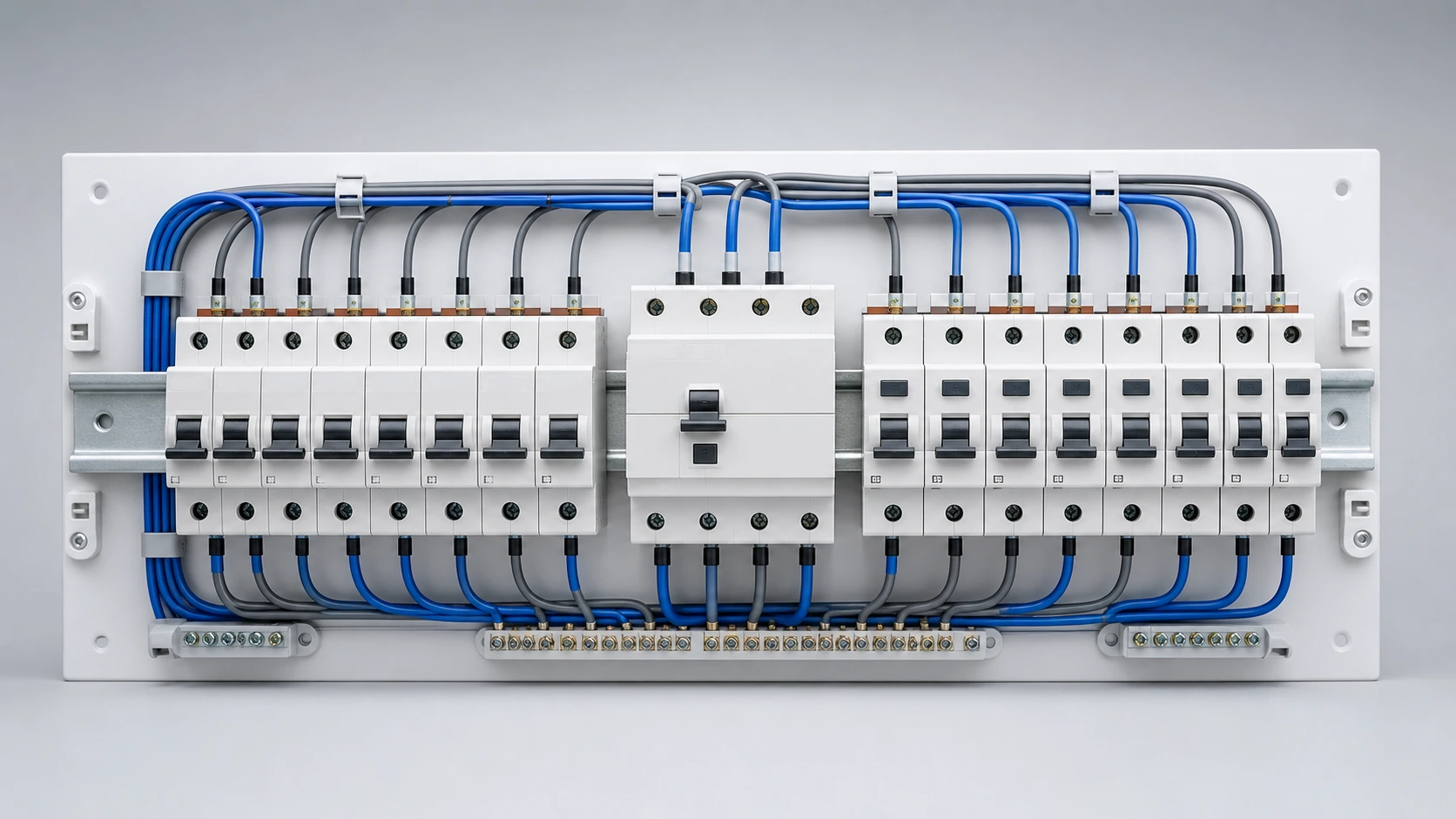
Technical diagram shown at a readable responsive scale.
4. Key point 2 — the main electrical panel
The main panel device is the energy stage. It diverts the bulk of an incoming surge to earth before it distributes into every circuit in the building. Without it, downstream devices absorb energy they were never rated for and fail early.
Select Type 1 where the building has a lightning protection system or an overhead service connection, and Type 2 where it does not. Match the maximum continuous operating voltage to the supply: NEUTRON's WCU8 range operates on AC 50/60 Hz supplies at rated operational voltages of 230 V and 440 V, with N-PE modules available at 275 V and 320 V maximum continuous operating voltage and nominal discharge currents of 20 kA and 40 kA (8/20 us) respectively, with a response time under 100 nanoseconds.
Wiring method depends on the panel's load current. For boards below 100 A, connect the supply switch to the protective device and then on to the load. For boards above 100 A, connect the protective device as a parallel tap from the supply switch while the load is fed directly — this keeps the protective device's conductor cross-section independent of the load current. A 32 A fuse should be connected in series on the line conductor so that a failed module cannot affect the supply.
5. Key point 3 — the indoor air handler or furnace board
The indoor unit holds the control board, the electronically commutated blower motor and, in a heat pump, part of the communication link to the outdoor unit. It is also the point where internal switching transients generated elsewhere in the building arrive.
Fit a Type 3 device at the equipment, either inside the air handler electrical compartment or in a small enclosure immediately beside it. This stage exists to reduce the residual let-through voltage that survives the upstream stages down to something the control electronics tolerate comfortably.
Do not overlook the low-voltage side. Thermostat wiring, indoor-to-outdoor communication buses and building management interfaces are long unscreened runs that behave as antennas. Signal-line protection is inexpensive and prevents failures that mains-side protection cannot address.
6. Coordinating the three stages and keeping them working
Cascaded protection only works if the stages are coordinated. Observe the separation distance between stages — a common practical guide is at least 10 metres of cable between the panel stage and the equipment stage, or a decoupling inductor where the run is shorter. Without separation, the upstream device may not operate first.
Surge protective devices are consumables. Every diverted transient degrades the varistor slightly until the module reaches end of life. Select only modules with an integral thermal disconnector and visible status indication. NEUTRON's WCU8 modules show green in normal service and red after disconnection, use plug-in cartridges replaceable individually without shutting down the installation, and can be supplied with a remote signalling contact rated AC 36 V, 1 A that closes on module failure.
Build inspection into planned maintenance. On each service visit, check the status window on every module and confirm the series fuse indicator is clear. Where a building management system exists, wire the remote contact so a failure raises a ticket automatically.
7. Installation mistakes that defeat the protection
- Long conductors — anything beyond roughly 500 mm total for connection plus earth wipes out much of the benefit.
- Coiled excess conductor — a neat coil is an inductor and raises let-through voltage.
- A single device at the panel only — leaves the equipment exposed to residual let-through voltage.
- A Type 3 device with no upstream stage — it will be destroyed by the first significant surge.
- Poor earthing — the device can only divert energy to an earth that is genuinely low-impedance.
- No series fuse — a failed module should not be able to disturb the supply.
- No status monitoring — a silently failed device gives the site false confidence for years.
- Ignoring signal lines — thermostat and communication wiring are a common damage path.
8. NEUTRON surge protection and enclosures
NEUTRON's WCU8 modular surge protective device range is designed for AC 50/60 Hz power circuits at rated operational voltages of 230 V and 440 V, covering the specification classes needed across a three-stage HVAC scheme.
The range is built as a rail-mounted base with detachable plug-in modules. Each module carries a degradation indicator, allowing individual replacement without a supply shutdown, and the base incorporates a transmission component and microswitch to support fault monitoring with optional audible and visual alarms. N-PE modules are available at 20 kA and 40 kA nominal discharge current with maximum continuous operating voltages of 275 V and 320 V, response time under 100 ns and 18 mm module width.
Ordering is by full specification rather than by a bare model number — maximum continuous operating voltage, pole configuration, whether a failure output signal contact is required, and maximum discharge current. NEUTRON also builds the enclosure: XL-21 power distribution cabinets, GGD and GCS low-voltage assemblies and control enclosures to IEC 61439, with protection classes from IP30 to IP65.
9. Safety and compliance notes
Surge protection reduces the probability and severity of transient damage. It does not make equipment immune, and it does not protect against sustained overvoltage, phase loss or a lost neutral — those require separate voltage monitoring and protection.
Installation must follow the wiring rules of the destination market, including any requirement for surge protection at the origin of the installation, permitted connection points relative to the main switch, and earthing arrangement. Standard modular devices are rated for -5 C to +40 C ambient, altitude up to 2000 m, pollution degree 3 and installation category I or III; outdoor enclosures in hot climates need thermal assessment. All work must be carried out by a qualified person with the supply isolated.
Media / Assets
Placement plan for the /insights article layout:
IMAGE PROMPT — Hero:
Subject: outdoor HVAC condenser unit beside a wall-mounted electrical disconnect enclosure with the cover removed, showing DIN-rail surge protection modules inside
Style: clean industrial B2B on-site photography
Details: grey weatherproof enclosure, plug-in surge cartridges with green status windows, short neat earthing conductor, flexible conduit to the condenser, condenser fan grille behind
Background: building exterior plant area, plain wall
Lighting: natural daylight, soft overcast
Aspect ratio: 16:9
No text, no logos unless specified.
IMAGE PROMPT — Section 2:
Subject: technical line diagram of a cascaded surge protection scheme showing main panel, sub-distribution, outdoor disconnect and indoor air handler
Style: clean technical line diagram, flat vector, two-colour
Details: standard IEC electrical symbols, surge device symbols at three stages, earthing conductors shown clearly, cable separation distance indicated
Background: plain white
- Hero image, 16:9, top of article
- Inline image 1, 16:9, inside Section 2 (SPD types) — technical diagram of the three-stage cascade
- Inline image 2, 4:5, inside Section 3 (outdoor disconnect) — condenser disconnect with SPD fitted
- Inline image 3, 1:1, inside Section 6 (maintenance) — SPD module status window close-up
- SPD class table rendered as a 4-column responsive table in Section 2
- FAQ rendered as Q/A accordion items
- CTA block at the end of the article
FAQ
Q: Where exactly should an HVAC surge protector be installed?
A: In three coordinated places: a Type 1 or Type 2 device at the main incoming panel, a Type 2 device at the outdoor condenser disconnect, and a Type 3 device at the indoor air handler or furnace control board.
Q: Line side or load side of the disconnect?
A: Line side is preferable where local wiring rules permit, because the device stays energised and protecting when the disconnect is opened for service. Load-side connection is acceptable where the rules require it.
Q: How long can the SPD connecting wires be?
A: As short as practical. Keep the total length of the connecting and earthing conductors under about 500 mm, avoid coils and sharp bends, and use an earth conductor of 4 mm2 or larger.
Q: Is one surge protector at the main panel enough?
A: No. A panel device handles bulk energy but leaves a residual let-through voltage that sensitive HVAC control electronics may not tolerate. A local Type 3 stage at the equipment completes the protection.
Q: How do I know when an SPD needs replacing?
A: Check the status indicator. Modules with a thermal disconnector show green in normal service and red after disconnection. A remote signalling contact can report failure to a building management system automatically.
Q: Do surge protectors stop brownouts or lost-neutral faults?
A: No. Surge devices handle short-duration transient overvoltage only. Sustained overvoltage, undervoltage, phase loss and lost-neutral conditions require separate voltage monitoring and protection devices.
Call to action
Send your HVAC single-line diagram, supply arrangement and equipment schedule, and NEUTRON engineering will return a three-stage surge protection specification with device ratings, wiring method and enclosure options.
Structured data (JSON-LD)
CODE: paste inside <script type="application/ld+json"> in the page head.
CODE: {
"@context": "https://schema.org",
"@graph": [
"@type": "Article",
"headline": "Where to Install an HVAC Surge Protector? 3 Key Points",
"description": "Three locations protect an HVAC system: outdoor disconnect, main panel and air handler board. SPD Type 1/2/3, In ratings, lead length and earthing.",
"inLanguage": "en",
"author": {
"@type": "Organization",
"name": "NEUTRON"
"publisher": {
"@type": "Organization",
"name": "NEUTRON",
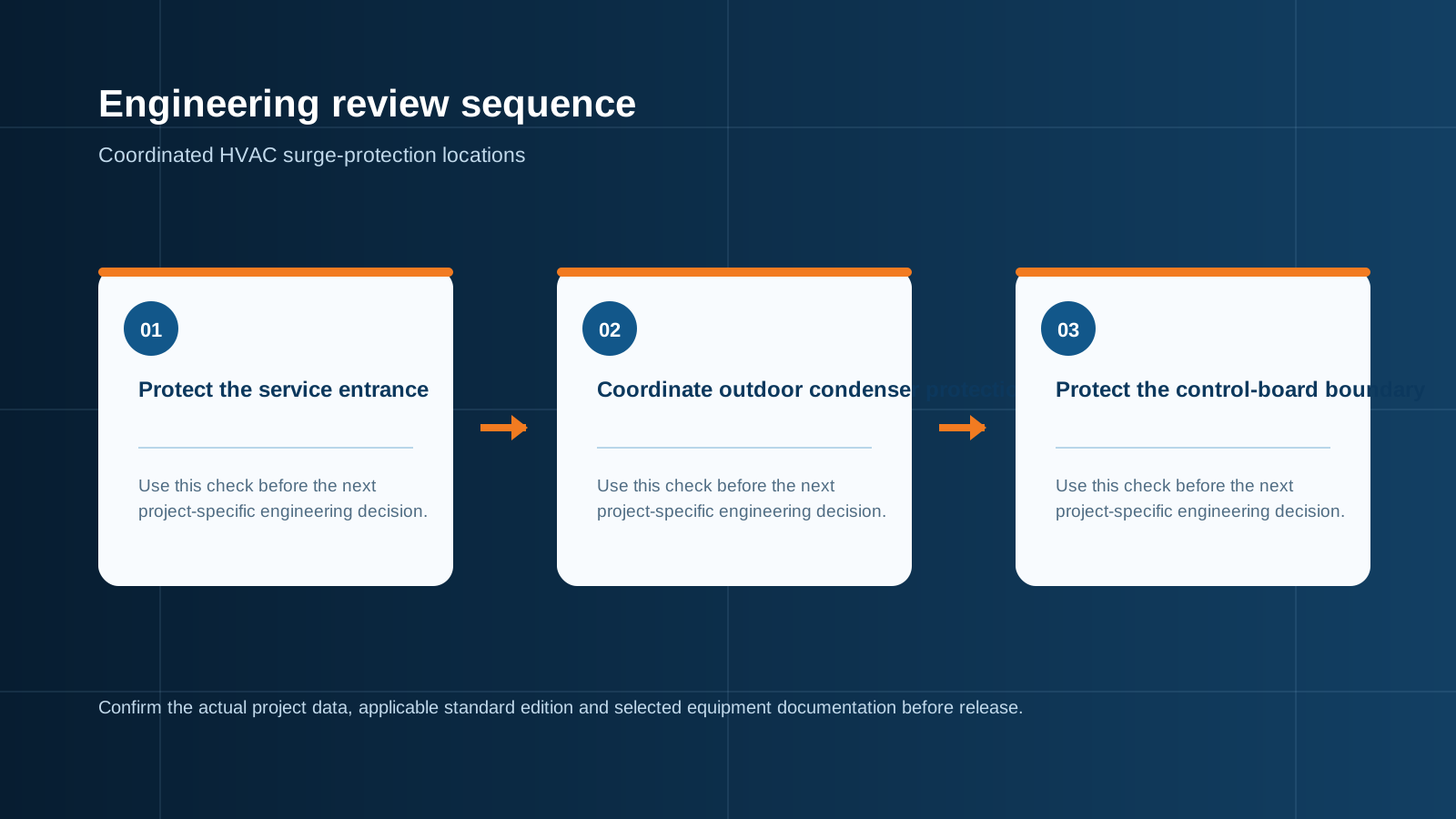
Engineering decision map
Use this compact sequence to review the approved guidance in order. Confirm actual ratings, interfaces, applicable standard editions and selected equipment documentation before final specification or release.
Technical diagram shown at a readable responsive scale.
This is general technical guidance, not a substitute for local electrical code, the applicable standard, product datasheets or a qualified engineer's design review. Confirm ratings and final configurations against the actual project.
Bring the project inputs to the first review.
NEUTRON can review the application context, electrical envelope, enclosure conditions and document requirements related to where to install an hvac surge protector? 3 key points before quotation.
Discuss a technical requirementContinue learning
Explore related technical guidance in Electrical Protection.
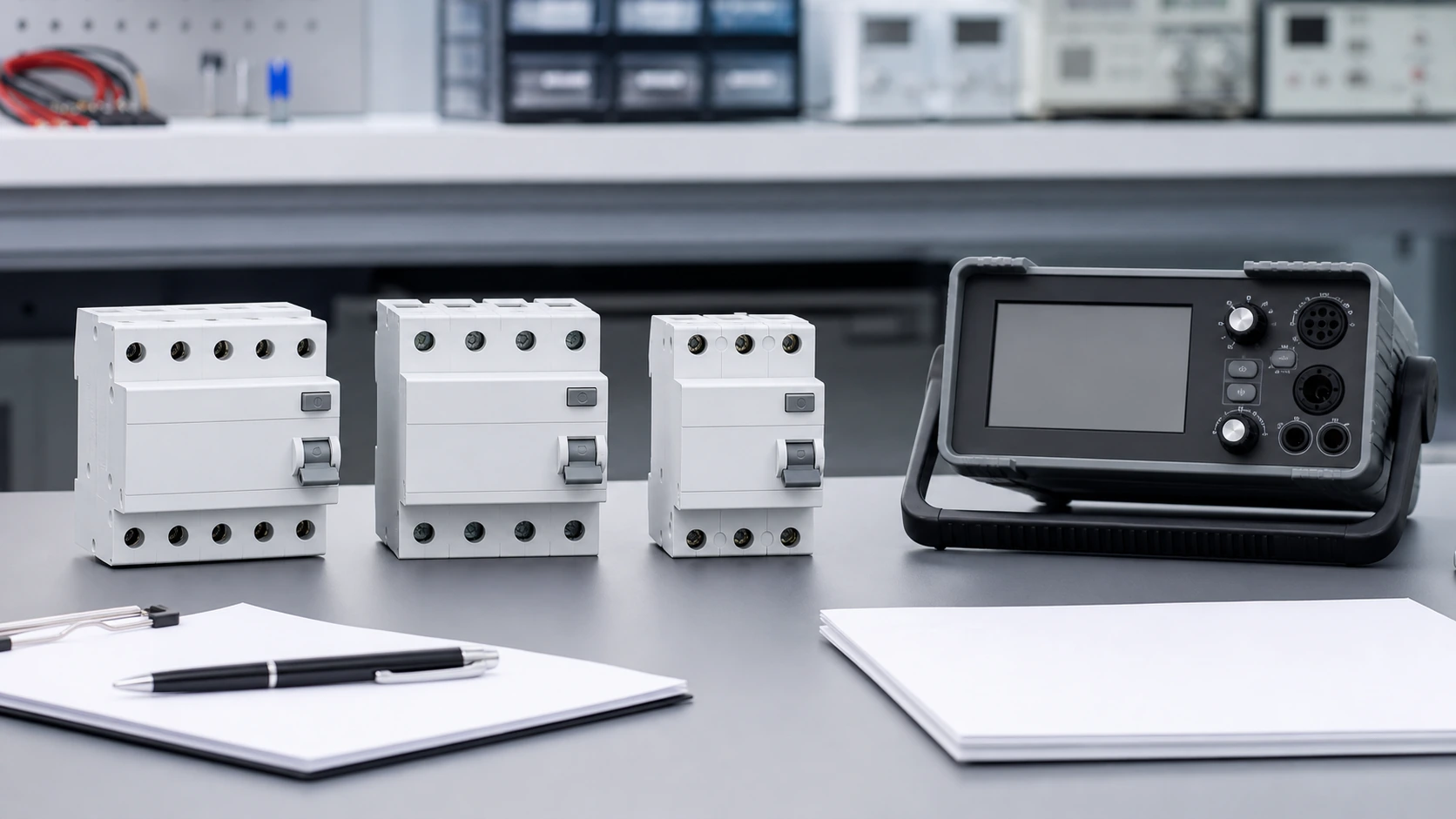

Technical note: source article content is retained for educational use. Applicable standards, ratings, protection coordination and final configurations must be confirmed for the actual project and destination market.