

1. What a 4-pole Type B RCCB is — and why both parts matter → #what-it-is
Review the project requirements and the applicable documentation for 1. what a 4-pole type b rccb is — and why both parts matter → #what-it-is.
2. Why Type B — the smooth-DC problem → #why-type-b
Review the project requirements and the applicable documentation for 2. why type b — the smooth-dc problem → #why-type-b.
| Application | Why Type B | Why 4-pole | Typical IΔn |
|---|---|---|---|
| Three-phase PV and BESS inverter AC side | Transformerless units produce smooth DC | Three-phase output with neutral | 30 mA |
| Commercial / industrial EV charging | DC leakage from the charger | Three-phase supply and neutral | 30 mA |
| VFD and heavy automation | Rectifier smooth DC component | Unbalanced three-phase loads | 100–300 mA |
| Data-centre and medical UPS output | Inverter smooth DC on the protected leg | Three-phase distribution with neutral | 30–100 mA |
| Industrial distribution incomer | Covers mixed converter loads downstream | Whole three-phase neutral switched | 300 mA + delay |
3. Why four poles, not two or three → #why-four-pole
Review the project requirements and the applicable documentation for 3. why four poles, not two or three → #why-four-pole.
Technical diagram shown at a readable responsive scale.
4. The parameters to set at enquiry → #selection-parameters
Review the project requirements and the applicable documentation for 4. the parameters to set at enquiry → #selection-parameters.
5. Where 4-pole Type B RCCBs are required → #application-table
Review the project requirements and the applicable documentation for 5. where 4-pole type b rccbs are required → #application-table.
6. The NEUTRON four-pole residual current range → #neutron-range
Review the project requirements and the applicable documentation for 6. the neutron four-pole residual current range → #neutron-range.
7. Common selection mistakes → #common-mistakes
- FAQ → #faq
- Request a quote → #request-a-quote
1. What a 4-pole Type B RCCB is — and why both parts matter
The name carries two independent requirements. '4-pole' is about the switching; 'Type B' is about the leakage it can detect. Both must be right for the installation to be safe.
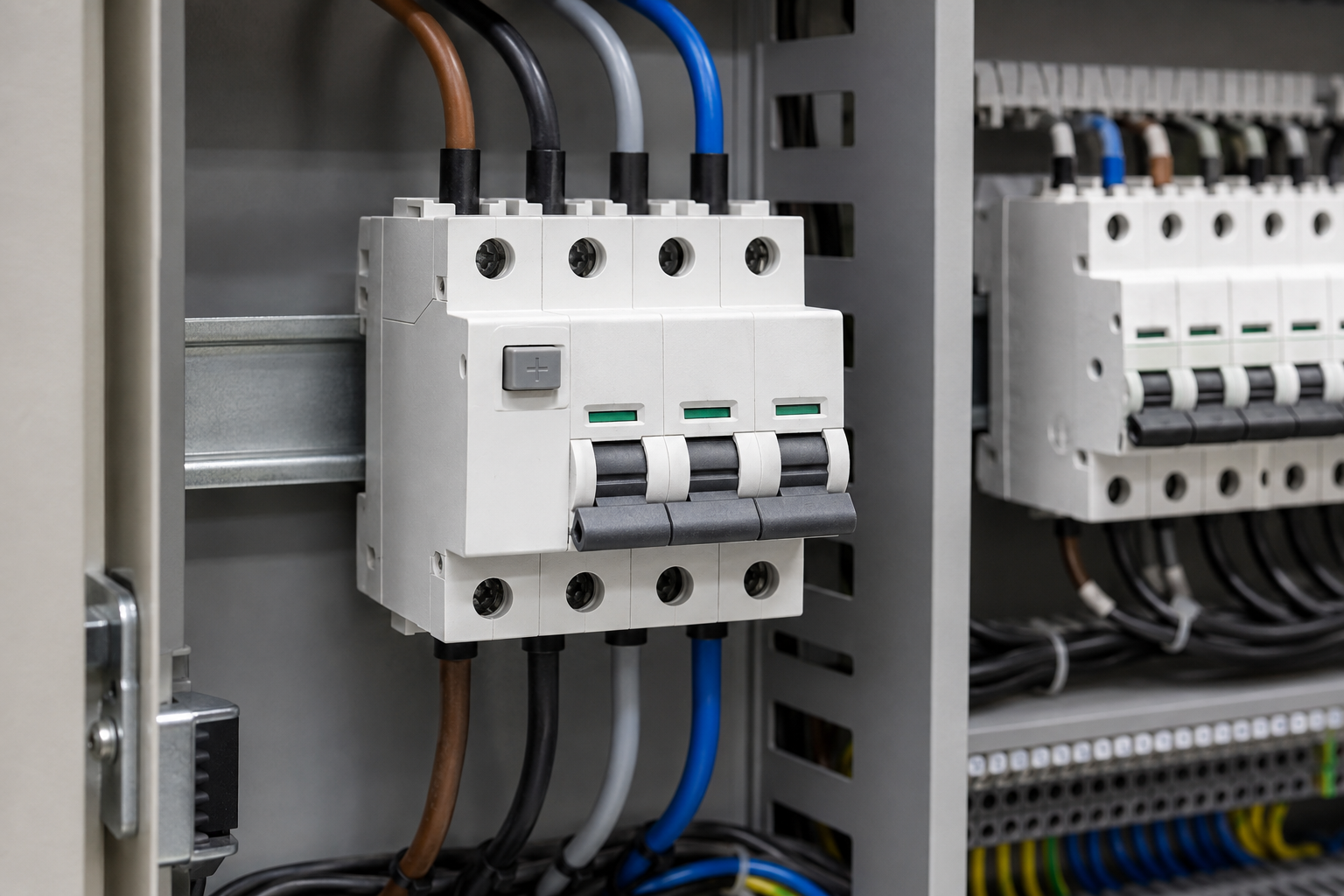
A 4-pole device has three phase poles and one neutral pole, all opened together by a single trip. That matters wherever the neutral carries current — unbalanced three-phase loads, three-phase inverters feeding a single-phase output, or any circuit where leaving the neutral connected would keep a fault energised. A 2-pole or 3-pole device would leave the neutral bonded and defeat the protection.
- 4-pole = three phases plus neutral, all interrupted on trip.
- Type B = residual current detection across AC, pulsating DC, composite and smooth DC to 1 kHz (Type B+ to 20 kHz), under IEC 62423.
- Together they protect three-phase industrial circuits that no Type A device can fully guard.
2. Why Type B — the smooth-DC problem
Modern industrial loads convert power with rectifiers and inverters, and those converters can place a smooth DC component on the earth path. A Type A device is blind to smooth DC: as the DC offset rises, the alternating residual current it does detect is shifted off the zero crossing and the device simply fails to trip. This failure mode is silent and dangerous, because the installation appears protected.
Type B closes that gap. By detecting smooth DC as well as the AC and pulsating components, it remains effective on transformerless photovoltaic inverters, EV charging equipment, variable frequency drives and UPS outputs. In short, any converter that could put DC on the protective conductor belongs behind a Type B device.
- Type A sees AC and pulsating DC only — blinded by smooth DC offset.
- Type B adds smooth DC detection — the converter-safe choice.
- Required by IEC 62423 where smooth DC leakage is expected.
3. Why four poles, not two or three
Three-phase loads split into balanced and unbalanced. A balanced motor with no neutral can use a 3-pole device. As soon as a neutral conductor is present and carries current — a three-phase distribution board, an inverter with a single-phase output stage, or any mixed three-phase and single-phase load — that neutral must also be opened on fault.
- 3-pole — three-phase loads with no neutral current.
- 4-pole — three-phase with neutral, including unbalanced and switched-neutral loads.
- Opening the neutral on trip removes the return path and de-energises the fault fully.
- In TN-C-S systems, never switch the combined PEN conductor; isolate upstream of the split point instead.
4. The parameters to set at enquiry
A correct specification lists five values. Get any one wrong and the device either nuisance-trips, fails to clear a fault, or cannot be coordinated with the rest of the board.
- Rated residual current IΔn — 30 mA for additional protection of people, 100 mA or 300 mA for fire protection and to obtain selectivity above downstream 30 mA devices; adjustable moulded case units span 30 mA to 500 mA.
- Frame rated current In — match the protected circuit; common industrial frames run 100 A, 225 A, 400 A and 800 A.
- Breaking capacity Icn and service capacity Ics — confirm against the prospective fault current at the installation. Ics equal to Icn means the device stays serviceable after clearing a fault.
- Selectivity — time-delay or adjustable-step versions let an incomer trip after a downstream device, preventing whole-board outages.
- Residual current type — state Type B explicitly so the device delivered matches the converter loads present.
5. Where 4-pole Type B RCCBs are required
Table — Typical industrial applications
Table — Type A versus Type B, and 2-pole versus 4-pole
6. The NEUTRON four-pole residual current range
NEUTRON builds four-pole residual current protection as moulded case and electronic devices, supplied loose or integrated into low-voltage assemblies. Real published ratings from the NEUTRON catalogue are below; for converter applications the residual current type should be confirmed as Type B at enquiry.
For any circuit feeding a photovoltaic inverter, EV charger, variable frequency drive or UPS, ask our engineers to confirm Type B residual current capability against the current catalogue revision before order release.
- WCM30L moulded case RCCB — four-pole frames of 100 A, 225 A, 400 A and 800 A, adjustable residual settings from 30 mA to 500 mA, non-delayed operation below 0.1 s or adjustable time-delay steps of 0.2 s, 0.4 s and 0.8 s, ultimate breaking capacity 35 kA to 50 kA, to IEC 60947-2. The delay steps are what give incomer selectivity.
- WCM7EL electronic residual current breaker — three-phase four-wire construction with a directly earthed neutral, residual settings 100 mA to 800 mA, 0.06 s delay type, configurable auto-reclosing between 20 and 60 seconds, and an LCD showing three-phase voltage, current and leakage.
- DZ47LE-63 residual current circuit breaker — available in 4P at 40 A and 63 A frames, to IEC 61009-1 and GB 16917.1, for smaller four-pole distribution circuits.
- All are offered with the residual current type matched to the application and are factory-fitted in NEUTRON GGD, GCS and XL-21 switchgear built to IEC 61439-1 and IEC 61439-2, with CE, CB and ISO 9001 documentation.
7. Common selection mistakes
- Fitting a Type A device on a converter-fed circuit and assuming the 'RCBO' label means it is safe — smooth DC is still undetected.
- Using a 3-pole device where the neutral carries current, leaving the fault path live.
- Specifying 30 mA at the incomer, which causes the whole board to trip on the first downstream leakage; use 300 mA with delay at the top.
- Ignoring Ics and assuming any high-Icn device survives a fault serviceable.
- Forgetting selectivity, so a single final-circuit fault blacks out production.
- Switching a PEN conductor in a TN-C-S system, which is prohibited and unsafe.
Media / Assets
Image placement follows the NEUTRON /insights article layout: one 16:9 hero above the first paragraph, then one inline visual every two to three sections. Every image needs descriptive English alt text and loading="lazy".
Slot: Hero — 16:9, directly under the H1
Alt text: NEUTRON four-pole moulded case residual current breaker in an industrial switchboard
IMAGE PROMPT — Hero:
IMAGE PROMPT — Hero:
Subject: NEUTRON four-pole moulded case residual current circuit breaker mounted in an open industrial switchboard, three phase conductors and a neutral entering the top
Style: clean industrial B2B product photography
Details: grey moulded case, clear rating label, copper busbar, grey enclosure, ferrule terminations
Background: plain light-grey studio
Lighting: soft even studio lighting
Aspect ratio: 16:9
No text, no logos unless specified.
Slot: Section 2 — Inline with the smooth-DC explanation
Alt text: Diagram of smooth DC offset blinding a Type A device, detected by Type B
FAQ
Render as a Q/A accordion. These pairs feed the FAQPage schema below.
Q: When is a Type B RCCB required instead of Type A?
A: Type B is required wherever a load can place smooth DC on the protective conductor: transformerless photovoltaic inverters, EV charging equipment, variable frequency drives and UPS outputs. A Type A device is blinded by smooth DC offset and will not trip.
Q: Why choose a 4-pole device for three-phase loads?
A: A 4-pole RCCB opens the three phases and the neutral together. It is needed when the neutral carries current — unbalanced three-phase loads, inverters with a single-phase stage, or any mixed load where leaving the neutral connected would keep the fault energised.
Q: What residual current setting should the incomer use?
A: Use 300 mA with a time delay at the incomer or distribution level for fire protection and to obtain selectivity above 30 mA downstream devices. 30 mA belongs on final circuits protecting people.
Q: Can NEUTRON supply four-pole Type B residual current protection?
A: NEUTRON supplies four-pole moulded case residual current breakers such as the WCM30L (100 A to 800 A frames, 30 mA to 500 mA adjustable, 35 kA to 50 kA) and the WCM7EL electronic RCD for three-phase four-wire systems. State Type B at enquiry so the residual current type matches the converter loads.
Q: How is selectivity achieved between devices?
A: Use time-delay or adjustable-step residual current breakers at the incomer — the WCM30L offers delay steps of 0.2 s, 0.4 s and 0.8 s — so a downstream 30 mA device trips first and the incomer only operates if the fault is closer to the supply.
Q: What breaking capacity do I need for an industrial board?
A: Confirm the prospective fault current at the installation and specify Icn accordingly, then check Ics. NEUTRON WCM30L units reach 35 kA to 50 kA; an Ics equal to Icn keeps the device serviceable after clearing a fault.
Request a quote
NEUTRON manufactures four-pole residual current protection from 40 A modular devices to 800 A moulded case breakers, with adjustable residual settings, time-delay selectivity and electronic monitoring, all verified to IEC 61439 and IEC 60947-2 with CE, CB and ISO 9001 documentation. Send us your single-line diagram and load list, and our engineers will confirm Type B capability and return a coordinated selection.
Structured data (JSON-LD)
Insert verbatim into the page <head> or the CMS schema field.
CODE: application/ld+json
"@context": "https://schema.org",
"@graph": [
"@type": "Article",
"headline": "Industrial 4-Pole Type B RCCB Selection Guide",
"description": "Select a 4-pole Type B RCCB for three-phase circuits: DC leakage, ratings, selectivity, wiring and IEC 62423 checks, with NEUTRON moulded case residual current breakers.",
"inLanguage": "en",
"author": {
"@type": "Organization",
"name": "NEUTRON",
"url": "https://neutronele.com/"
"publisher": {
"@type": "Organization",
Engineering decision map
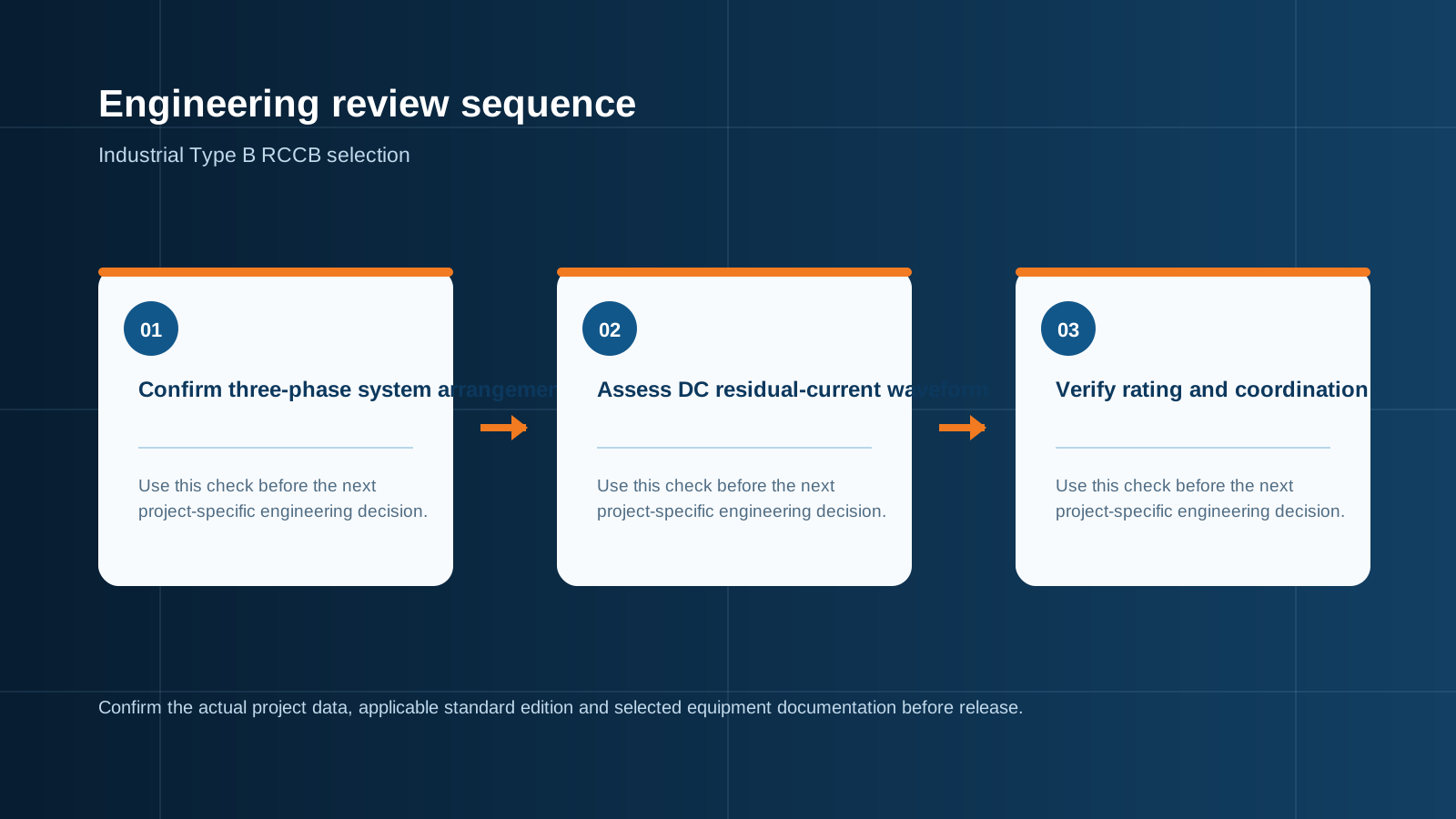
Use this compact sequence to review the approved guidance in order. Confirm actual ratings, interfaces, applicable standard editions and selected equipment documentation before final specification or release.
Technical diagram shown at a readable responsive scale.
This is general technical guidance, not a substitute for local electrical code, the applicable standard, product datasheets or a qualified engineer's design review. Confirm ratings and final configurations against the actual project.
Bring the project inputs to the first review.
NEUTRON can review the application context, electrical envelope, enclosure conditions and document requirements related to industrial 4-pole type b rccb selection guide before quotation.
Discuss a technical requirementContinue learning
Explore related technical guidance in Electrical Protection.

Technical note: source article content is retained for educational use. Applicable standards, ratings, protection coordination and final configurations must be confirmed for the actual project and destination market.