
2. What an RCBO protects against
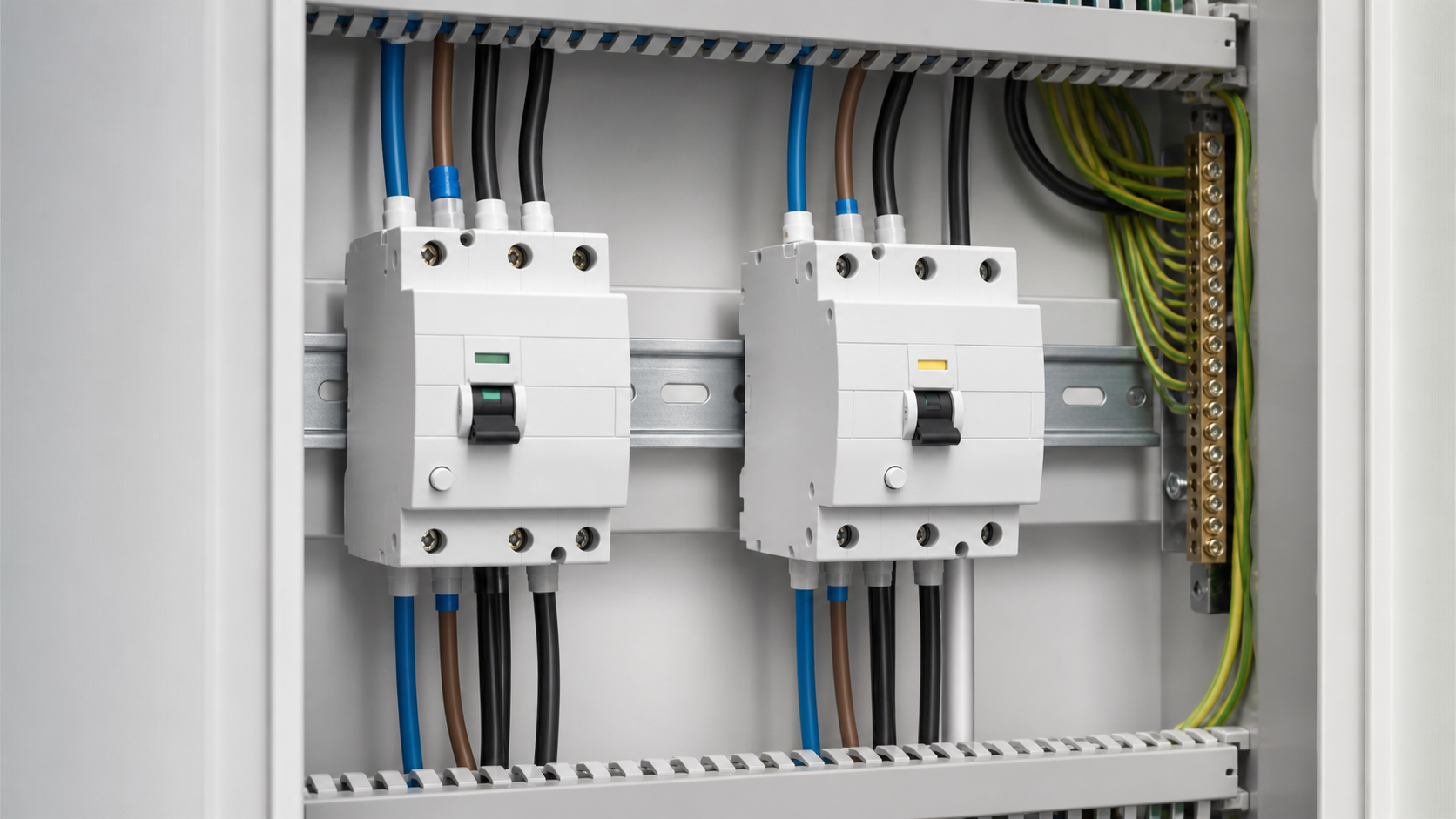
The RCBO is defined by IEC 61009-1 and is the workhorse of modern final-circuit protection. NEUTRON's WSB7L-63, WSB7LE-63 and WSB9LE-63 are built to it alongside GB 16917.1.
Three protective functions in one module:
Configurations run 1P+N, 2P, 3P, 3P+N and 4P at 6 to 63 A, covering 230 V single-phase and 400 V three-phase circuits at 50 or 60 Hz.
- Residual current protection. Line and neutral pass through a toroidal core; balanced current produces no net flux, leakage to earth produces an imbalance and the trip mechanism operates. Rated residual operating currents are 30, 50, 100 and 300 mA, with non-operating currents at half those values — WSB9LE-63 declares 15, 25 and 50 mA.
- Overload protection. A bimetallic thermal element with an inverse time characteristic, sized to the conductor's continuous capacity.
- Short-circuit protection. An electromagnetic element operating within milliseconds. WSB7LE-63 declares 6000 A ultimate breaking capacity; WSB9LE-63 offers 6000 A or 10000 A at cos φ 0.7.

1. The short answer
An RCBO watches where the current goes. An AFDD watches what the current looks like.
An RCBO measures the vector sum of line and neutral current. If current leaves the circuit through an unintended earth path — a person, damaged insulation, a wet enclosure — the sum is no longer zero and the device trips. It also carries a thermal-magnetic unit for overload and short circuit.
An AFDD samples the current waveform at high rate and applies a digital algorithm looking for the signature of arcing: broadband noise, chaotic current, and zero shoulders where the arc extinguishes and restrikes each half cycle. It does not care about magnitude, only shape.
Both exist because the two failure mechanisms are independent. A fault can be perfectly balanced between line and neutral and still be a fire risk; a fault can leak 30 mA to earth with no arcing at all.
3. The RCBO blind spot: series arcs
Consider a loose screw terminal on a socket outlet feeding a 10 A load. The connection oxidises, contact resistance rises, and current begins to arc across the microscopic gap each half cycle. Examine what each protective element sees.
Meanwhile the arc runs at thousands of degrees, confined to a point contact against a polymer backbox. The energy is modest — a few hundred watts — but concentrated into a fraction of a square millimetre. It is a well-documented ignition mechanism, and exactly the condition conventional protection is structurally unable to see.
The same reasoning applies to a partially severed conductor, a cable crushed by furniture, a damaged flexible cord at a strain relief and a corroded connection in a damp junction box.
- Residual current element. The arc is *in series* with the load, in the same conductor, so the vector sum is still zero. No residual current is detected.
- Thermal overload element. The arc adds impedance, so circuit current is the same or slightly *lower* than normal. No overload is detected.
- Magnetic short-circuit element. There is no high fault current. Nothing operates.
Technical diagram shown at a readable responsive scale.
4. What an AFDD does
An arc fault detection device is specified by IEC 62606. It samples current, usually voltage too, at high rate and processes the result through a digital algorithm.
What the algorithm looks for:
The engineering difficulty is not detection but discrimination. Normal equipment arcs constantly — brushed motors, switch contacts, thermostats, dimmers. An AFDD that trips on these will be bypassed within a week. IEC 62606 therefore specifies both a masking test, so the device does not trip on defined normal load signatures, and a detection test, so it trips on defined arc signatures within specified times.
Most AFDDs ship as a combined module with an integral MCB or RCBO, because a detection element alone cannot break the circuit. The processor also needs an internal supply, making the device inherently voltage-dependent.
- Broadband high-frequency content. An arc is a noisy, unstable plasma injecting energy across a wide spectrum that normal load current does not contain.
- Current zero shoulders. The arc extinguishes as current passes through zero and must restrike as voltage rises, producing a characteristic flat shoulder.
- Chaotic, non-repeating variation. Arc current varies unpredictably cycle to cycle; load current, even from a switching supply, is far more repeatable.
- Persistence over multiple half cycles. A genuine arc fault persists; a switching transient does not.
5. Parallel arcs versus series arcs
Arc faults divide into two families, and the distinction explains exactly where each device is effective.
Parallel arc — between conductors or to earth. Insulation breaks down and current arcs across the gap. Fault current is limited by arc and circuit impedance and can range from a few amperes to hundreds.
Series arc — within a single conductor. A break, loose connection or damaged strand. Current is unchanged or reduced.
This is the entire case for fitting an AFDD: it closes a gap no combination of conventional devices can close.
- A line-to-earth parallel arc produces residual current, so an RCBO detects it.
- A line-to-neutral parallel arc produces none. High fault current trips the magnetic element, but if arc impedance limits it to say 25 A on a 20 A circuit the thermal element takes tens of seconds — ample time to ignite adjacent material.
- An AFDD detects both, typically far faster than a thermal element.
- No RCBO function detects it — not residual current, not thermal, not magnetic.
- Only an AFDD detects it.
6. Direct comparison
Table 1 — RCBO and AFDD compared
7. Can one replace the other?
Can an AFDD replace an RCBO? Only if it is a combined AFDD/RCBO module including a residual current element of the required sensitivity. A pure detection device with a plain MCB gives no protection against electric shock — an "AFDD" marking alone does not imply residual current protection.
Can an RCBO replace an AFDD? No. The series arc case in section 3 is the most common arc-related ignition mechanism, and residual current, thermal and magnetic elements are all structurally blind to it.
In fire-sensitive installations the correct arrangement is protection in depth:
Combined AFDD/RCBO modules deliver all three in one device, the practical choice where DIN rail space is limited.
Where AFDDs are most justified. Sleeping accommodation such as hotels, care homes and student residences; combustible construction; heritage buildings; ageing wiring; restricted escape routes; and data rooms where a small fire causes disproportionate loss. Several markets now mandate AFDDs in some of these categories.
- AFDD for arc fault detection.
- RCBO or RCD at 30 mA for protection against electric shock.
- MCB or the RCBO's own overcurrent element for overload and short circuit.
8. Panel design, coordination and procurement
Practical design considerations:
Procurement checks. Require type test certification to IEC 62606 for AFDDs and IEC 61009-1 for RCBOs from a recognised laboratory. Confirm whether the product is a pure detection device or a combined unit, and if combined, the declared IΔn, RCD type, rated current and breaking capacity. Ask for endurance figures and behaviour on loss of the auxiliary supply.
NEUTRON manufactures low-voltage protection and distribution equipment: RCBO and residual current ranges to IEC 61009-1, arc fault protection, moulded case circuit breakers, surge protective devices and complete assemblies to IEC 61439, with enclosures from IP30 to IP65 produced under an ISO 9001 quality system.
Local qualification. Arc fault protection requirements differ between markets and are revised frequently. Confirm the destination country's wiring rules before finalising the circuit schedule, and use a licensed electrician for installation and certification.
- DIN rail space. Combined AFDD/RCBO modules occupy 2 to 4 modules per circuit against 1 to 2 for an RCBO, so retrofitting often means a larger enclosure.
- Auxiliary supply dependence. An AFDD needs power for its processor. Confirm behaviour on loss of neutral, a foreseeable condition in TN-C-S installations.
- Commissioning discipline. Test every device with its integral test button at handover and record the result. Many AFDDs indicate fault type, distinguishing an arc trip from an overcurrent or residual current trip.
- Nuisance trip management. If an AFDD trips repeatedly on one circuit, the fault is real until proved otherwise. Investigate terminations first.
- Cost proportionality. AFDDs cost several times an equivalent RCBO, so target them at the highest-risk circuits rather than the whole board.
This is general technical guidance, not a substitute for local electrical code, the applicable standard, product datasheets or a qualified engineer's design review. Confirm ratings and final configurations against the actual project.
Bring the project inputs to the first review.
NEUTRON can review the application context, electrical envelope, enclosure conditions and document requirements related to what is the difference between an rcbo and an afdd? before quotation.
Discuss a technical requirementContinue learning
Explore related technical guidance in Electrical Protection.

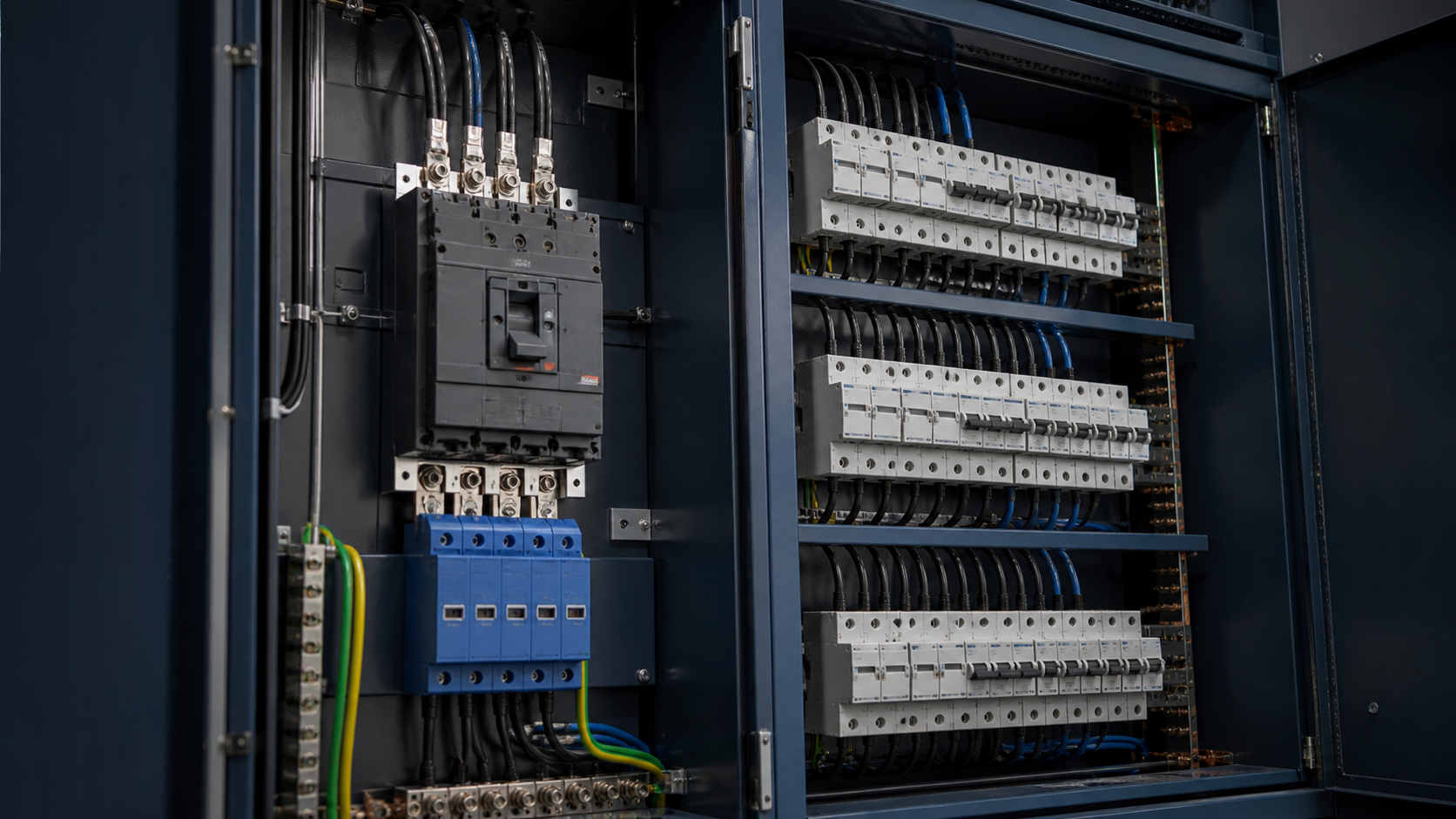
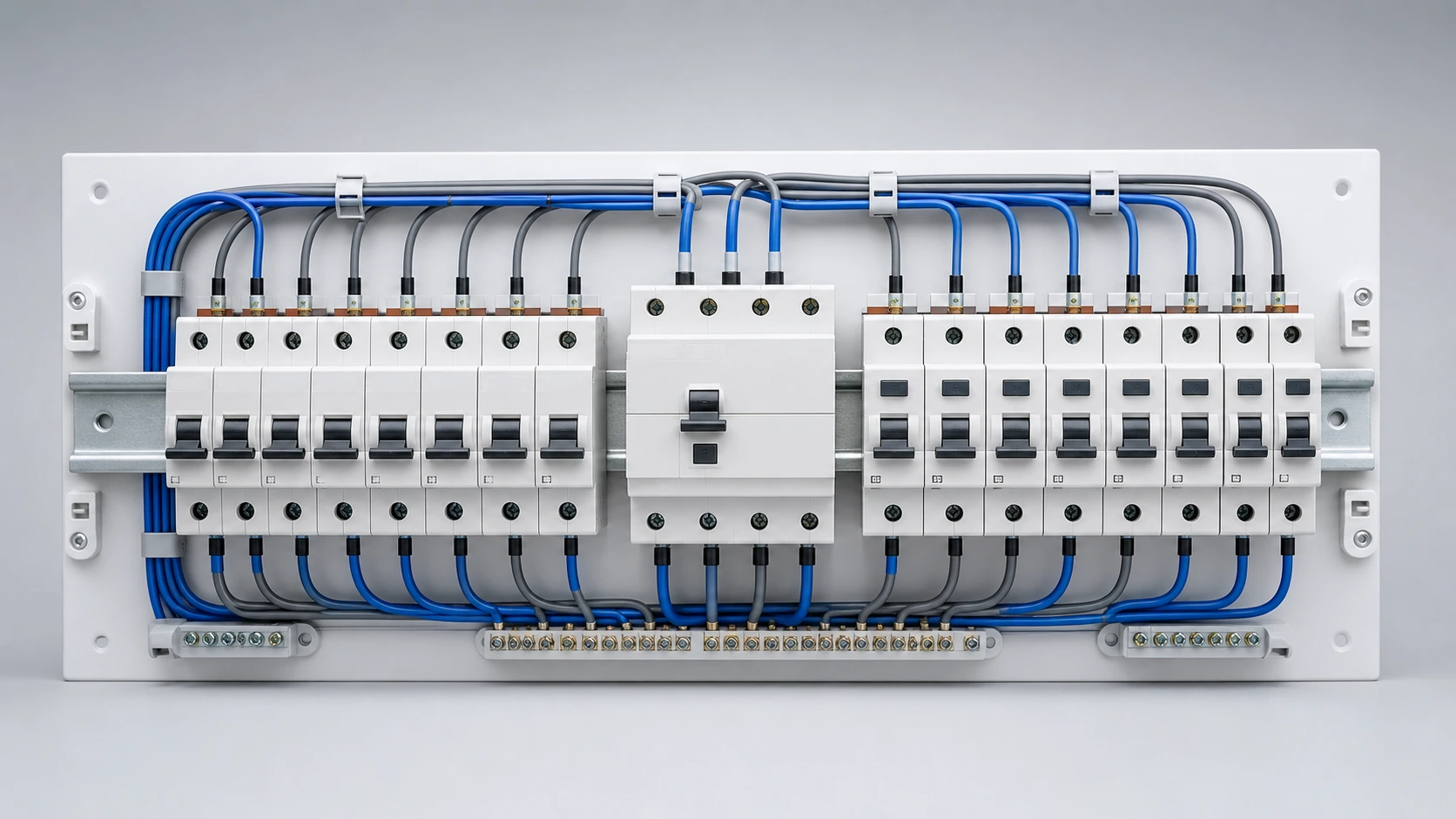
Converted from the approved Period 01 source article for What Is the Difference Between an RCBO and an AFDD?. Editorial instructions, duplicate anchor placeholders and embedded publishing directions were removed; the technical body is retained for educational use.