
1. What an electrical substation actually does
Anchor: #what-is-an-electrical-substation-s1
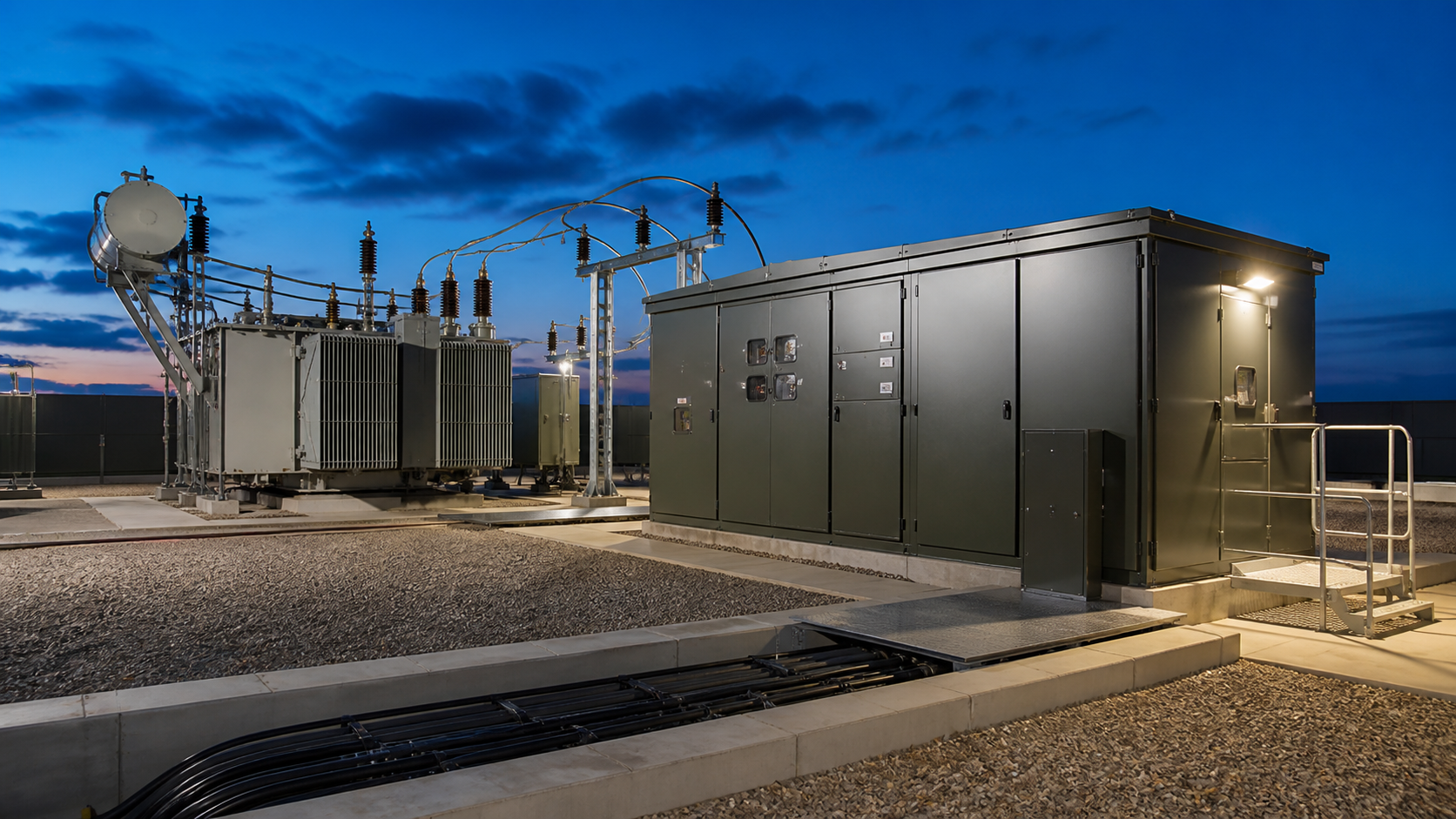
A substation performs five functions, and every piece of equipment inside it maps to one of them:
Everything else — the enclosure, the earthing grid, the cable trenches, the auxiliary DC system — exists to let those five functions run safely and continuously. A substation is therefore best specified function by function, not as a single catalogue item. When a project team skips that decomposition, the result is usually an assembly with correct transformer rating but undersized switching or missing auxiliary supply.
- Transformation — raising or lowering voltage through a power transformer.
- Switching — connecting and isolating circuits under load or no-load conditions.
- Protection — detecting and clearing faults before conductors or plant are damaged.
- Measurement — metering energy, current, voltage and power quality for billing and control.
- Regulation — correcting power factor, suppressing harmonics and stabilising voltage.
2. Why voltage transformation decides grid efficiency
Anchor: #what-is-an-electrical-substation-s2
Conductor loss follows P = I²R. Loss scales with the square of current, so halving current cuts line loss to a quarter. Because apparent power S = √3 × U × I in a three-phase system, raising voltage for a fixed power transfer proportionally reduces current.
A worked example makes the effect concrete. Moving 10 MW at 400 V requires roughly 14,400 A — physically impossible over distance. The same 10 MW at 110 kV needs about 52 A. That is why generation steps up immediately, transmission runs at 35 kV to 750 kV, and distribution steps back down close to the load. Each step requires a substation, and each substation adds transformer losses of roughly 0.3–1.5 % depending on rating and efficiency tier. The engineering trade-off is always line loss avoided versus transformation loss added, which is why distribution substations are placed as near to load centres as land and noise limits allow.
| Category | Typical voltage | Primary role | Common enquiry driver |
|---|---|---|---|
| Step-up | 0.4–35 kV → 110–500 kV | Connect generation to the transmission grid | Utility-scale solar, wind and thermal plant |
| Transmission / switching | 110–500 kV | Route bulk power, no voltage change in pure switching yards | Grid reinforcement, interconnection |
| Distribution | 35 kV → 10/6/0.4 kV | Feed industrial parks, buildings and networks | Factories, data centres, districts |
| Collector | 0.4–1.5 kV → 10–35 kV | Gather many small generators onto one feeder | PV farms, battery storage plants |
3. The four substation categories buyers specify
Anchor: #what-is-an-electrical-substation-s3
Collector substations dominate current renewable procurement. On a PV plant, string inverters at 0.4–0.8 kV feed PV step-up package substations that lift output to 10–35 kV for the grid connection point. This is the format most export buyers now request, because it arrives pre-wired and pre-tested and compresses the site programme from weeks to days.
4. Inside the substation: the main equipment groups
Anchor: #what-is-an-electrical-substation-s4
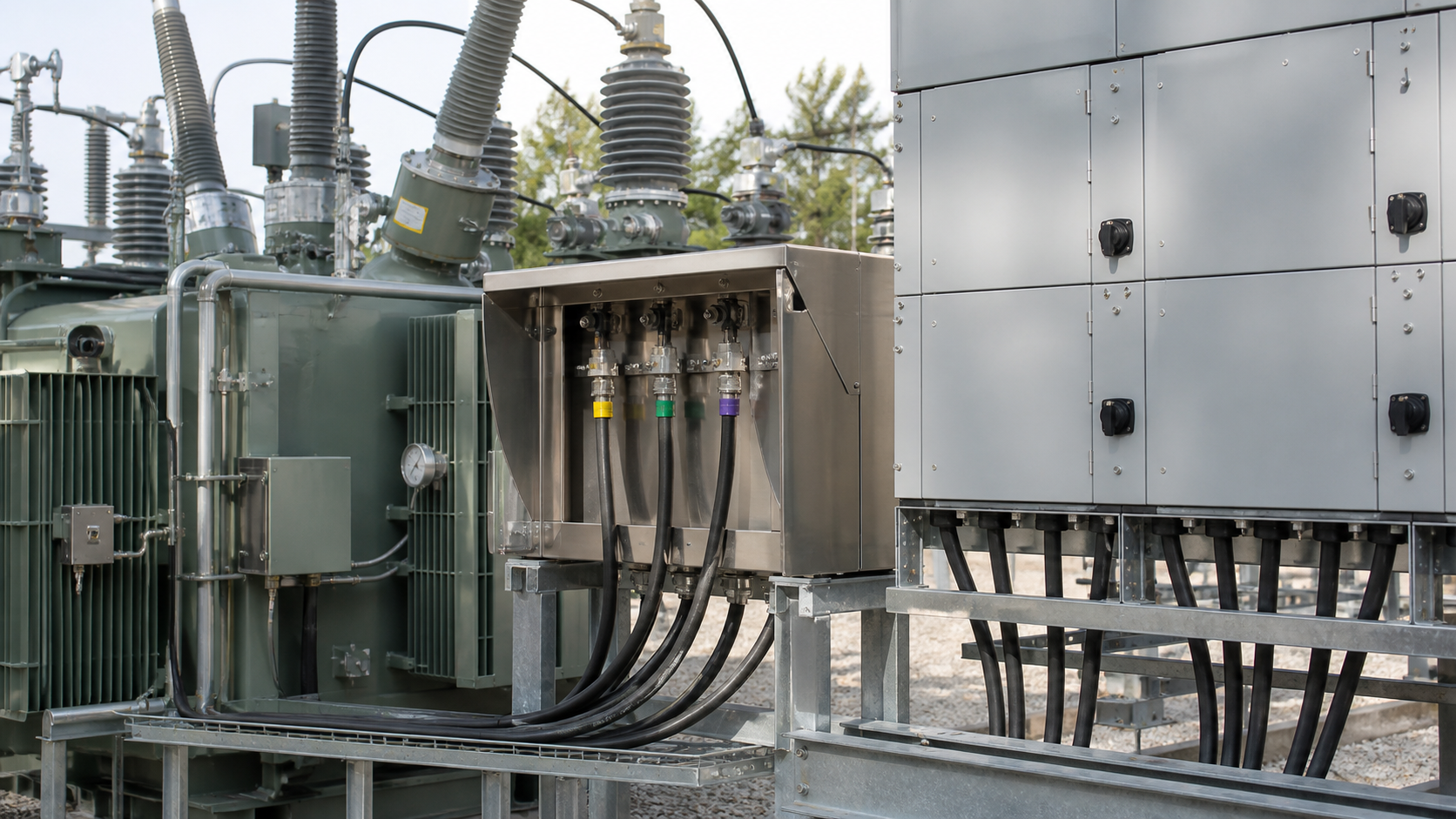
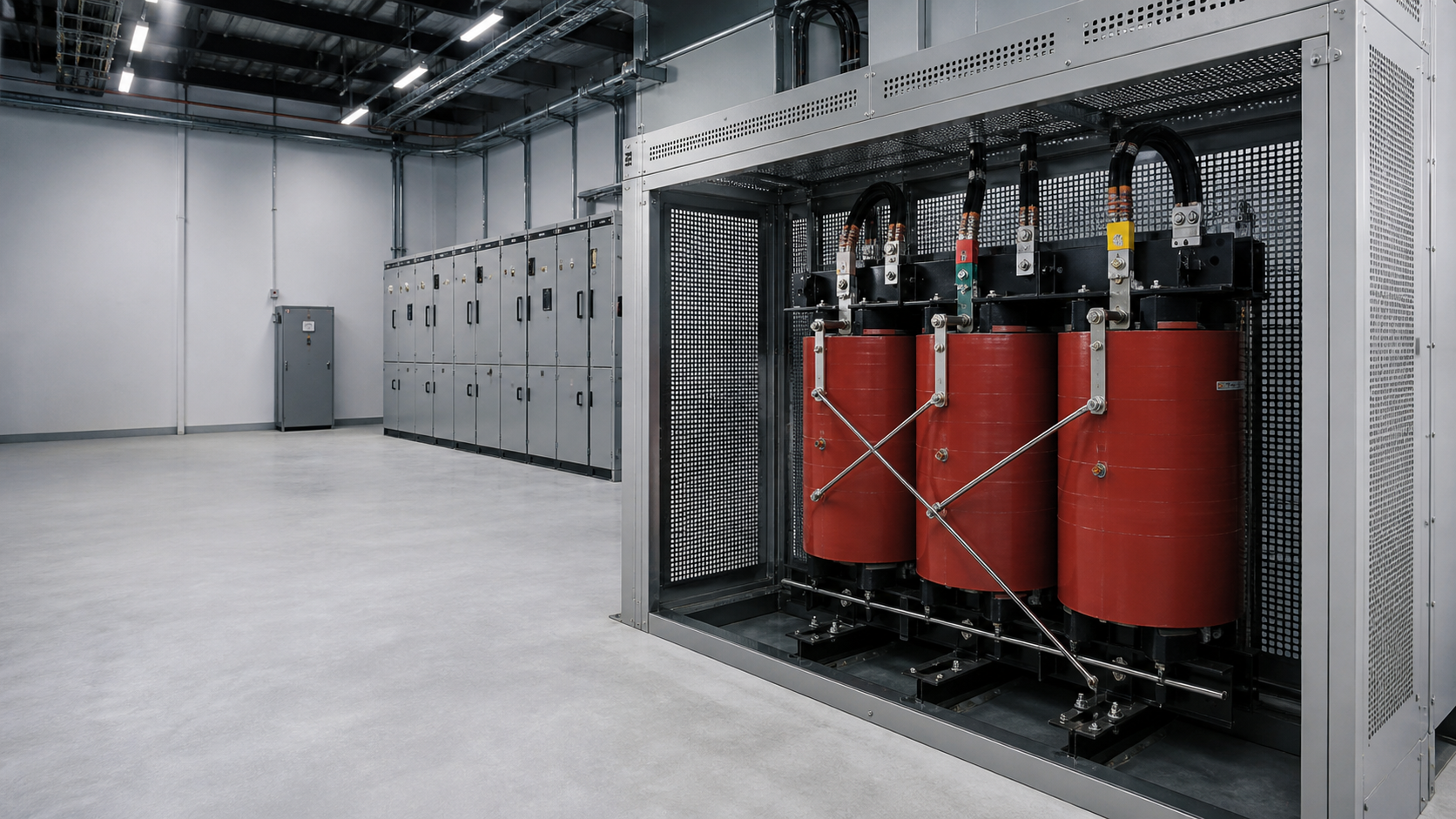
- Power transformer — the largest single asset. Oil-immersed or cast-resin dry type, rated per IEC 60076, with vector group, impedance and tap range fixed at enquiry stage.
- HV switchgear — vacuum or SF6 circuit breakers, load-break switches and disconnectors to IEC 62271-100 and IEC 62271-200, providing fault interruption and visible isolation.
- LV assemblies — incomer, busbar tie and feeder cabinets built and verified to IEC 61439-1/-2, distributing 400 V power to the site.
- Protection and control — numerical relays, current and voltage transformers, interlocking, SCADA gateways with RS485 / Modbus RTU.
- Auxiliary DC system — a battery charger panel supplying 110 V or 220 V DC for trip coils, relays and indication when the AC supply is lost.
- Power-quality plant — capacitor banks for power-factor correction, detuned reactors, harmonic filters and arc-suppression equipment on the MV neutral.
- Earthing and surge protection — an earthing grid sized for step and touch potential, plus surge protective devices coordinated to IEC 61643-11 on LV circuits.
5. Package substations vs conventional open-terminal yards
Anchor: #what-is-an-electrical-substation-s5
For export projects the deciding factor is usually not price but verification evidence. A factory-assembled unit arrives with design verification and routine test reports covering temperature rise, dielectric withstand and short-circuit withstand. A site-built assembly needs those checks reconstructed in the field, which is slower and harder to defend during grid-operator witness testing.
6. Specification checklist before you issue an enquiry
Anchor: #what-is-an-electrical-substation-s6
Common errors repeat across enquiries. Teams quote a transformer rating without short-circuit data, so the LV assembly cannot be verified for Icw. They specify IP65 for an indoor room, forcing forced cooling that was never budgeted. They omit altitude, then discover clearance derating after manufacture. And they leave the auxiliary DC system out of scope entirely, which stalls commissioning because trip circuits have no supply.
- System data — nominal voltage each side, frequency, earthing arrangement (TN-S, TN-C-S, TT or IT), and prospective short-circuit current in kA.
- Transformer duty — kVA rating, vector group, impedance, tap changer type and cooling class.
- Switchgear ratings — rated current, Icu / Icw, Icm and internal arc classification for MV panels.
- Environment — ambient range, altitude above 2000 m, humidity, salt mist, pollution degree and required IP class.
- Compliance set — IEC 61439 for LV assemblies, IEC 62271 series for MV switchgear, IEC 60076 for transformers, CE marking scope and factory ISO 9001 certification.
- Interfaces — cable entry direction, busbar material, metering and communication protocol.
7. Where NEUTRON equipment fits in the substation
Anchor: #what-is-an-electrical-substation-s7
NEUTRON manufactures the low-voltage and power-quality side of the substation, plus package substation solutions for PV and industrial connections. Confirmed product families include:
- GGD fixed-pattern LV switchgear and GCS withdrawable LV assemblies for incomer, busbar tie and feeder duties, built to IEC 61439 / GB 7251 with copper busbar and RAL 7035 powder-coated cold-rolled or galvanised steel enclosures.
- Incomer, busbar and feeder cabinets plus XL-21 power cabinets for distribution boards downstream of the transformer.
- WCW1 intelligent air circuit breakers, 200 A to 6300 A, breaking capacity 80 kA to 120 kA, available fixed or draw-out, with intelligent controllers offering long-delay, short-delay, instantaneous and single-phase earth-fault protection and remote telemetry, signalling, control and adjustment.
- WCQ2 automatic transfer switches, 16 A to 2000 A at 400 V to IEC 60947-6-1, for utility-to-standby changeover on essential feeders.
- WCU8 surge protective devices on LV distribution, and GZDW intelligent high-frequency DC panels for substation auxiliary supply.
- Reactive power compensation and arc-suppression / harmonic-elimination cabinets for power-factor correction and neutral treatment.
8. Safety, standards and site limits
Anchor: #what-is-an-electrical-substation-s8
Substations are high-energy installations. Only qualified personnel working under a permit-to-work system should enter live compartments. Arc-flash risk assessment, lockout-tagout and verified earthing must be in place before any intervention.
Two questions come up repeatedly from neighbours and site owners. Electromagnetic fields around distribution substations fall off rapidly with distance and, at the boundary fence, are normally far below ICNIRP reference levels. Audible noise comes mainly from transformer core magnetostriction and cooling fans; it is controlled by rating selection, anti-vibration mounts and acoustic enclosures, and is verified against the local night-time limit at the nearest receptor.
Finally, equipment ratings assume standard service conditions — typically −5 °C to +40 °C with a 24-hour mean not exceeding +35 °C, altitude up to 2000 m, and relative humidity not exceeding 50 % at +40 °C. Outside that envelope, declare the actual conditions at enquiry stage so derating is applied before manufacture rather than discovered on site. Local wiring rules always take precedence over generic guidance.
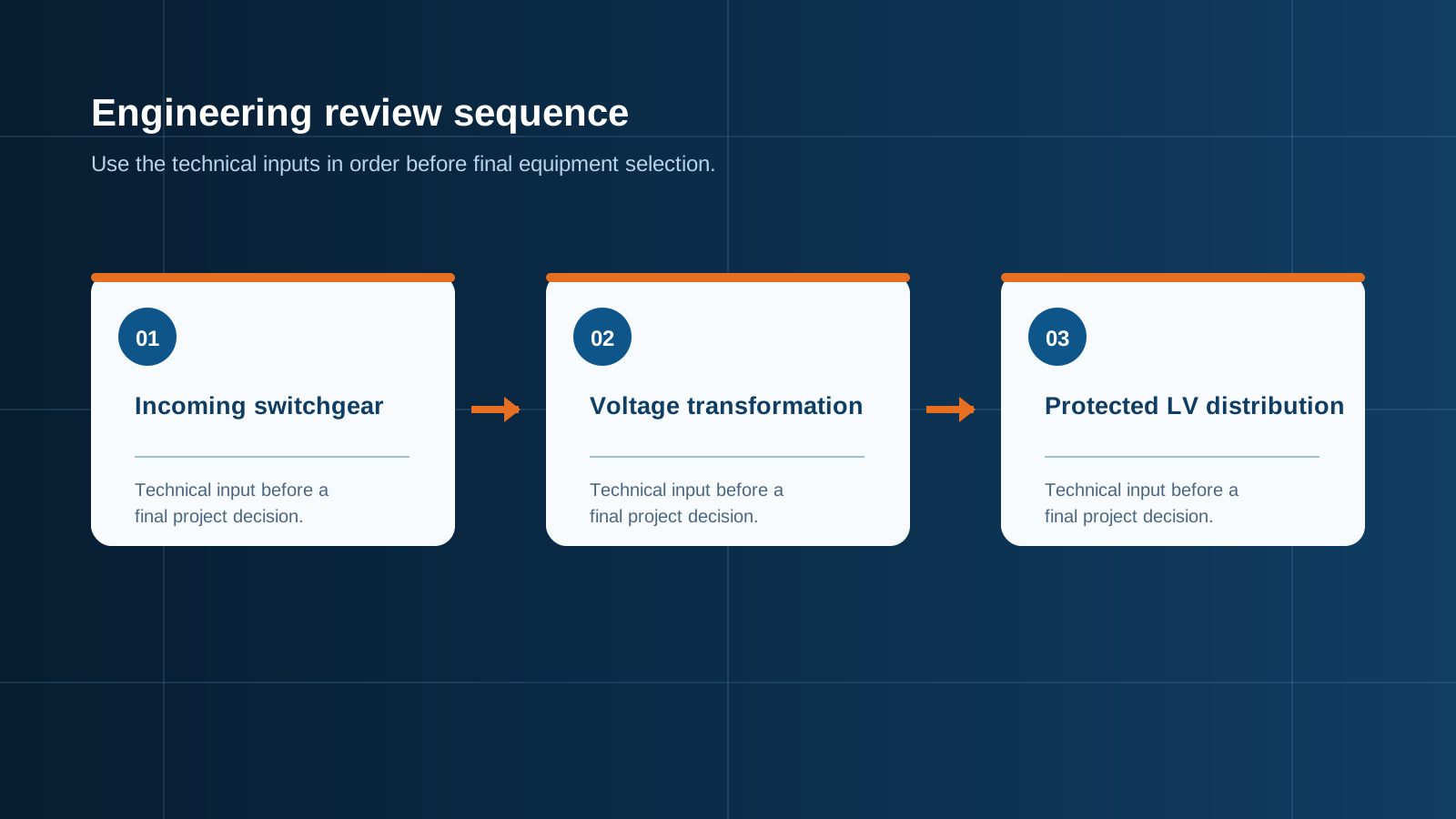
Technical diagram shown at a readable responsive scale.
Frequently asked questions
Anchor: #what-is-an-electrical-substation-faq
Q: What is the difference between a substation and a transformer?
A: A transformer is one component; a substation is the complete installation that houses it. Alongside the transformer, a substation contains switchgear, protection relays, metering, earthing and often power-factor correction. A transformer on its own cannot isolate circuits or clear faults.
Q: What voltage is a distribution substation?
A: A distribution substation typically takes 35 kV, 20 kV or 10 kV on the primary side and delivers 400 V three-phase or 230 V single-phase on the secondary side. Exact levels depend on the national network; confirm them with the local grid operator before ordering equipment.
Q: How much space does a package substation need?
A: A factory-assembled package substation for a PV or industrial connection generally occupies a single prepared foundation rather than a fenced yard. Because the transformer, MV switchgear and LV assembly share one enclosure, the civil scope is reduced to a level slab, cable ducts and an earthing grid.
Q: Which standards apply to substation equipment?
A: IEC 61439-1/-2 covers low-voltage switchgear and controlgear assemblies, the IEC 62271 series covers MV switchgear and prefabricated substations, IEC 60076 covers power transformers, IEC 60529 defines IP enclosure protection, and IEC 61643-11 covers low-voltage surge protective devices.
Q: Are electrical substations safe to live near?
A: Distribution substations built to IEC standards are enclosed, earthed and interlocked, and magnetic field strength drops sharply within a few metres of the equipment. Noise and field levels at the site boundary are normally assessed during permitting and kept below the applicable national limits.
Q: Can NEUTRON supply the complete low-voltage side of a substation?
A: Yes. NEUTRON manufactures GGD and GCS low-voltage switchgear, incomer, busbar and feeder cabinets, WCW1 air circuit breakers from 200 A to 6300 A, WCQ2 automatic transfer switches, WCU8 surge protective devices, DC auxiliary panels and reactive power compensation cabinets, all built to IEC 61439 and IEC 60947.
Talk to a NEUTRON engineer
Send your single-line diagram, ratings and destination-market standards. NEUTRON engineering returns a specification-matched proposal with drawings, test scope and lead time.
This is general technical guidance, not a substitute for local electrical code, the applicable standard, product datasheets or a qualified engineer's design review. Confirm ratings and final configurations against the actual project.
Bring the project inputs to the first review.
NEUTRON can review the application context, electrical envelope, enclosure conditions and document requirements related to what is an electrical substation? a complete guide before quotation.
Discuss a technical requirementContinue learning
Explore related technical guidance in Power Distribution.
Converted from the approved Period 01 source article for What Is an Electrical Substation? A Complete Guide. Editorial instructions, duplicate anchor placeholders and embedded publishing directions were removed; the technical body is retained for educational use.