
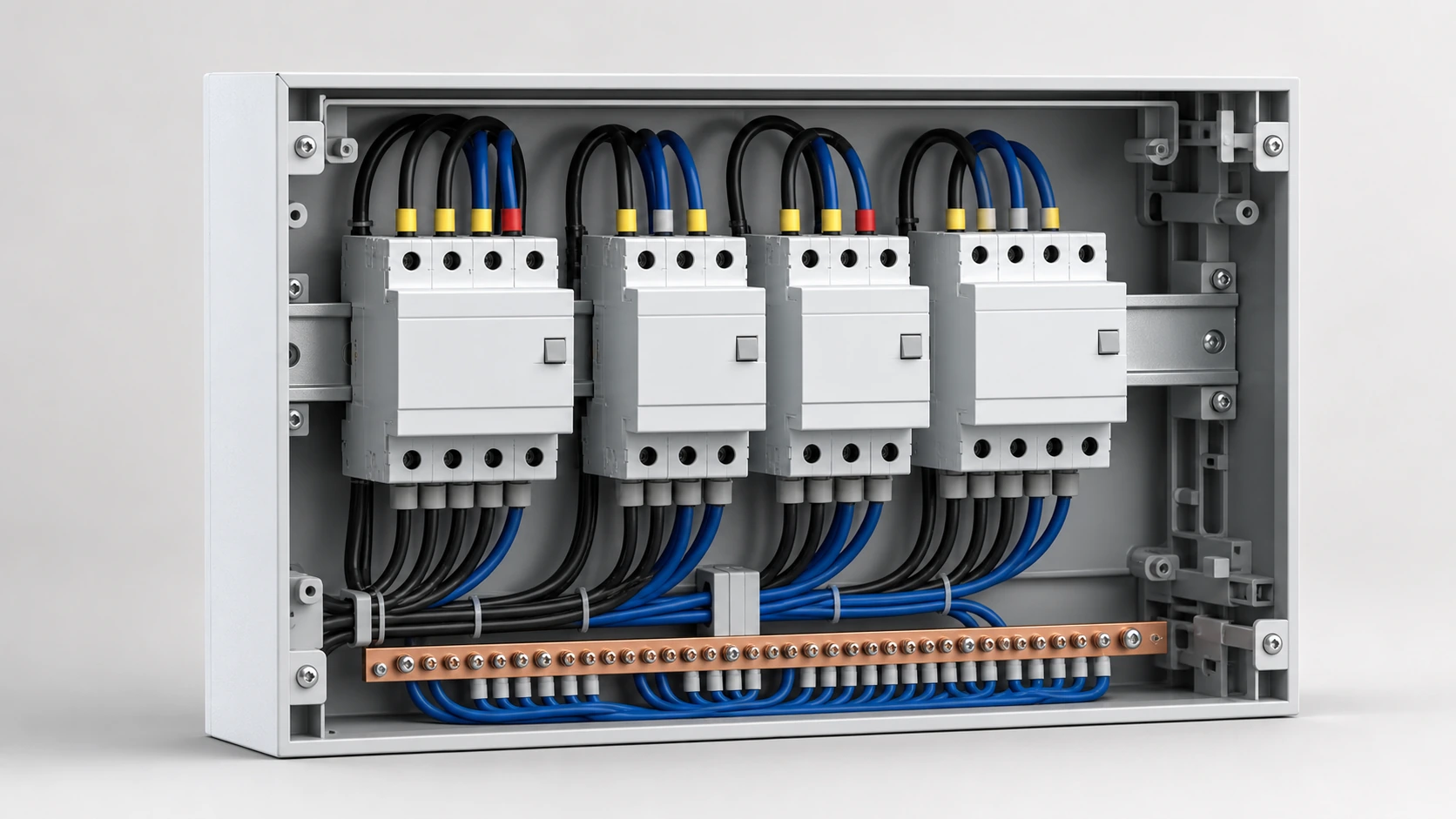
1. The price gap and where it comes from
Buyers comparing quotations regularly ask why one four-pole 40 A residual current circuit breaker costs a few units of currency and the apparently identical Type B version costs an order of magnitude more. The answer is that they are not the same class of product. One is a passive electromechanical device; the other is an instrument.
A Type AC or Type A device works from the energy in the residual current itself. A toroidal core sums line and neutral currents, and the imbalance drives a sensitive polarised relay directly. There is no electronics in the sensing path, no supply requirement, and the whole assembly is built on high-speed automated lines in very large volumes.
A Type B device must detect residual current that does not alternate at all. Smooth DC leakage produces a constant flux offset, which a passive core cannot convert into usable signal energy — and that offset also drives the core towards saturation, degrading its ability to see the AC component. The only practical answer is active magnetic sensing: a powered measurement chain in a product that previously needed none.
2. What the standard actually requires
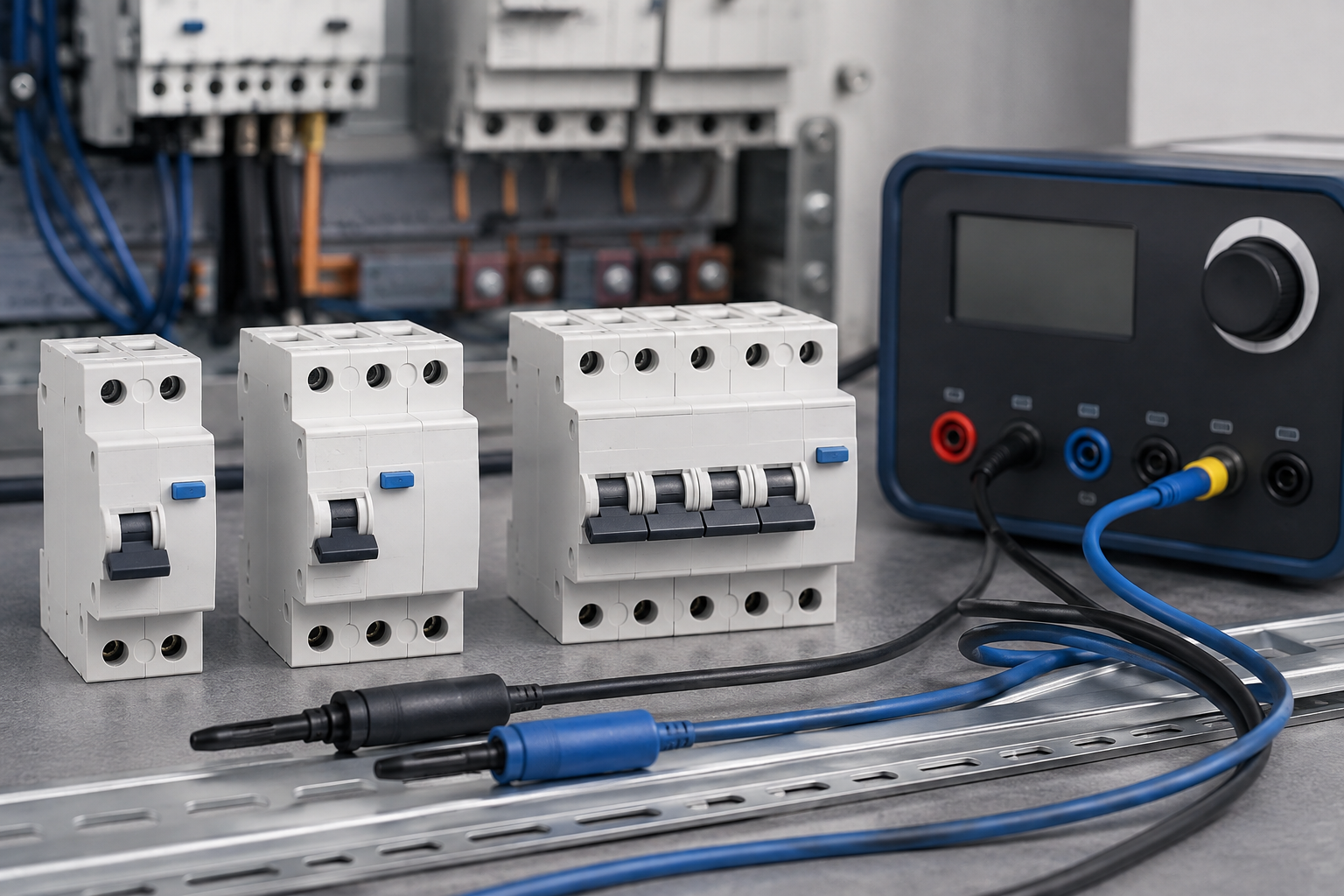
Type B behaviour is defined in IEC 62423, applied on top of the base product standards IEC 61008-1 for RCCBs and IEC 61009-1 for RCBOs. The device must trip correctly across a far wider set of conditions than a Type A.
Each waveform is a separate test regime with its own generator and tolerance band. That expands the type-test programme, the production test fixture and the quality documentation — costs amortised over the units sold.
- Sinusoidal AC residual current at rated frequency — the Type AC requirement.
- Pulsating DC residual current, including with a superimposed smooth DC component — the Type A requirement.
- Composite and mixed-frequency residual current — the Type F requirement.
- Smooth DC residual current, with a defined tripping range for the rated value.
- Residual current across a broad frequency band, typically evaluated from a few hertz up to 1 kHz, because inverter leakage is rarely at 50 Hz.
| Title tag (45 chars) | Type B RCCB Pricing: Cost Structure Explained |
|---|---|
| Meta description (150 chars) | Why Type B RCCBs cost several times a Type A: fluxgate sensors, firmware, calibration yield and IEC 62423 certification, plus total cost of ownership. |
| Slug | understanding-type-b-rccb-pricing |
| Canonical | https://neutronele.com/insights/understanding-type-b-rccb-pricing |
| Primary keyword | type b rccb pricing |
| Secondary keywords | type B RCD cost, fluxgate sensor, IEC 62423, type B vs type A RCCB, EV charging residual current device |
| Search intent | Commercial investigation — buyers and specifiers justifying the budget for Type B residual current protection |
| Schema type | Article + FAQPage + BreadcrumbList |
3. Cost breakdown of a Type B device
Table 1 — Where the money goes in a Type B residual current device
Two of those lines dominate. The fluxgate sensing chain replaces a passive component with a measurement instrument, and the volume effect means every fixed cost is divided across a much smaller production run. A standard Type A device may be produced in millions of units per year on one line; a Type B variant of the same frame may be produced in tens of thousands.
Calibration and yield are less visible but material. The device must distinguish a small DC residual current from sensor drift across the full temperature range, so every unit is tested and every unit outside the band is scrap or rework.
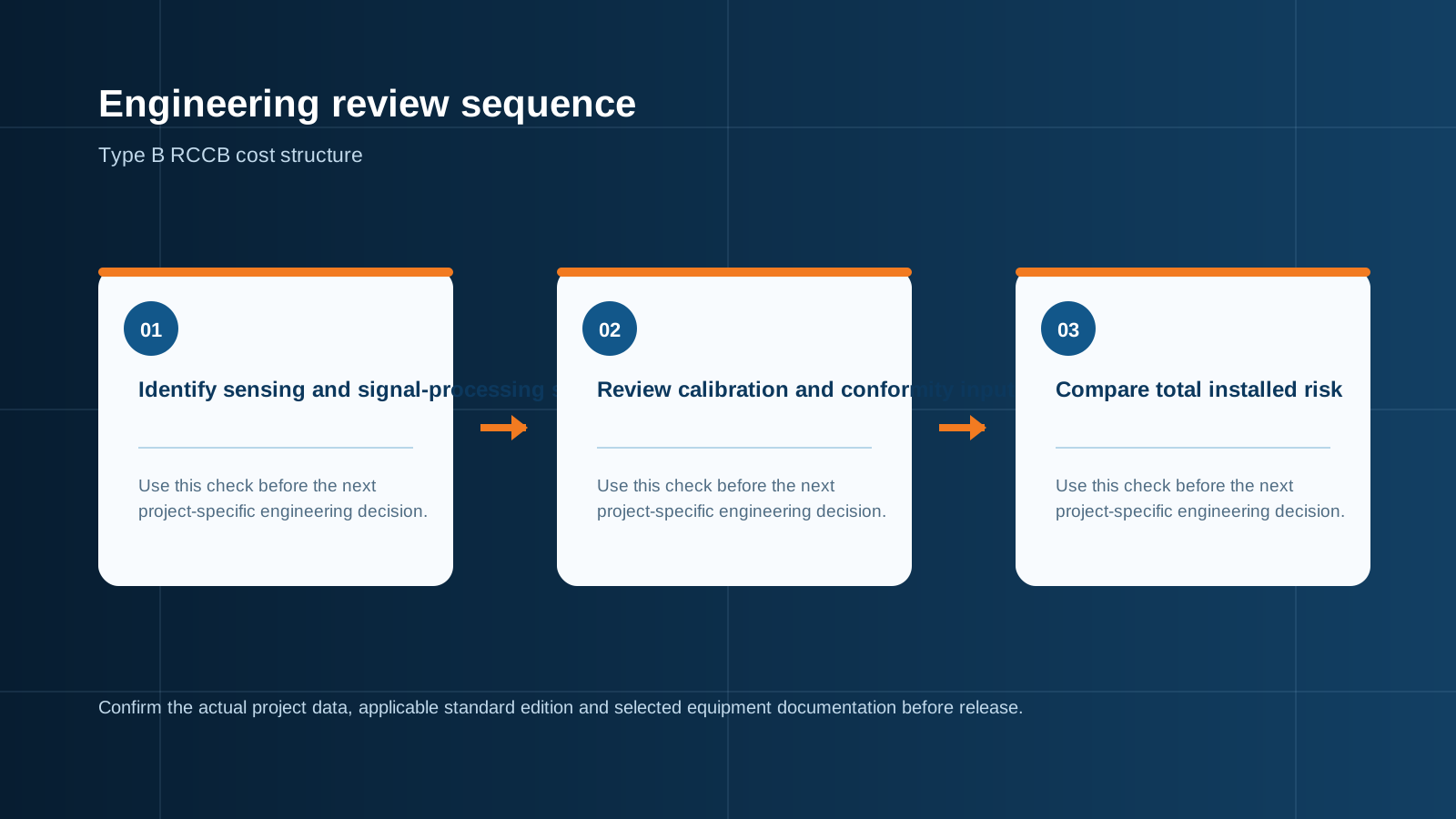
Technical diagram shown at a readable responsive scale.
4. Market price tiers and what separates them
Quotations for a nominally identical Type B device can differ by a factor of three. The differences are usually real and traceable to the specification.
Table 2 — Type B price tiers, indexed to a comparable Type A device = 1.0
Three questions separate a genuine Type B from an optimistic data sheet: which frequency range was actually tested, what is the tripping tolerance for smooth DC residual current, and what happens if the internal supply or the sensor fails — does the device annunciate the fault, or does it silently stop protecting? A device that fails quietly is worse than no device, because it removes the incentive to investigate.
5. Total cost of ownership beyond the purchase price
The purchase price is normally the smallest number in the lifetime cost of residual current protection.
- Nuisance tripping. Standing leakage from inverters and filters accumulates. A device set too sensitively, or a circuit loaded with too many electronic supplies, will trip without a fault. On a charging hub or a production line, one unnecessary trip can cost more than the device.
- The blinding effect. This is the decisive technical argument. A smooth DC residual current pushes the sensing core of a Type AC or Type A device towards saturation. The device may then fail to trip on a genuine AC earth fault, while still looking perfectly healthy — including when the test button is pressed, because the test circuit does not reproduce the DC bias.
- Liability. Where regulations require Type B protection and a lower type was fitted, the installation is non-compliant, and that is a difficult position to defend after an incident.
- Discrimination. One Type B device on a main feeder is cheaper, but a single trip then disconnects everything downstream. The economics usually favour Type B at the circuits that need it, with time-delayed protection upstream.
- Retrofit cost. Adding Type B protection after commissioning means panel modification, downtime and re-certification.
6. Specify Type B where it is needed, and only there
Over-specification wastes budget and board space; under-specification removes protection. Match the type to the load technology.
Table 3 — Matching residual current type to the load
Procurement checklist: confirm the certificate references IEC 62423 for the exact rating and pole configuration; get the tested frequency range and DC tripping tolerance in writing; check module width against board space; and verify discrimination with the upstream device.
NEUTRON supplies residual current protection across the range — miniature devices, moulded case residual current circuit breakers to IEC 60947-2 Annex B for feeders up to 800 A, and electronic protection with adjustable delay for TT networks — built into distribution boards and assemblies verified to IEC 61439-1/-2, with the specified Type B devices integrated where the project requires them.
Media and assets
Placement plan for the /insights article template:
IMAGE PROMPT — Hero:
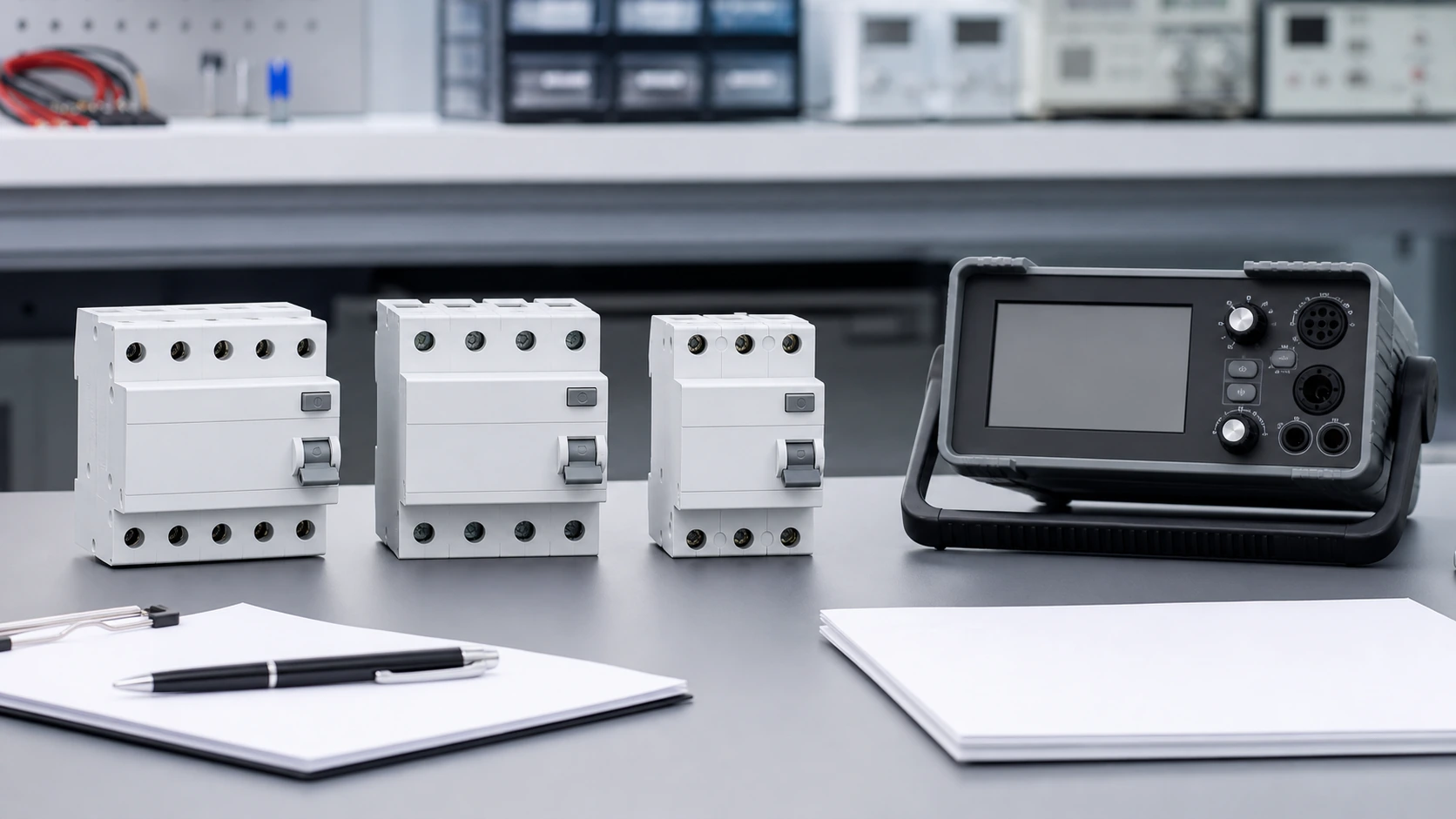
Subject: four-pole residual current devices mounted in an open industrial distribution board feeding inverter and charging circuits, thick outgoing cables below
Style: clean industrial B2B product photography
Details: white and grey DIN-rail devices, four-pole widths, printed circuit labels, orange and black outgoing cables, copper neutral bar, no branding
Background: plain light-grey studio sweep
Lighting: soft even studio lighting
Aspect ratio: 16:9
No text, no logos unless specified.
IMAGE PROMPT — Section 1:
Subject: technical comparison diagram showing a passive toroidal residual current sensor next to an actively excited fluxgate sensor with excitation winding, amplifier and microcontroller
Style: flat technical line diagram, two-colour engineering drawing
Details: two side-by-side blocks, labelled windings and signal paths, annotation for AC-only detection versus AC plus smooth DC detection
Background: plain white
- Hero image, 16:9, under the H1 — four-pole residual current devices in a distribution board serving inverter and charging circuits.
- Inline technical diagram after Section 1, 4:5 — passive toroidal sensing versus active fluxgate sensing.
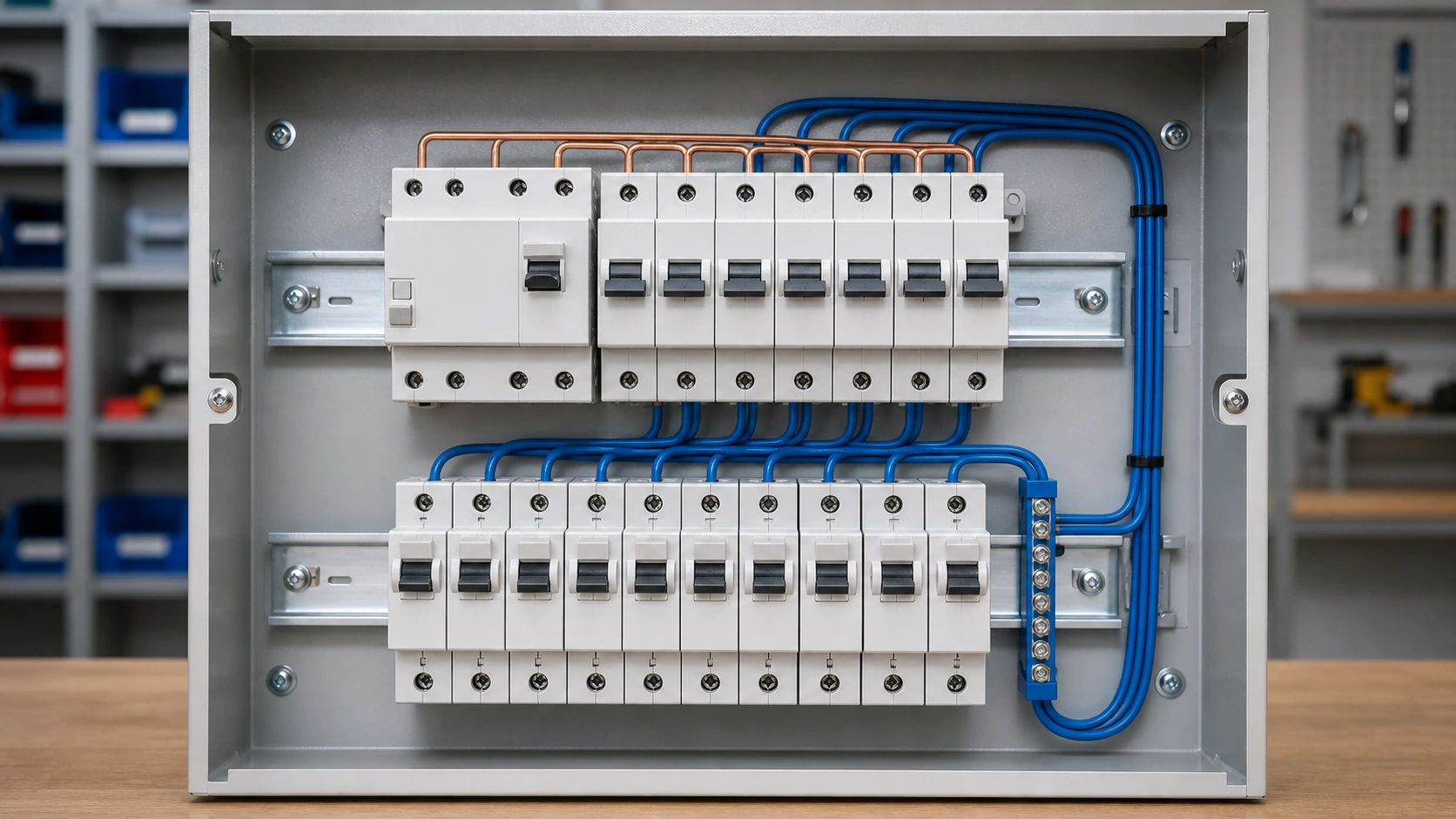
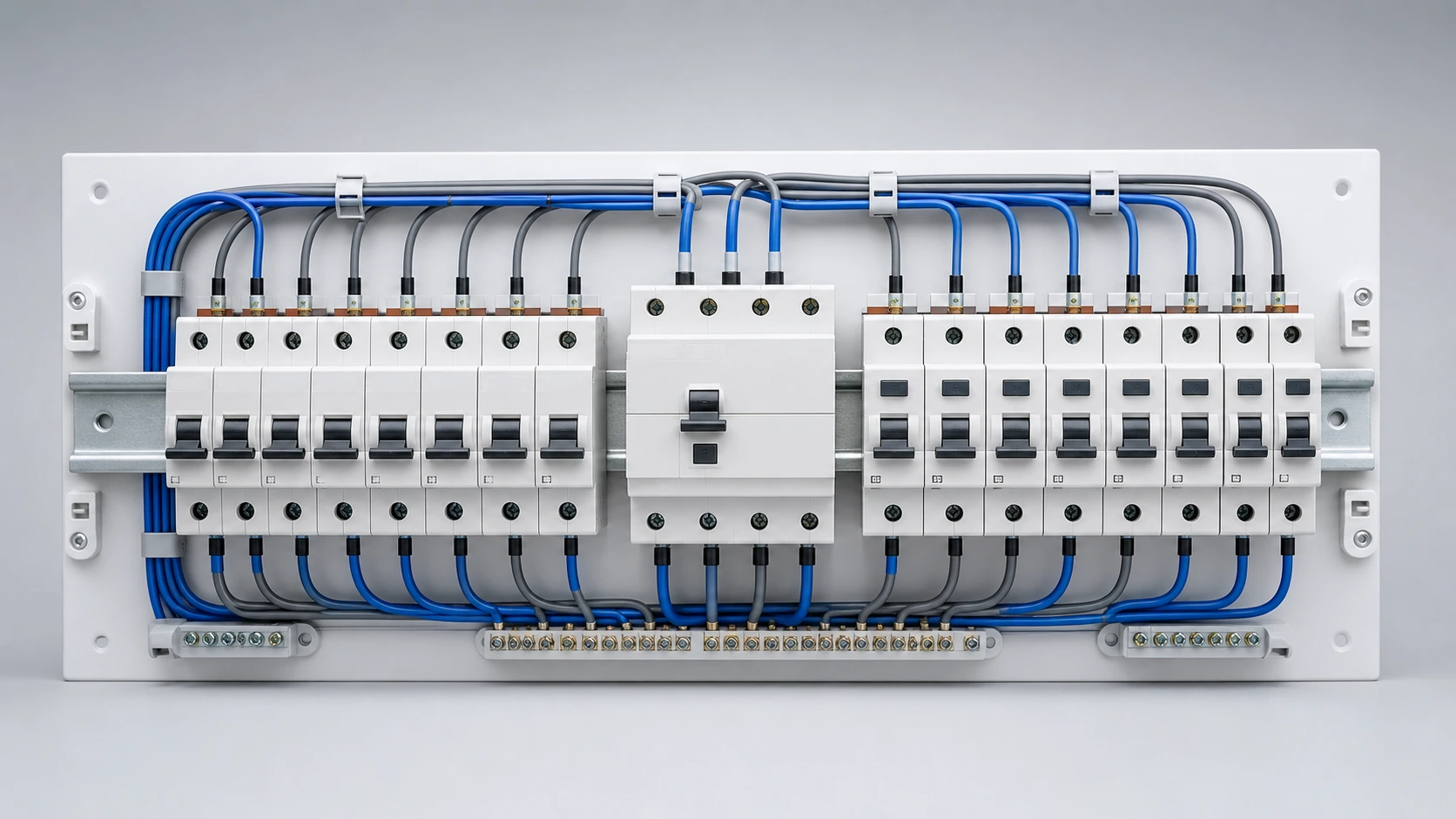
- Inline image after Section 5, 1:1 — panel interior with mixed device types and clear labelling.
- Tables 1 to 3 rendered as responsive tables inside Sections 3, 4 and 6.
- CTA block at the end of the article, full width.
FAQ
Q: Why is a Type B RCCB so much more expensive than a Type A?
A: Because it is a fundamentally different device. Detecting smooth DC residual current requires an actively excited fluxgate sensor, a microcontroller with validated firmware, an auxiliary supply and per-unit calibration, all certified to IEC 62423 and produced in far lower volumes. Typical market pricing runs five to fifteen times a comparable Type A.
Q: Can I use a Type A device instead of a Type B to save money?
A: Not where a smooth DC residual current can occur. DC leakage biases the sensing core of a Type A device towards saturation, so it may fail to trip even on an ordinary AC earth fault. The device continues to look healthy and the test button still works, which makes the failure particularly dangerous.
Q: Does every EV charging point need a Type B device?
A: No. Where the charging equipment includes certified 6 mA DC residual current detection, a Type A device upstream is generally acceptable. Where it does not, Type B protection is required. Confirm the requirement against the charging equipment data sheet and the national wiring regulations for the destination market.
Q: What should I check before accepting a low Type B quotation?
A: Ask for the IEC 62423 certificate covering the exact rating and pole configuration, the tested frequency range, the tripping tolerance for smooth DC residual current, and the behaviour of the device if the internal supply or sensor fails. Large price gaps usually reflect real differences in these four points.
Q: Is one Type B device on the main incomer enough?
A: It is compliant in some designs but poor practice for availability, because any earth fault then disconnects the whole installation. The usual arrangement is Type B protection on the circuits that need it, with a time-delayed device upstream to achieve discrimination.
Q: Can NEUTRON supply boards with Type B protection fitted?
A: Yes. NEUTRON builds distribution boards and low voltage assemblies verified to IEC 61439 with the specified residual current devices installed, wired, labelled and documented, including the discrimination study and the board space required for wider Type B modules.
Request a quote
Specifying residual current protection for charging, photovoltaic or drive circuits? Send your circuit schedule, load technologies and destination-market regulations. NEUTRON engineers will confirm the required residual current types and sensitivities, propose a discrimination scheme, and quote the devices loose or fully integrated into a distribution assembly.
Structured data
CODE: JSON-LD — paste inside <script type="application/ld+json"> tags in the article head (three separate blocks).
CODE:
"@context": "https://schema.org",
"@type": "Article",
"headline": "Understanding Type B RCCB Pricing: A Cost Structure Guide",
"description": "Why Type B RCCBs cost several times a Type A: fluxgate sensors, firmware, calibration yield and IEC 62423 certification, plus total cost of ownership.",
"inLanguage": "en",
"mainEntityOfPage": {
"@type": "WebPage",
"@id": "https://neutronele.com/insights/understanding-type-b-rccb-pricing"
"author": {
"@type": "Organization",
"name": "NEUTRON",
"url": "https://neutronele.com/"
Engineering decision map
Use this compact sequence to review the approved guidance in order. Confirm actual ratings, interfaces, applicable standard editions and selected equipment documentation before final specification or release.
Technical diagram shown at a readable responsive scale.
This is general technical guidance, not a substitute for local electrical code, the applicable standard, product datasheets or a qualified engineer's design review. Confirm ratings and final configurations against the actual project.
Bring the project inputs to the first review.
NEUTRON can review the application context, electrical envelope, enclosure conditions and document requirements related to understanding type b rccb pricing: a cost structure guide before quotation.
Discuss a technical requirementContinue learning
Explore related technical guidance in Electrical Protection.
Technical note: source article content is retained for educational use. Applicable standards, ratings, protection coordination and final configurations must be confirmed for the actual project and destination market.