

1. Why the supplier decision carries more risk than the product decision
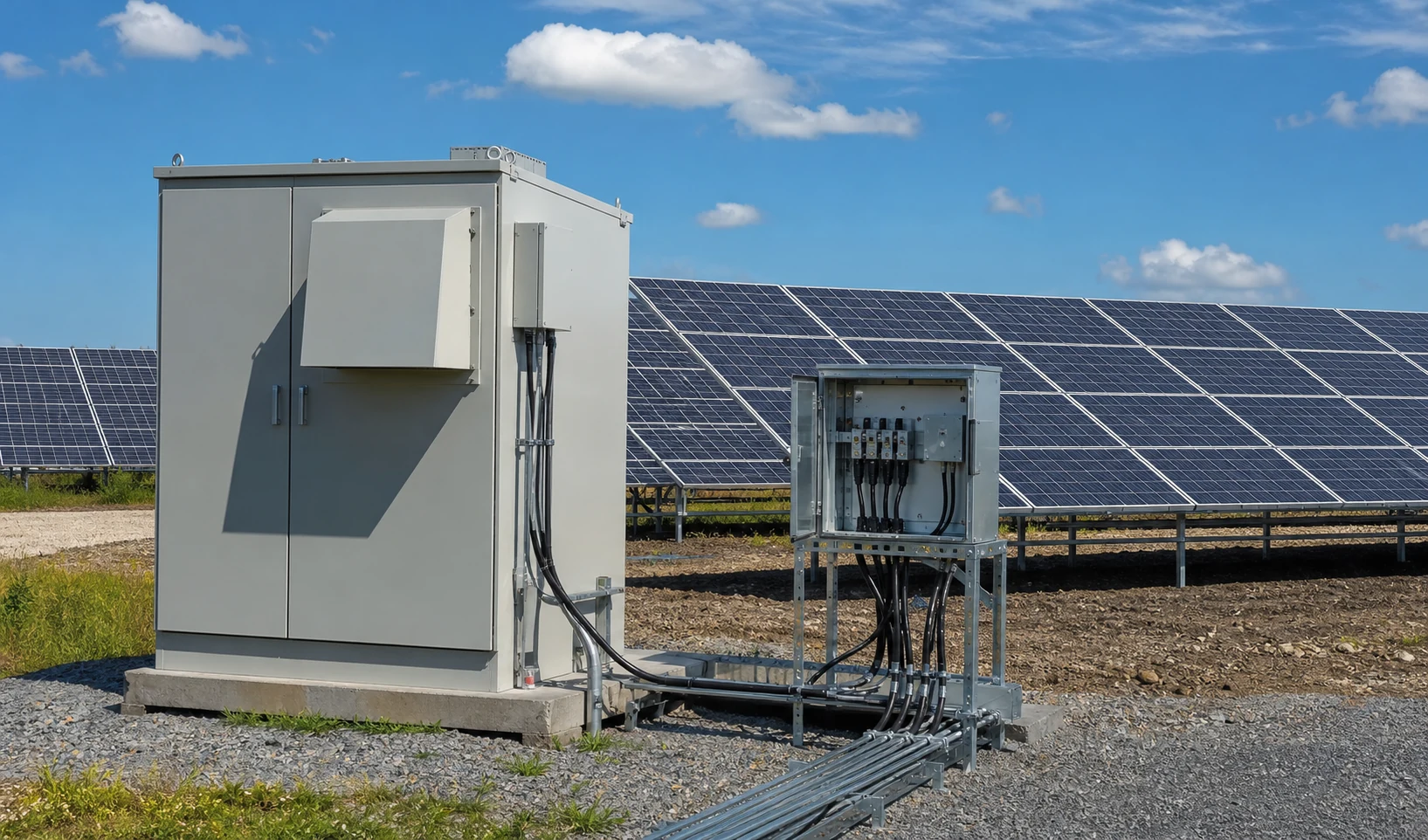
A combiner box is a low-value item in a PV plant budget and a high-value item in a PV plant risk register. It sits outdoors, carries full array current, contains the only DC overcurrent protection in the string circuit, and is rarely inspected after commissioning.
The failure modes are quiet. A fuse holder with poor contact pressure heats slowly for two summers before it carbonises. A surge module without a thermal disconnector fails short and sustains a DC arc. A gland that does not match the cable diameter admits water that tracks along the conductor into the terminal block. None of these are visible in a product photograph, and none are covered by a generic type-test certificate.
This is why the evaluation has to be of the manufacturer, not the model. Two boxes with identical published ratings can differ by an order of magnitude in field reliability depending on component selection, assembly discipline and whether every unit is actually tested before it ships.
2. Criteria 1 to 3 — manufacturing model, components and protection design
Criterion 1: Is the company a manufacturer or an assembler? Ask what is made in-house. A genuine manufacturer will have sheet-metal fabrication, powder coating, busbar processing and its own assembly and test lines. Ask for the address of the production site, the number of assembly lines, and whether enclosure fabrication and coating happen under the same roof. A trading company can still deliver a good product, but the quality control chain is longer and slower to correct.
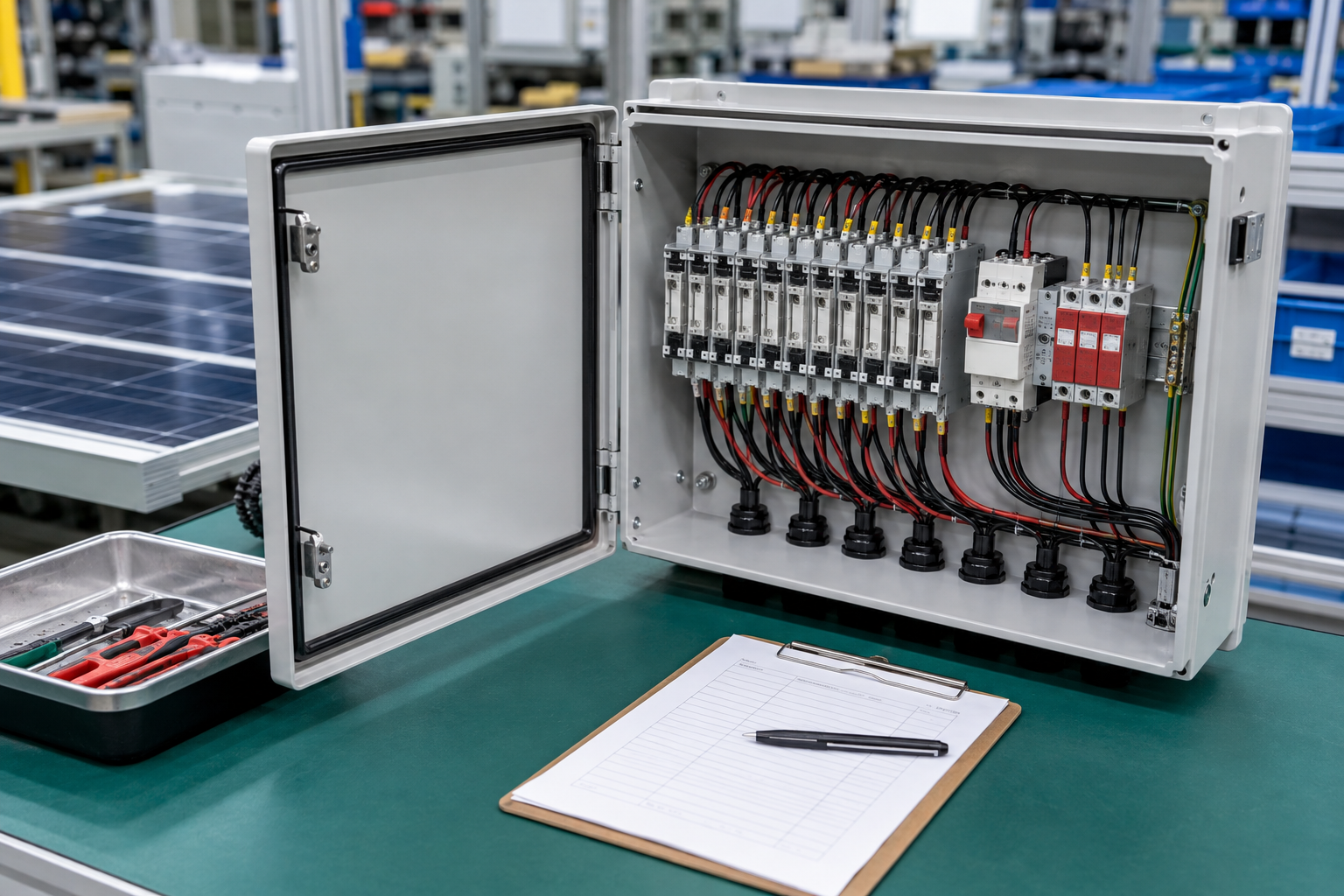
Criterion 2: Are the internal components DC-rated? This is where cost is quietly removed. Every switching and protective device in the DC circuit must carry a DC rating, not an AC rating with a DC footnote. Ask for the brand and part number of the fuse holders, the DC isolator and the surge modules, and check those part numbers against the component maker's own datasheet.
Criterion 3: Does the protection design follow explicit rules? A competent supplier will state its sizing rules without being prompted: fuses at 1.25 x Isc or above on both incoming and outgoing terminations, blocking diodes where fitted rated at 2 x Uoc (STC) or above in reverse, surge protection on both PV+ and PV- with In (8/20 us) of 10 kA or more, surge maximum continuous operating voltage above 1.2 x Uoc (STC), and surge modules with an integral disconnector and fault indication. A supplier that cannot recite these is not designing, it is copying.
| Field | Value | Chars |
|---|---|---|
| Title tag | Solar Combiner Box Manufacturers in China: 10 Checks | 52 |
| Meta description | A 10-point framework for evaluating solar combiner box manufacturers in China: factory capability, DC components, IEC testing, IP rating and QC evidence. | 153 |
| Slug | top-10-solar-combiner-box-manufacturers-in-china | |
| Primary keyword | solar combiner box manufacturers in china | |
| Search intent | Commercial investigation — international buyer building a supplier shortlist for PV DC combiner boxes | |
| Schema type | Article + FAQPage + BreadcrumbList | |
| Canonical path | /insights/top-10-solar-combiner-box-manufacturers-in-china |
3. Criteria 4 to 6 — enclosure capability, testing and certification
Criterion 4: What protection classes can the factory actually build? Not every workshop can hold an IP65 seal in production. Ask which protection classes are routinely produced, what gasket material is used, how unused cable entries are blanked, and what enclosure materials are available. A capable supplier will offer cold-rolled steel, galvanised steel and stainless steel, with powder coating to a stated colour standard such as RAL 7035.
Criterion 5: Is every unit tested, or only the first one? This is the single most discriminating question in the evaluation. Ask for a blank copy of the routine inspection report. A serious report covers appearance and structure, nameplate content, live-parts warning marking, lock and door operation, terminal marking (PV+, PV-, PE), earth marking in yellow-green, insulation resistance on the main circuit and on secondary wiring, earth continuity, clearance and creepage, fuse and surge verification, protection class verification, and packing contents.
Criterion 6: Is the certification scope real and current? Check that the certificate covers the product family you are buying and is still valid. Expect IEC 61439 for assembly practice, IEC 60947 for the switching devices, IEC 60529 for protection class, CE and CB for export markets, and quality-system certification such as ISO 9001, with ISO 14001 and ISO 45001 as further indicators of process maturity.
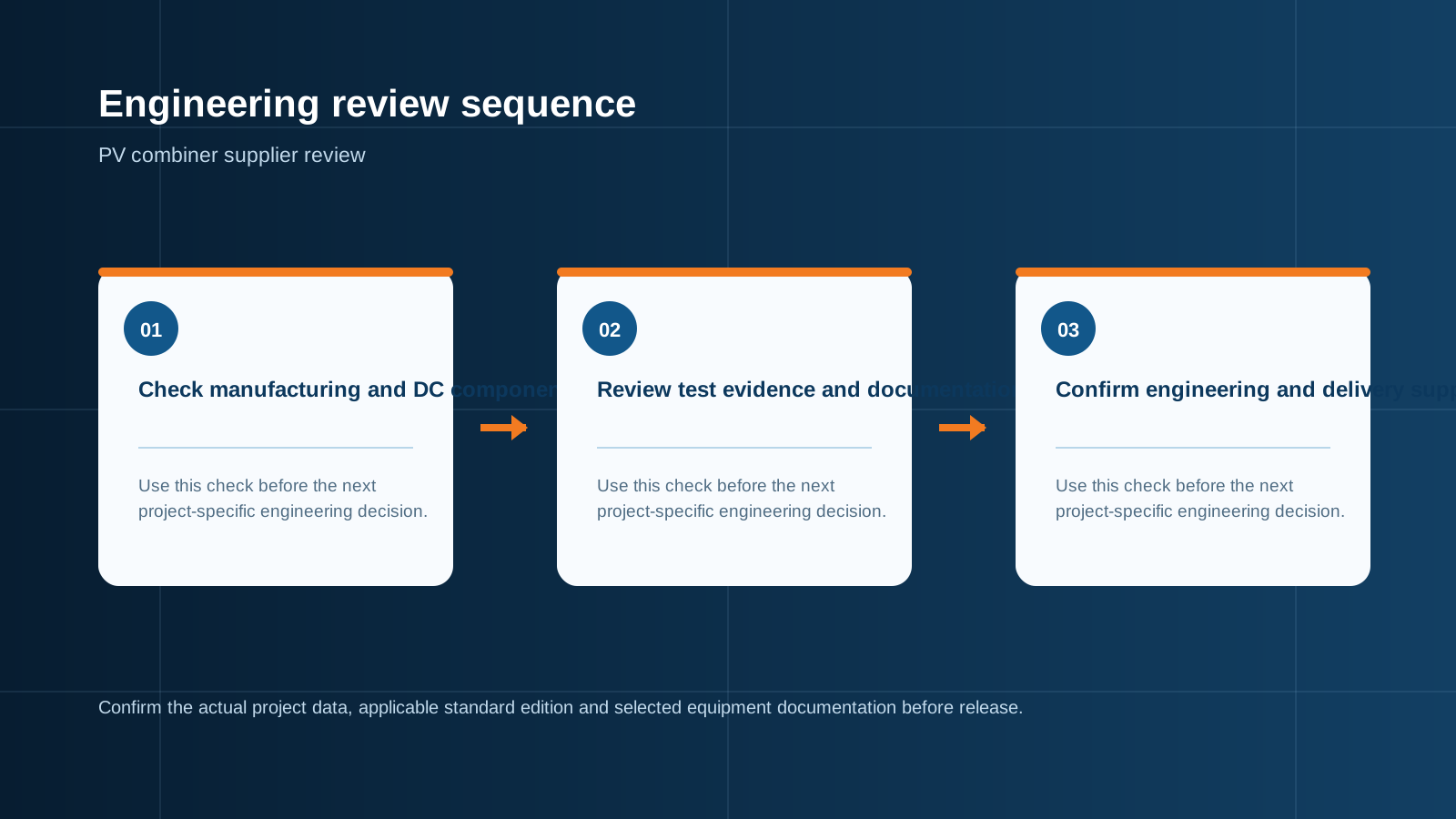
Technical diagram shown at a readable responsive scale.
4. The 10-point evaluation table
Use the table below as a scoring sheet during factory audit or supplier questionnaire. Each criterion should be answered with evidence, not with a claim.
Ten-point supplier evaluation framework for PV DC combiner boxes.
5. Criteria 7 to 10 — engineering, customisation, logistics and support
Criterion 7: How does the supplier answer a technical question? Send one specific query during evaluation — for example, ask how they would size fuses for a module with an Isc of 13.8 A across 20 strings at a site with a -15 C winter minimum. A supplier with engineering capability will answer with numbers and assumptions. A supplier without it will answer with a catalogue page.
Criterion 8: Can they build to your drawing? Real projects rarely fit catalogue configurations. Ask whether the supplier will build to your single-line diagram, adjust input count and busbar rating, change the isolator type, add or remove monitoring, and modify gland layout for your cable schedule. Customisation depth is the clearest indicator of whether the factory has genuine engineering staff.
Criterion 9: What arrives in the crate? Packing quality determines how much of the product survives the container. Confirm the packing standard, external marking (factory name, model, specification, weight), and that each unit ships with a packing list, warranty card, conformity certificate, wiring or schematic diagram, and any accessories or special tools. A missing schematic diagram costs a day on site.
Criterion 10: What happens after commissioning? Ask about warranty period and scope, availability of replacement surge cartridges and fuse links, lead time for spares, and whether the supplier can supply matching downstream equipment later. Suppliers that also build AC distribution and grid-connection equipment can support the plant beyond the combiner box itself.
6. A practical shortlisting process
Rather than ranking suppliers by reputation, run a structured filter. It takes about two weeks and removes most of the risk.
- Week 1, filter one: Issue an identical technical enquiry to eight to ten candidates, including your array data and site conditions. Discard anyone who replies with a price but no technical questions.
- Week 1, filter two: Request the routine inspection report template and the certificate set. Discard anyone offering a type-test certificate in place of per-unit testing.
- Week 2, filter three: Ask for the component part numbers and verify them against the component maker's datasheets. Discard anyone using AC-rated devices in the DC circuit.
- Week 2, filter four: Request a sample unit or a video factory audit covering fabrication, assembly and the test bench. Confirm the test equipment exists and is calibrated.
- Award stage: Compare the remaining two or three on lead time, packing standard, spares policy and total landed cost — not on unit price alone.
7. Where NEUTRON fits against this framework
NEUTRON manufactures PV DC combiner boxes and PV grid-connection cabinets alongside a full low-voltage assembly range, and answers the framework above with documentation rather than description.
Every DC combiner box is shipped with a factory inspection report prepared against GB/T 34936 and GB/T 34933, covering appearance and structure, nameplate and warning marking, terminal and earth marking, insulation resistance on main and secondary circuits, earth continuity, clearance and creepage, fuse and surge device verification, protection class and packing completeness. Assembly practice follows IEC 61439, switching devices follow IEC 60947, and protection class is verified to IEC 60529.
Boxes are built to project drawings: configurable input count and busbar rating, DC fuse rating selected against measured Isc, DC load-break isolation, output surge protection with thermal disconnector and status indication, optional blocking diodes, optional monitoring with RS485 Modbus-RTU and channel current and bus voltage display, and enclosure classes from IP20 indoor to IP65 for sand and coastal exposure in cold-rolled, galvanised or stainless steel with RAL 7035 powder coating.
Because the same factory produces GGD and GCS low-voltage assemblies, XL-21 power distribution cabinets, capacitor and metering panels, transfer switch cabinets and package substations, a combiner box order can be extended into the full DC-to-grid chain without adding a second supplier.
8. Limitations of any supplier framework
No evaluation framework substitutes for a contract. Fix the technical specification, inspection regime, acceptance criteria and remedy for non-conformity in writing before placing an order, and state which standard governs in a dispute.
Confirm destination-market obligations separately. Wiring rules, product listing requirements, rapid-shutdown provisions and grid-connection conditions vary by country and remain the responsibility of the project designer.
Media / Assets
Placement plan for the /insights article layout:
IMAGE PROMPT — Hero:
Subject: wide view of a low-voltage switchgear and combiner box assembly line inside a modern Chinese electrical equipment factory
Style: clean industrial B2B documentary photography
Details: rows of grey powder-coated steel enclosures on assembly benches, technicians in uniform working on internal wiring, overhead lighting, organised component bins
Background: bright factory floor with clear aisles
Lighting: even industrial daylight-balanced lighting
Aspect ratio: 16:9
No text, no logos unless specified.
IMAGE PROMPT — Section 2:
Subject: close-up of DC fuse holders, a DC load-break isolator and surge protection modules mounted on a backplate inside a PV combiner box
Style: macro industrial product photography
Details: cylindrical fuse carriers, rotary DC isolator handle, plug-in surge cartridges with status windows, tinned copper busbar
Background: shallow depth of field enclosure interior
- Hero image, 16:9, top of article
- Inline image 1, 4:5, inside Section 2 (components) — DC fuse holders and isolator detail
- Inline image 2, 16:9, inside Section 3 (testing) — factory test bench with insulation tester
- Inline image 3, 1:1, inside Section 7 (NEUTRON) — combiner box exterior, closed, IP65
- 10-point evaluation table rendered as a 4-column responsive table in Section 4
- FAQ rendered as Q/A accordion items
- CTA block at the end of the article
FAQ
Q: What is the single most useful question to ask a combiner box manufacturer?
A: Ask for a blank copy of their routine per-unit inspection report. Suppliers that test every unit will send it immediately. Suppliers that test only a first article will offer a type-test certificate instead.
Q: How do I verify a factory is real without travelling?
A: Request the production site address, a live video walkthrough covering sheet-metal fabrication, coating, assembly and the test bench, and the calibration records for the test instruments used.
Q: What certifications should a PV combiner box carry?
A: IEC 61439 for assembly practice, IEC 60947 for switching devices and IEC 60529 for protection class, plus CE and CB for export markets and ISO 9001 quality-system certification for the manufacturer.
Q: Is a cheaper combiner box ever the right choice?
A: Only when the specification is identical and verified. Price differences in this category usually reflect component grade, protection class capability and whether per-unit testing is performed, all of which affect field reliability.
Q: Should I order combiner boxes and AC distribution from the same supplier?
A: It simplifies drawings, inspection and warranty. A manufacturer that also builds low-voltage assemblies, grid-connection cabinets and package substations can supply the whole DC-to-grid chain under one specification.
Q: What documents should ship with each unit?
A: A packing list, conformity certificate, warranty card, wiring or schematic diagram, the routine inspection report for that serial number, and any accessories or special tools noted on the packing list.
Call to action
Run the ten-point framework against NEUTRON. Send your array data and site conditions, and engineering will return a configured PV DC combiner box specification together with the inspection report template used for your order.
Structured data (JSON-LD)
CODE: paste inside <script type="application/ld+json"> in the page head.
CODE: {
"@context": "https://schema.org",
"@graph": [
"@type": "Article",
"headline": "How to Evaluate Solar Combiner Box Manufacturers in China: A 10-Point Framework",
"description": "A 10-point framework for evaluating solar combiner box manufacturers in China: factory capability, DC components, IEC testing, IP rating and QC evidence.",
"inLanguage": "en",
"author": {
"@type": "Organization",
"name": "NEUTRON"
"publisher": {
"@type": "Organization",
"name": "NEUTRON",
Engineering decision map
Use this compact sequence to review the approved guidance in order. Confirm actual ratings, interfaces, applicable standard editions and selected equipment documentation before final specification or release.
Technical diagram shown at a readable responsive scale.
This is general technical guidance, not a substitute for local electrical code, the applicable standard, product datasheets or a qualified engineer's design review. Confirm ratings and final configurations against the actual project.
Bring the project inputs to the first review.
NEUTRON can review the application context, electrical envelope, enclosure conditions and document requirements related to how to evaluate solar combiner box manufacturers in china: a 10-point framework before quotation.
Discuss a technical requirementContinue learning
Explore related technical guidance in Solar PV.
Technical note: source article content is retained for educational use. Applicable standards, ratings, protection coordination and final configurations must be confirmed for the actual project and destination market.