
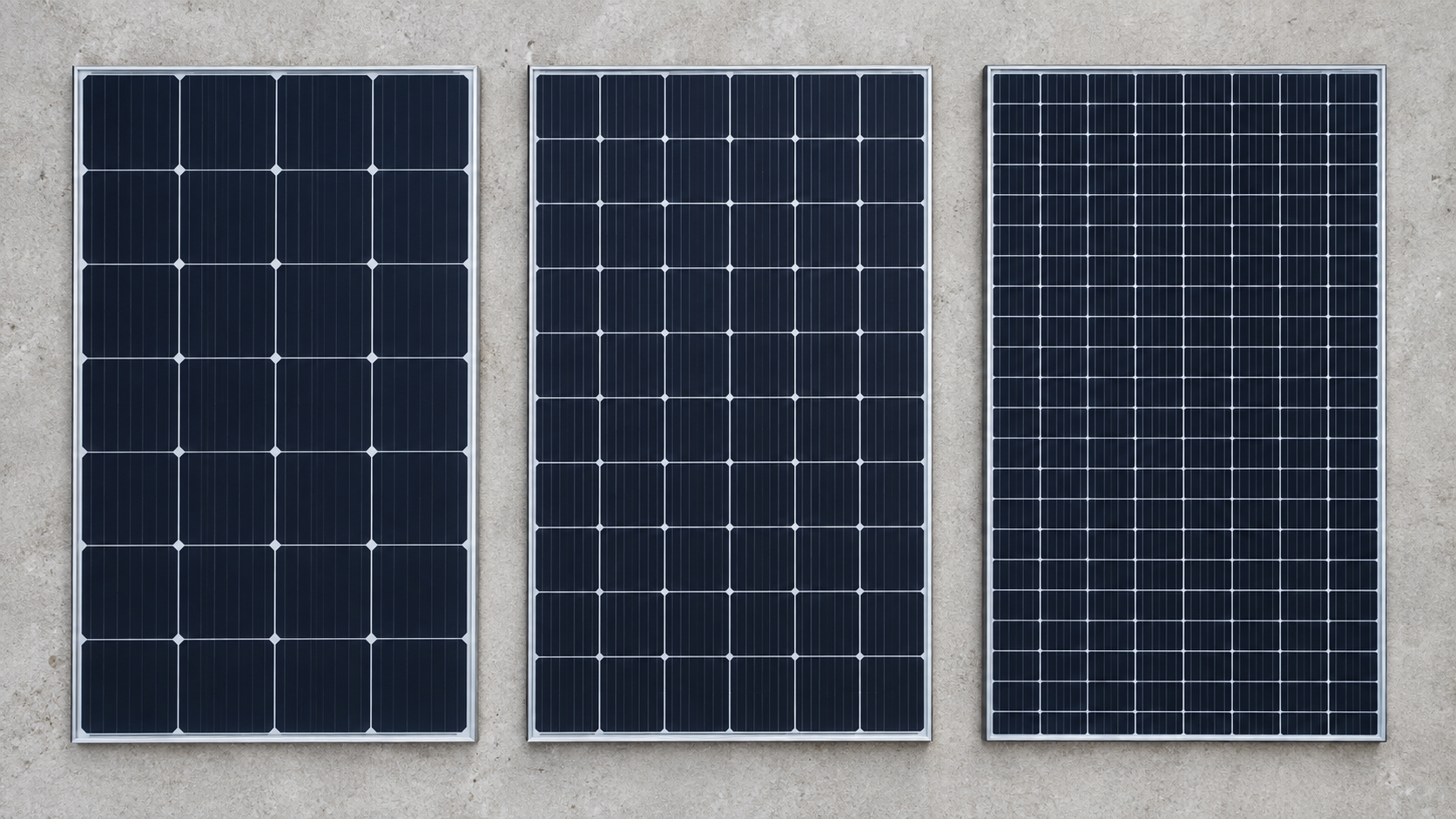
Why cell count matters
The number of cells in a panel sets its voltage, physical size and how it fits a string. A 60-cell residential panel and a 144-cell half-cut module behave very differently in the same array design.
Because cell count drives panel voltage, it also drives how many panels fit in a string and therefore how the combiner box and DC protection are specified. It is a first-order design input, not a detail.
Technical diagram shown at a readable responsive scale.
60-cell and 72-cell panels
Traditional full-cell panels come in 60-cell (residential) and 72-cell (commercial) layouts. A 60-cell panel delivers roughly 30 to 40 V open-circuit, while a 72-cell panel reaches about 45 to 50 V.
These voltages set the baseline for string math: more cells per panel means fewer panels needed to hit the inverter's voltage window, which simplifies the combiner layout.
Half-cut: 120 and 144 cells
Half-cut technology slices each cell in two, so a 60-cell equivalent becomes 120 half-cells and a 72-cell becomes 144. The panel's external voltage stays similar, but internal losses drop and shading tolerance improves.
A 144-cell half-cut panel keeps about the same voltage as a 72-cell full-cell version yet runs cooler and harvests better under partial shade — a popular commercial choice.
Technical diagram shown at a readable responsive scale.
Voltage and size differences
Cell count tracks with panel length: 60-cell panels are compact for rooftops; 72 and 144-cell panels are longer and better suited to ground mounts and large commercial roofs with crane access.
Because voltage scales with cell count, a 72-cell panel reaches the inverter window with fewer units per string than a 60-cell panel, changing both the wiring plan and the combiner input count.
Which fits residential vs commercial
Residential roofs favour 60-cell or 120-cell half-cut panels for weight, handling and roof fit. Commercial and utility sites use 72-cell or 144-cell layouts to reduce panel count and balance-of-system complexity.
The decision is mostly mechanical, but it feeds straight into electrical design: pick the panel, read its voltage, then size strings and the combiner box around it.
Impact on string voltage
String voltage equals panel Voc times panels in series. A higher-voltage panel (more cells) reaches the target string voltage with fewer panels, while a lower-voltage panel needs more in series to fill the MPPT window.
Cold-weather Voc still applies regardless of cell count, so the limit on panels per string comes from the panel's own voltage multiplied by the coldest-condition coefficient.
Combiner and protection implications
Fewer, higher-voltage strings mean fewer combiner inputs but the same total current; more, lower-voltage strings mean more inputs and a busier box. Either way, each string needs its own gPV fuse.
NEUTRON combiner boxes are specified from the chosen panel's voltage and current: input count, fuse rating per string, and output busbar sized for the summed current your cell-count decision produces.
Choosing cell count for your array
Match cell count to your roof or site: 60/120 for homes, 72/144 for commercial. Then let the panel's actual Voc and Isc drive string length, fuse sizing and combiner selection rather than a fixed rule.
The cell count is the starting point; the datasheet numbers are what NEUTRON uses to build a combiner box and DC protection layer that fits the array you install.
This is general technical guidance. Confirm final ratings, protection coordination, installation and applicable local requirements against current standards, manufacturer documentation and the approved project design.
Frequently asked questions
60 or 72 cell — which is better?
Neither is universally better. 60-cell panels suit residential roofs for size and weight; 72-cell panels suit commercial sites and need fewer panels per string. Choose by roof type, then design the BOS around the panel's voltage.
What are 144-cell panels?
They are 72-cell panels built with half-cut cells, giving 144 half-cells. External voltage is similar to a 72-cell panel, but losses drop and shading tolerance improves, making them popular for commercial arrays.
Does cell count change voltage?
Yes. More cells mean higher panel voltage, so fewer panels are needed per string to reach the inverter's window. Cold-weather Voc still sets the maximum panels per string regardless of count.
How does cell count affect the combiner?
Higher-voltage panels mean fewer strings and fewer combiner inputs; lower-voltage panels mean more strings and a busier box. Each string still needs its own gPV fuse, and the output busbar is sized for total current.
Discuss your PV requirement
Share the system voltage, string arrangement, inverter interface and installation environment. NEUTRON can review the equipment configuration around your project documentation.
Discuss a projectContinue learning
Explore related technical guidance in Solar PV.



Published from the approved Period 06 source package. Technical values and final design decisions must be verified against the current applicable standard, manufacturer documentation and approved project design.