
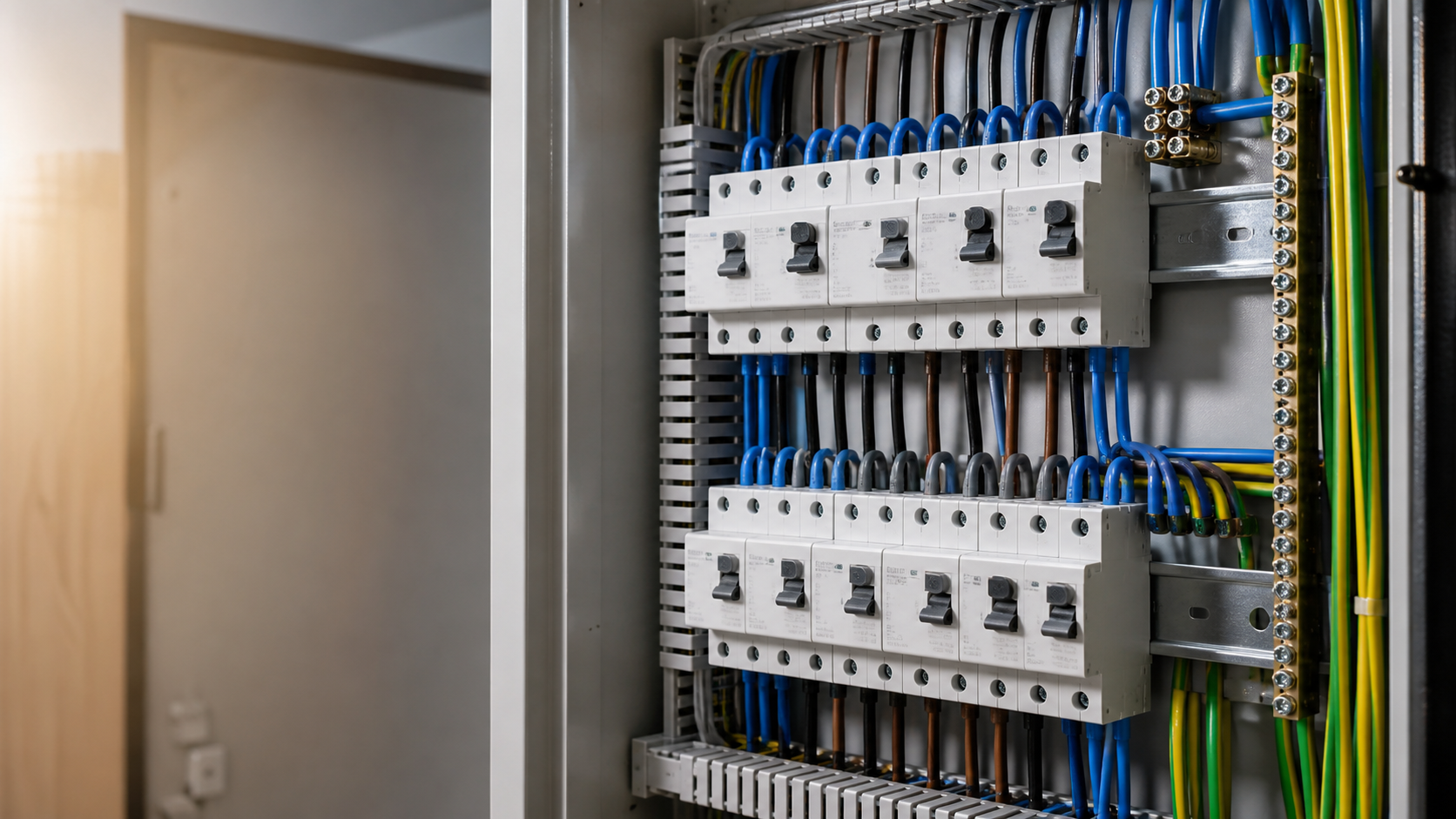
What RCCB means
In a healthy circuit, every ampere leaving through the line conductor returns through the neutral, so the vector sum through the sensing core is effectively zero. Leakage through damaged insulation, moisture or a person creates a residual current that the device can detect.
- RCCB: residual-current and earth-fault protection.
- MCB: overload and short-circuit protection.
- RCBO: residual-current, overload and short-circuit protection in one device.
How an RCCB works
All live conductors pass through a toroidal, zero-sequence current transformer. Balanced currents cancel magnetically. An imbalance creates a secondary signal that releases the operating mechanism and opens the contacts.
The test button creates a deliberate imbalance to check the trip mechanism. It does not prove that the device can detect every waveform produced by every modern load.

The specifications that define an RCCB
An enquiry should state more than the word RCCB. Confirm the continuous current, residual threshold, non-operating current, poles, short-circuit coordination and waveform type.
- Rated current (In): continuous current the device can carry.
- Rated residual operating current: often 30 mA, 100 mA or 300 mA, depending on the protection objective.
- Residual non-operating current: commonly half the operating threshold, limiting nuisance trips from standing leakage.
- Pole count: 1P+N, 2P, 3P or 4P to match the supply and neutral arrangement.
- Breaking capacity and backup protection: the RCCB must be coordinated with the device that clears overcurrent.
- Type AC, A, F or B: the residual-current waveform the device can detect.
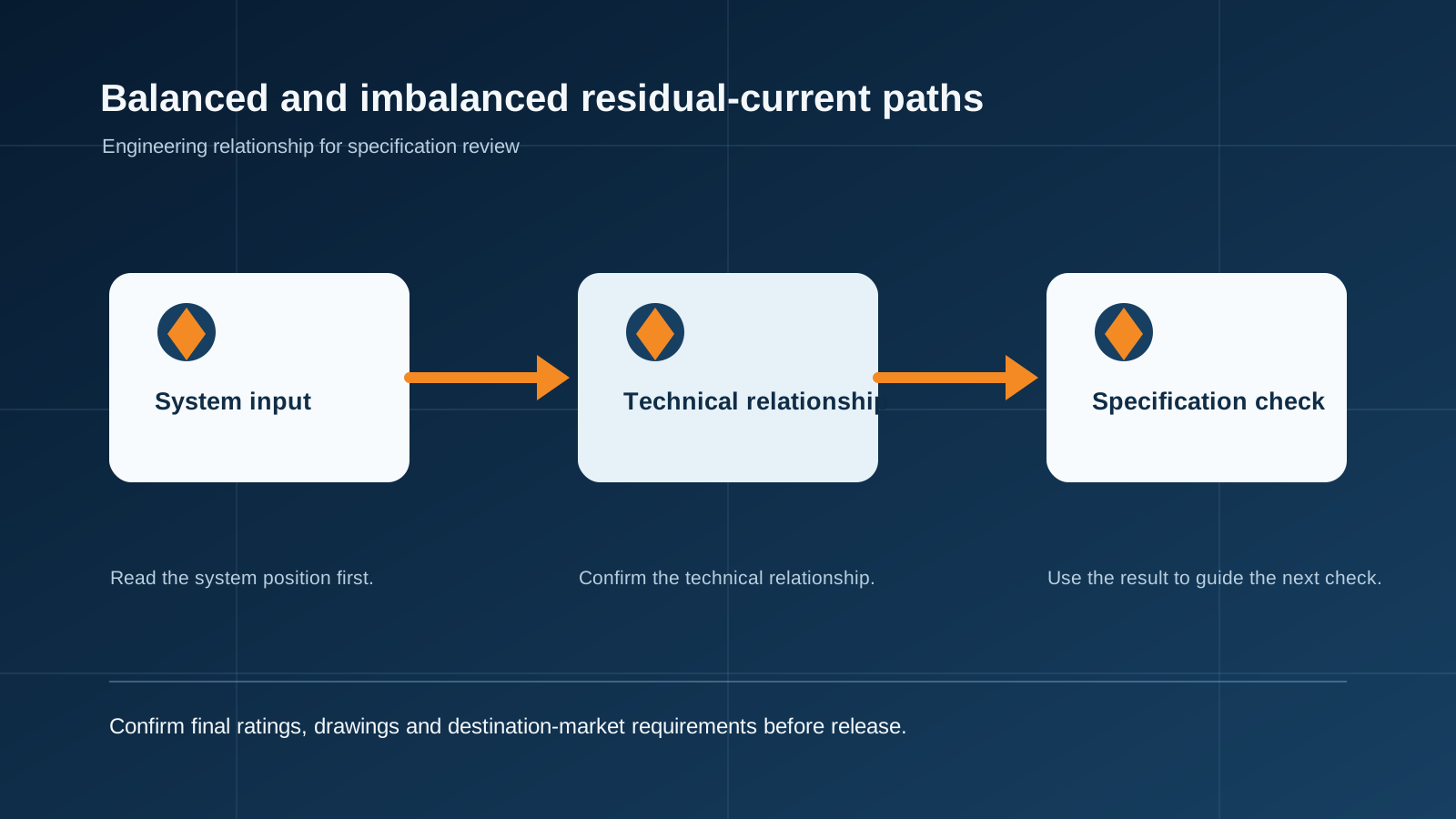
Technical diagram shown at a readable responsive scale.
Type AC, A, F and B
Type AC detects sinusoidal AC, Type A adds pulsating DC, Type F adds mixed-frequency behavior and Type B also detects smooth DC. Modern electronic loads make type selection a functional requirement, not a product-quality ranking.
| Type | Detects | Typical application |
|---|---|---|
| AC | Sinusoidal AC | Compatible legacy or resistive circuits where permitted |
| A | AC plus pulsating DC | Many modern electronic circuits |
| F | Type A plus mixed-frequency components | Selected single-phase drives |
| B | Type F plus smooth DC | PV, EV and storage applications where required |
RCCB vs MCB vs RCBO
An RCCB protecting several downstream circuits can disconnect all of them when one circuit leaks. An RCBO on each circuit costs more but confines a trip to the affected circuit, which may matter in server rooms, cold storage and process plant.
| Function | MCB | RCCB | RCBO |
|---|---|---|---|
| Overload protection | Yes | No | Yes |
| Short-circuit protection | Yes | No | Yes |
| Earth-leakage protection | No | Yes | Yes |
| Circuit-only trip | Yes | No for a group RCCB | Yes |
Standards and safety limits
IEC 61008-1 is commonly used for RCCBs without integral overcurrent protection, IEC 61009-1 for RCBOs, IEC 62423 for Type F and Type B devices, and IEC 61439 for the distribution assembly. Confirm the exact standard and environmental envelope for the destination market.
- Test the integral button at commissioning and at the interval required by local rules.
- Confirm the earthing arrangement before selecting poles and sensitivity.
- Install and maintain the device with the supply isolated and by qualified personnel.
An RCCB does not detect a line-to-neutral fault where current returns through the sensing core, and it is not a substitute for overcurrent protection or a sound earthing system.
Frequently asked questions
What is the full form of RCCB?
RCCB stands for Residual Current Circuit Breaker. It detects an imbalance between outgoing and returning current and opens the circuit when the residual current exceeds its rated threshold.
What is the difference between an RCCB and an MCB?
An MCB protects against overload and short circuit. An RCCB detects earth leakage but provides no overcurrent protection. An RCBO combines both functions.
What RCCB sensitivity is commonly used for personnel protection?
30 mA is commonly used on final circuits, while 100 mA or 300 mA may be considered for feeder or fire-protection duties. The design must follow local rules and the protection study.
Does the test button prove all RCCB functions?
It checks the trip mechanism and contacts. It does not prove detection of every residual-current waveform, which depends on the device type class.
Build an RCCB schedule from the circuit list
Send the circuit schedule, earthing arrangement and load types so residual thresholds, waveform classes, pole counts and overcurrent coordination can be reviewed.
Request a quoteContinue learning
Explore related technical guidance in Electrical Protection.

This guide is general application guidance. Final ratings, protection coordination, standards evidence, installation and local code compliance must be confirmed against the actual project and destination-market requirements by qualified personnel.