
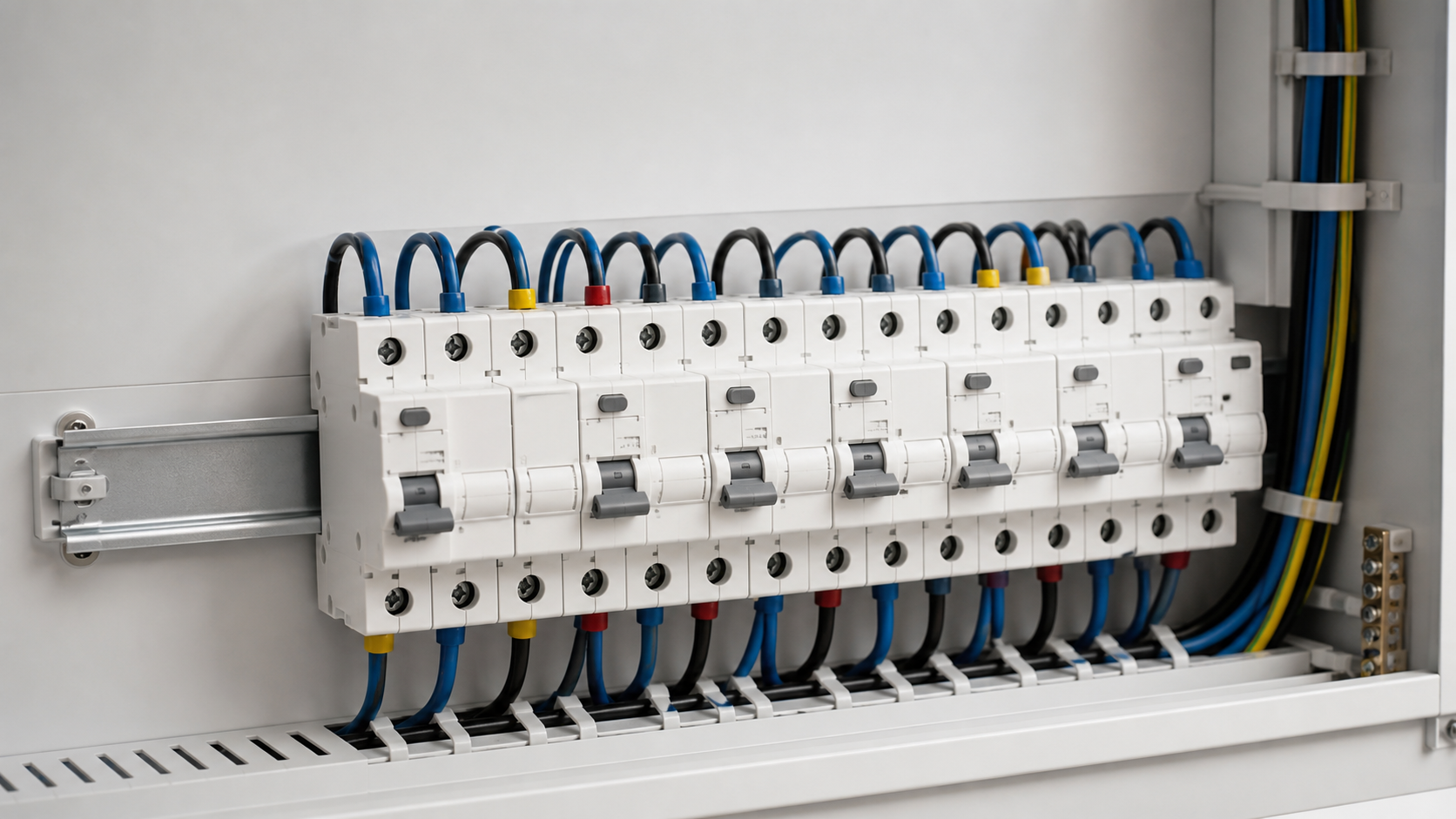
What RCBO Stands For, Letter by Letter
R is Residual: the device measures the difference between current leaving on the line and returning on the neutral. C is Current: the residual value is expressed in milliamperes. B is Breaker: it interrupts the circuit and may provide manual isolation when marked suitable. O is Overcurrent: thermal and magnetic protection is included in the same device.
Some catalogues use the expanded phrase Residual Current Circuit Breaker with Overcurrent protection. The key distinction from an RCCB is that an RCCB provides residual-current protection only and needs separate overcurrent protection.
How an RCBO Works Inside
Line and neutral pass through a zero-sequence current transformer. In a healthy circuit their magnetic effects cancel; leakage to earth creates an imbalance that releases the trip mechanism when it exceeds IΔn. A bimetallic element responds to sustained overload, while an electromagnetic element responds to short-circuit current.
The source document distinguishes electronic and electromechanical trip energy. The choice affects operation during supply abnormalities and should be checked against the device data and the integrity of the installation supply.
- Residual-current path: detects current leaving the intended circuit path.
- Thermal path: protects against sustained overload according to the cable and curve selection.
- Magnetic path: opens quickly for short-circuit current.
- Arc chute: divides and cools the switching arc during interruption.
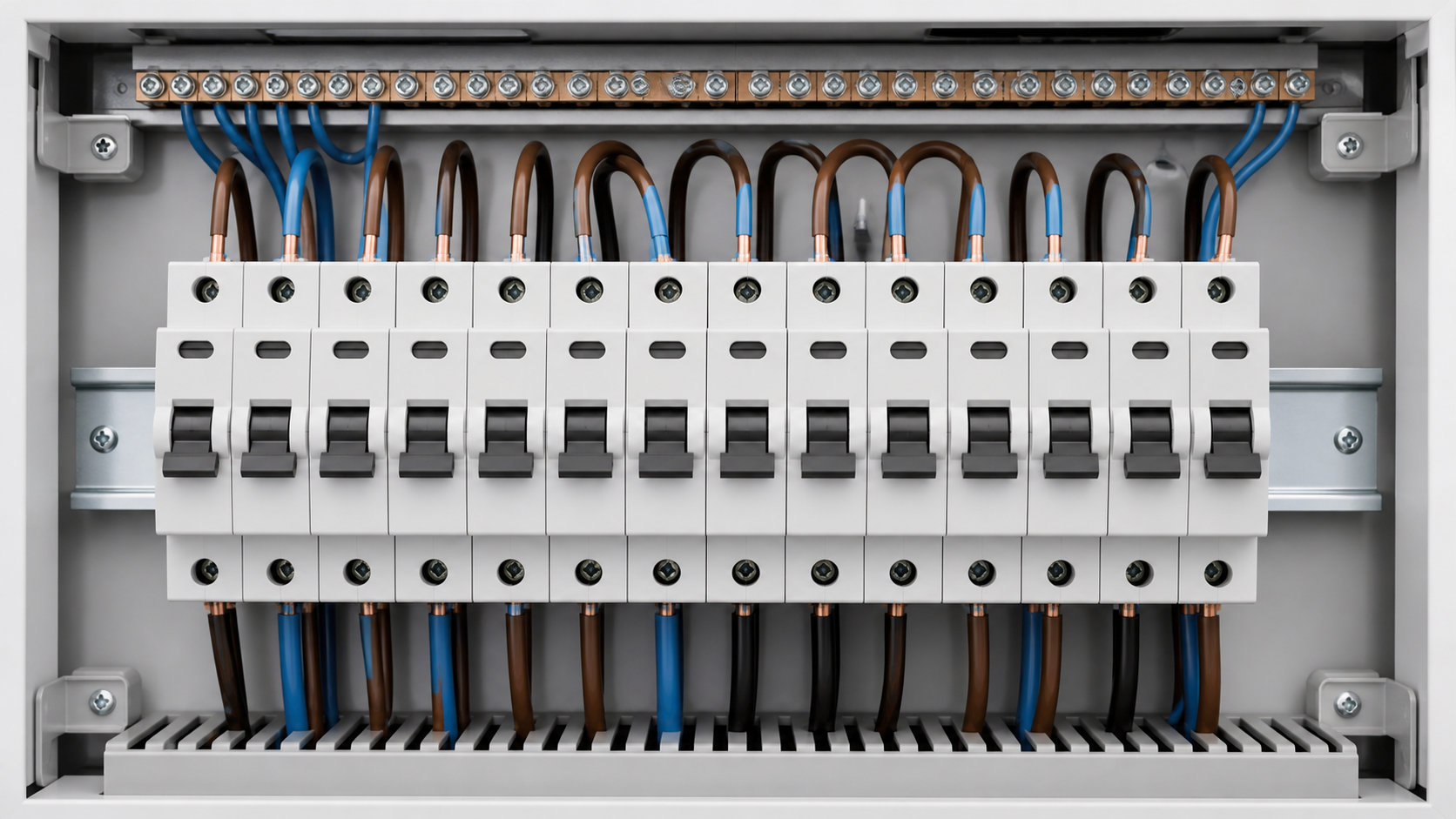
Ratings You Must Specify
An order line such as 32 A RCBO is incomplete. The circuit schedule should identify the current, curve, breaking capacity, residual sensitivity, residual-current type, poles and applicable standard.
| Parameter | Typical values | What it controls |
|---|---|---|
| Rated current In | 6–63 A | Cable protection; size to the cable |
| Trip curve | B, C or D | Instantaneous threshold and inrush tolerance |
| Breaking capacity Icn | 4,500–10,000 A | Must exceed prospective fault current |
| Residual operating current IΔn | 10–300 mA | Shock, fire or equipment protection level |
| Residual-current type | AC, A, F or B | Leakage waveforms detected |
| Poles and width | 1P+N to 4P | Board space and neutral switching |
| Product standard | IEC 61009-1 | Conformity and test regime |
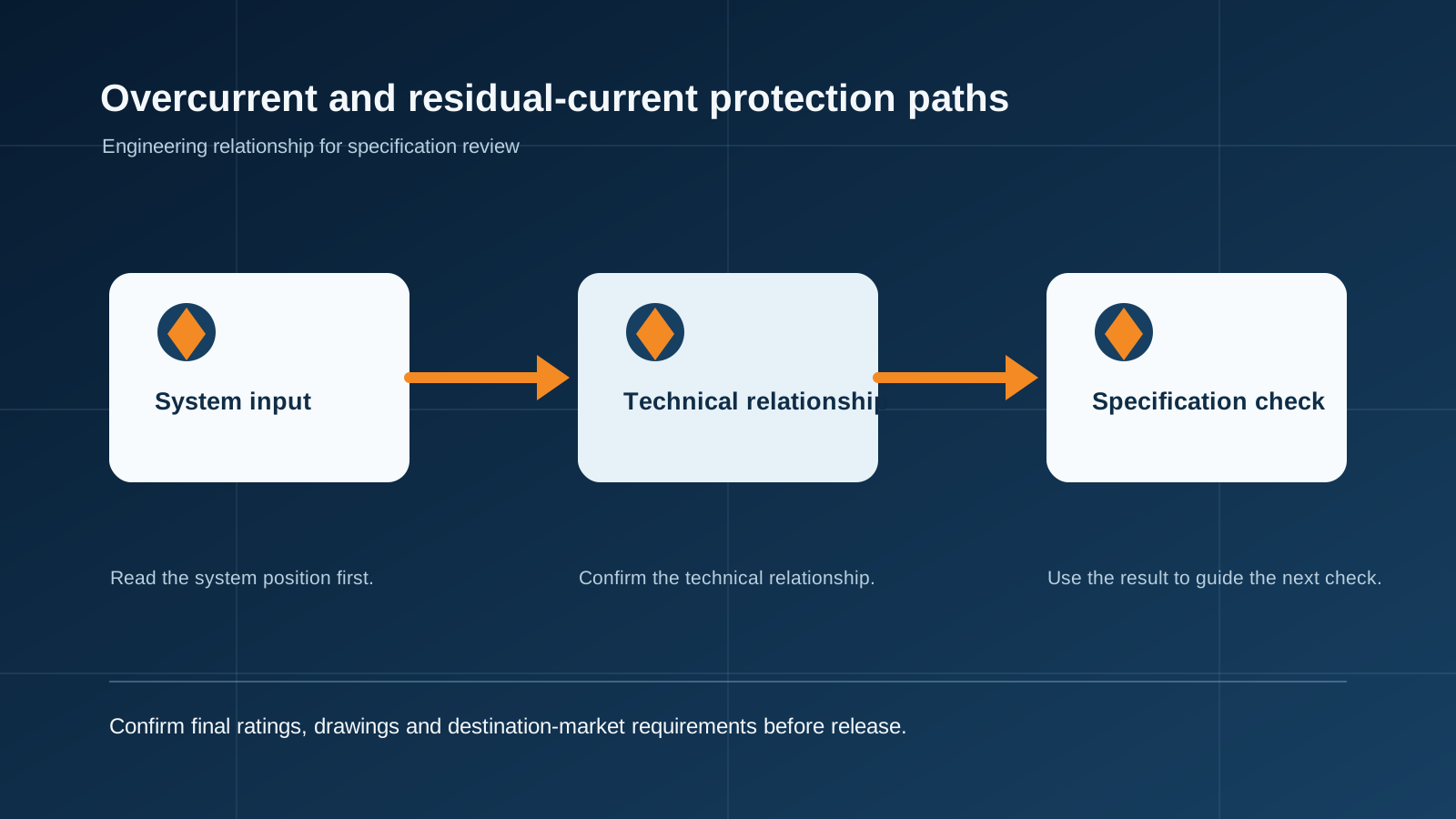
Technical diagram shown at a readable responsive scale.
Residual-Current Types AC, A, F and B
The type letter states which residual-current waveforms the device can detect. Type AC detects sinusoidal AC only. Type A adds pulsating DC. Type F covers composite and mixed-frequency currents. Type B adds smooth DC residual current and is used where the load technology can produce it.
| Type | Detects | Typical application |
|---|---|---|
| AC | Sinusoidal AC residual current | Simple resistive circuits where permitted |
| A | AC plus pulsating DC | Sockets, lighting and electronic appliances |
| F | Type A plus composite and mixed-frequency current | Single-phase drives, heat pumps and washing machines |
| B | Type F plus smooth DC residual current | EV charging, PV inverters and three-phase drives |
Applications and Trip Diagnosis
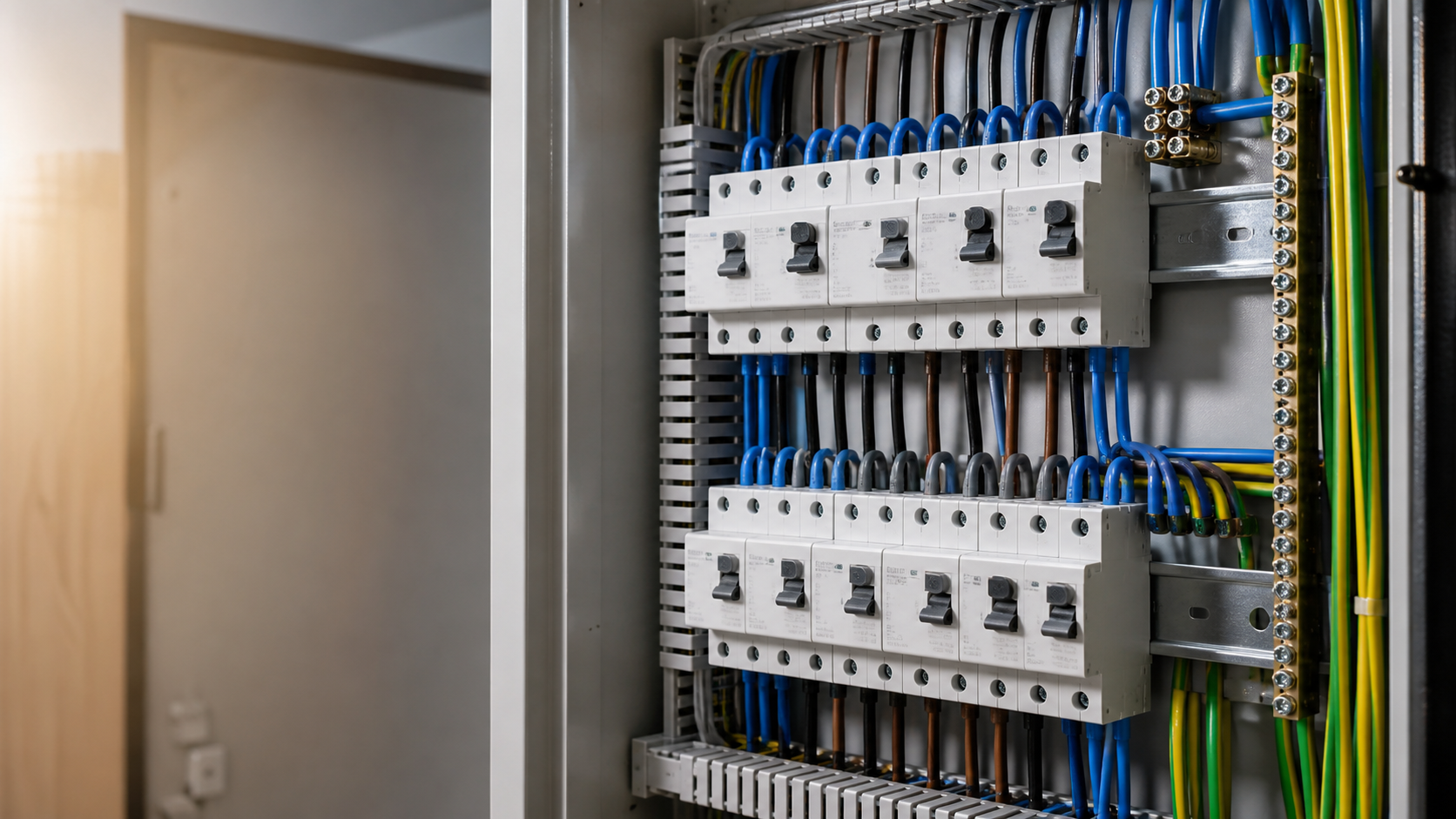
RCBOs are useful where circuit-level discrimination matters: commercial boards, multi-tenant buildings, cold storage, data rooms, construction sites, medical areas and machine-control panels. The source article also describes RCBOs installed loose or integrated into low-voltage assemblies.
When an RCBO trips, first identify whether the residual or overcurrent element operated. Then isolate loads, check for borrowed neutrals, measure insulation resistance with the circuit isolated, assess standing leakage and confirm that the residual-current type matches the connected equipment.
- Test the device with its test button at the required interval and record the result.
- Do not raise sensitivity simply to hide accumulated leakage; split circuits where appropriate.
- Check the device type on circuits with inverters, charging equipment or frequency conversion.
- Follow local wiring regulations and safe-isolation procedures.
This is selection guidance, not a substitute for the equipment datasheet, prospective-fault calculation, cable design or national wiring regulations.
Frequently asked questions
What is the full form of RCBO?
RCBO stands for Residual Current Breaker with Overcurrent protection. It combines earth-leakage, overload and short-circuit protection for one circuit and is covered by IEC 61009-1.
What is the difference between an RCBO and an RCCB?
An RCCB provides residual-current protection only and needs an MCB or fuse for overcurrent protection. An RCBO includes thermal and magnetic overcurrent protection in the same device.
Do I need an RCBO on every circuit?
Not always, but RCBOs localize a fault to one circuit. They are often preferred where availability, discrimination or multi-tenant isolation matters; the final arrangement depends on the design and local rules.
Which RCBO type is suitable for EV charging?
Type B is used where smooth DC residual current can occur, unless the charging equipment provides a certified 6 mA DC detection function that permits the specified upstream arrangement. Check the charger data and local regulations.
What size RCBO do I need?
Size the rated current to the cable it protects, then select the curve from inrush, confirm breaking capacity against prospective fault current, and choose sensitivity and residual-current type from the risk and regulations.
Specify the Circuit, Not Just the Amps
Send the circuit schedule, cable sizes, prospective fault current, load technologies and destination-market rules for a complete RCBO schedule.
Request a quoteContinue learning
Explore related technical guidance in Electrical Protection.
Source DOCX: NEUTRON_PUBLISH_rcbo-full-form-in-electrical_v1.0.docx. Product ratings and certification evidence require confirmation for the quoted configuration.