

Define the operational question first
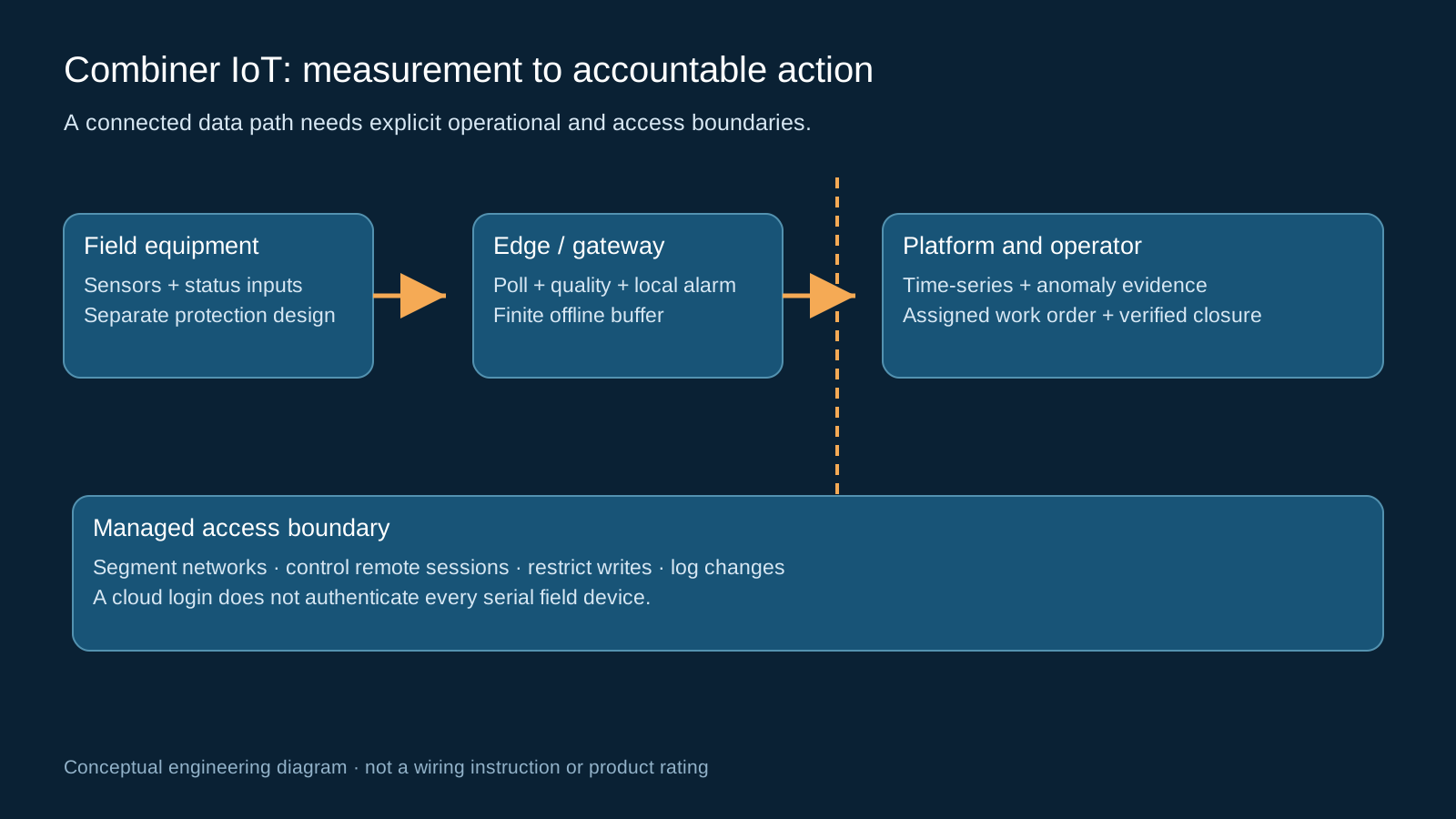
A platform should help operators locate abnormal strings, distinguish electrical events from missing data and document the response. Begin with the decisions and event types required by the plant, then choose sensing, gateway and storage functions. Connectivity alone is not an operational outcome.
Keep asset identity consistent from the physical string and combiner to the gateway channel and platform record. Retain configuration history when equipment is replaced so historical trends do not silently combine different measurement points.
Technical diagram shown at a readable responsive scale.
Preserve the sensing and protection boundaries
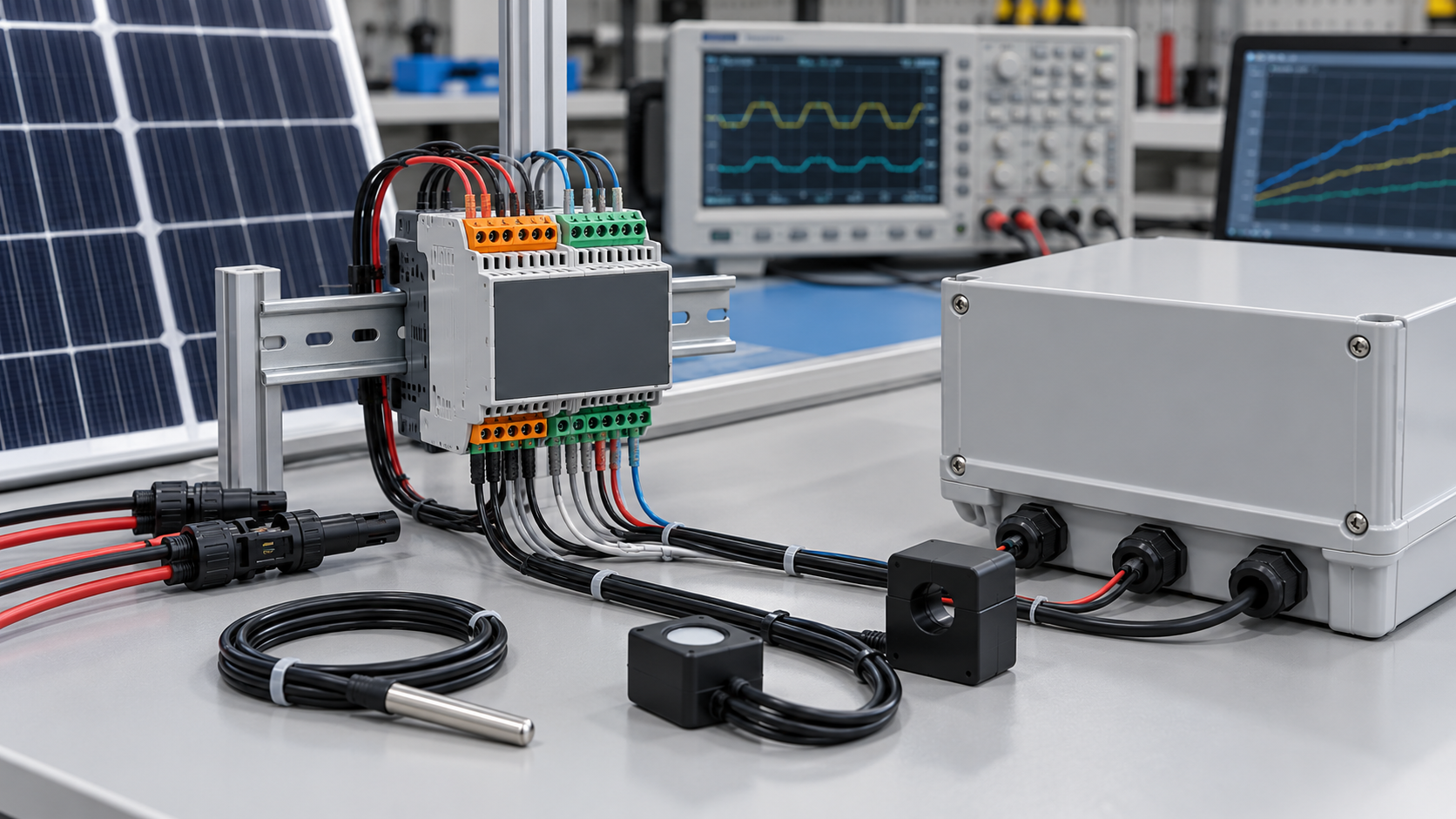
A monitoring layer can receive current, voltage, temperature and compatible auxiliary-contact signals. These sensors and inputs may be separate from the equipment providing electrical protection. Do not assume a monitoring channel is part of an approved trip or protective system.
Select DC-capable sensors and appropriate insulation for the assembly. A contact might indicate fuse state, switch position or a combined fault only where the installed accessory provides that function. Document what each input actually observes and which failure modes it cannot distinguish.
Use the edge for defined local behavior
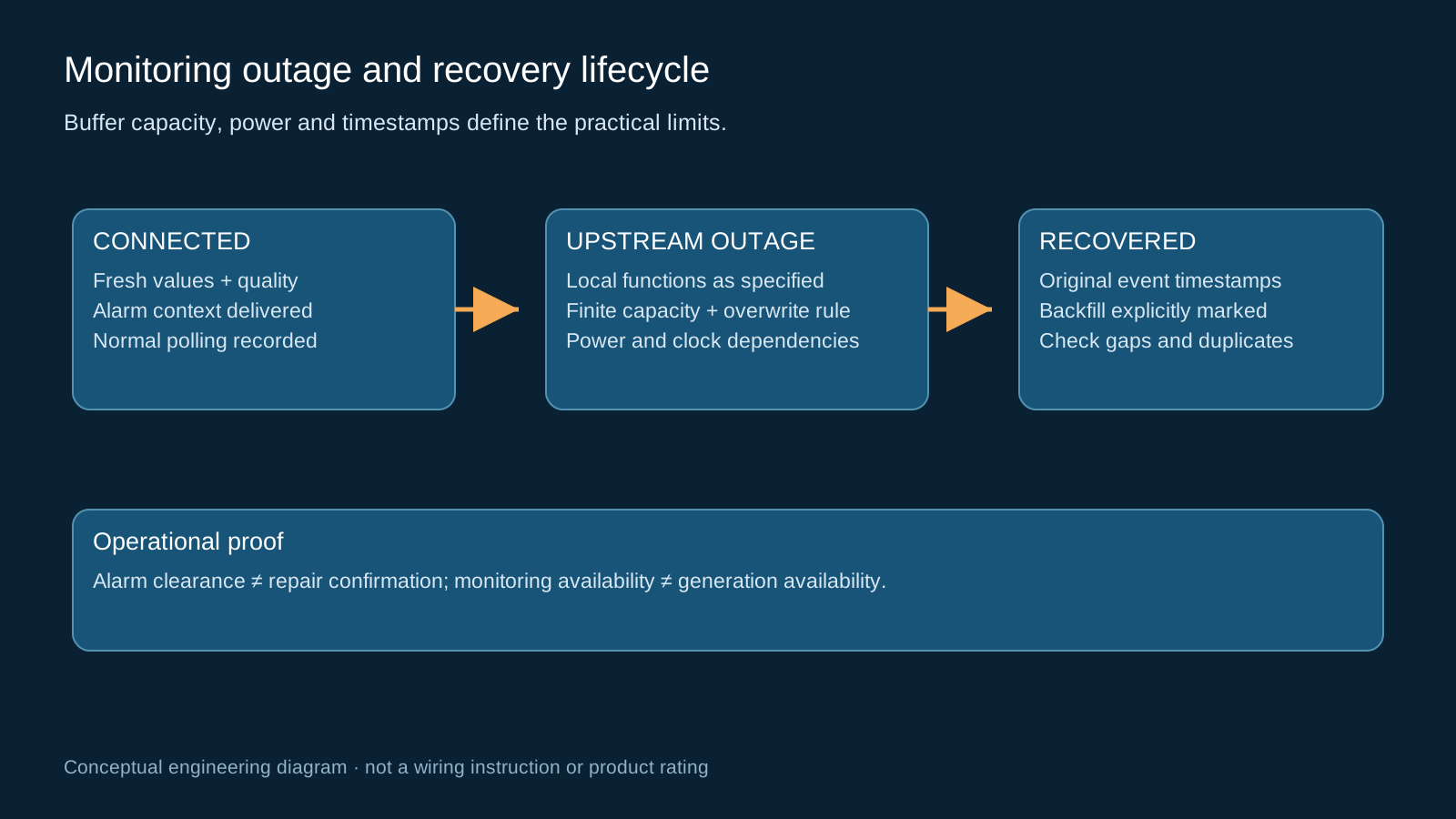
A field controller or gateway can filter measurements, apply local monitoring thresholds and queue events. Specify which functions remain available without the upstream network and whether operators have a local alarm interface. Cloud loss must not silently change required electrical protection.
Offline buffering has finite capacity. Define sample priority, buffer duration, overwrite policy, timekeeping and recovery rules. After reconnection, retain original event times and mark backfilled data; a short outage can still lose information if the buffer is full or power is also lost.
Technical diagram shown at a readable responsive scale.
Connect fieldbus and upstream networks deliberately
RS485 with Modbus RTU can connect several combiner devices to a polling gateway. The gateway may forward records over Ethernet, fiber, cellular or another approved path to an on-site or hosted platform. Choose based on exposure, coverage, latency, maintenance and site architecture.
The gateway must translate the actual register map and preserve units, scale, source identity, time and quality. Communication success does not prove a measurement is current or correct. Treat network loss, fieldbus timeout and sensor diagnostics as distinct events.
Protect operational access
Use network segmentation, controlled remote access, individual identities where supported, least privilege and managed credentials. Keep monitoring reads separate from configuration changes or remote writes; disable unnecessary services and log administrative actions. NIST OT guidance is a useful design reference, not a certification claim.
Traditional serial Modbus provides no built-in authentication. A secure cloud login does not secure every field device or the gateway automatically. Review encrypted upstream transport, patch support, backup and recovery, vendor access and the method for authorizing changes within the actual site environment.
Make analytics explainable
Store the value together with its quality state and timing information. Compare equivalent strings under appropriate irradiance and operating conditions. Flag missing or stale values explicitly rather than drawing an uninterrupted healthy trend across a communication gap.
Expected-current models require valid inputs and suitable baselines. An anomaly can prioritize a field check, but does not uniquely diagnose a failed fuse, PID or a defective module. Model output and sensor uncertainty should remain visible enough for the operator to assess the finding.
Turn an alarm into a verifiable work order
Include box and string location, event time, relevant measurements, data quality and the reason for the alert. Use persistence, acknowledgement and escalation policies to avoid a repeated-notification flood. Assign responsibility and retain the investigation outcome.
After intervention, verify electrical restoration through the approved procedure and confirm fresh measurements under valid operating conditions. Alarm clearance alone may reflect a reset, stale-data suppression or changed configuration, so it does not independently prove a successful repair.
Measure value without promising it
Evaluate alarm detection delay, false or unconfirmed event rate, data completeness, dispatch time and verified repair time. A platform may reduce searching and support targeted maintenance, but repair time also depends on crew access, spares, safety and the underlying fault.
Report monitoring availability separately from generation availability. Energy recovery and operating-cost claims need a stated baseline, measurement method and actual evidence. Do not replace routine inspection or required safety checks solely because a dashboard is connected.
General engineering guidance, not a project design, product certificate or safe-work procedure. Verify ratings, isolation, protection coordination, software behavior and local requirements against the exact equipment documentation and approved project design.
Frequently asked questions
What does IoT monitoring add to a combiner box?
It connects supported measurements and status inputs to a gateway and operational platform, providing location-aware trends, alarms and maintenance records when the data path is correctly commissioned.
Can the platform continue during an internet outage?
Local behavior depends on the controller and gateway design. Specify available local alarms, finite buffering, power dependencies and recovery rules; continuous cloud visibility cannot be assumed.
Is Modbus data secure by default?
Traditional Modbus RTU lacks authentication. Network boundaries, access control, gateway hardening and controlled remote connections must address the actual architecture.
Can the platform identify a blown fuse from zero current?
Zero current is a symptom with several possible causes. Operating conditions, fresh data, compatible indication and safe field checks are needed to confirm the cause.
Does IoT guarantee higher yield or lower MTTR?
No. It may support faster localization and targeted response, but quantified improvements need baseline evidence and depend on maintenance resources, data quality and the actual failure.
Review your combiner monitoring requirement
Share the DC system voltage, string count, sensor and alarm requirements, existing gateway interface and installation environment so the proposed configuration can be reviewed against the project documentation.
Discuss a projectContinue learning
Explore related technical guidance in Solar PV.


References describe general technology and documented scope. They do not certify a NEUTRON configuration or establish measured performance at a customer installation.