
2. ONAN, ONAF and forced cooling compared
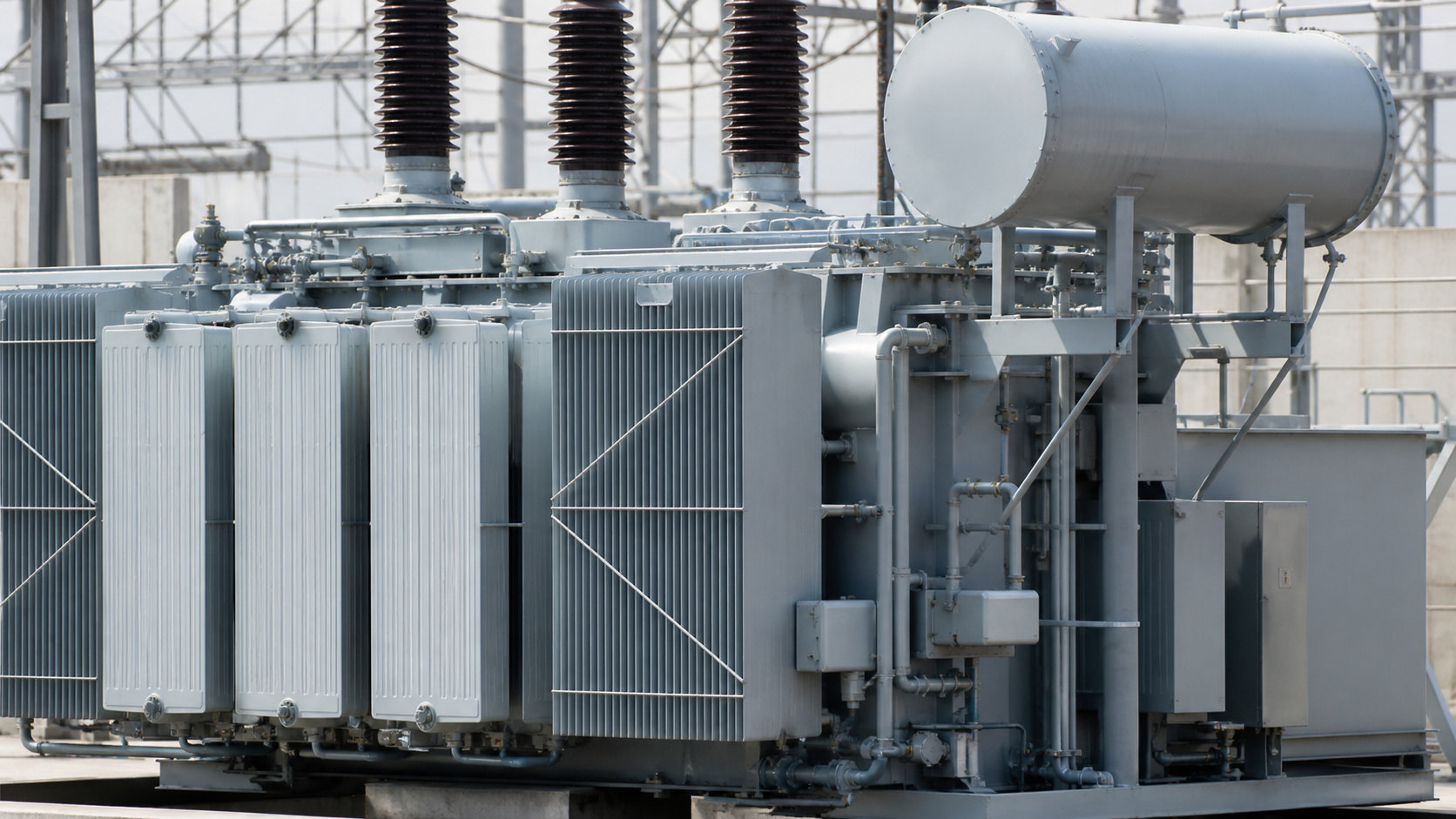
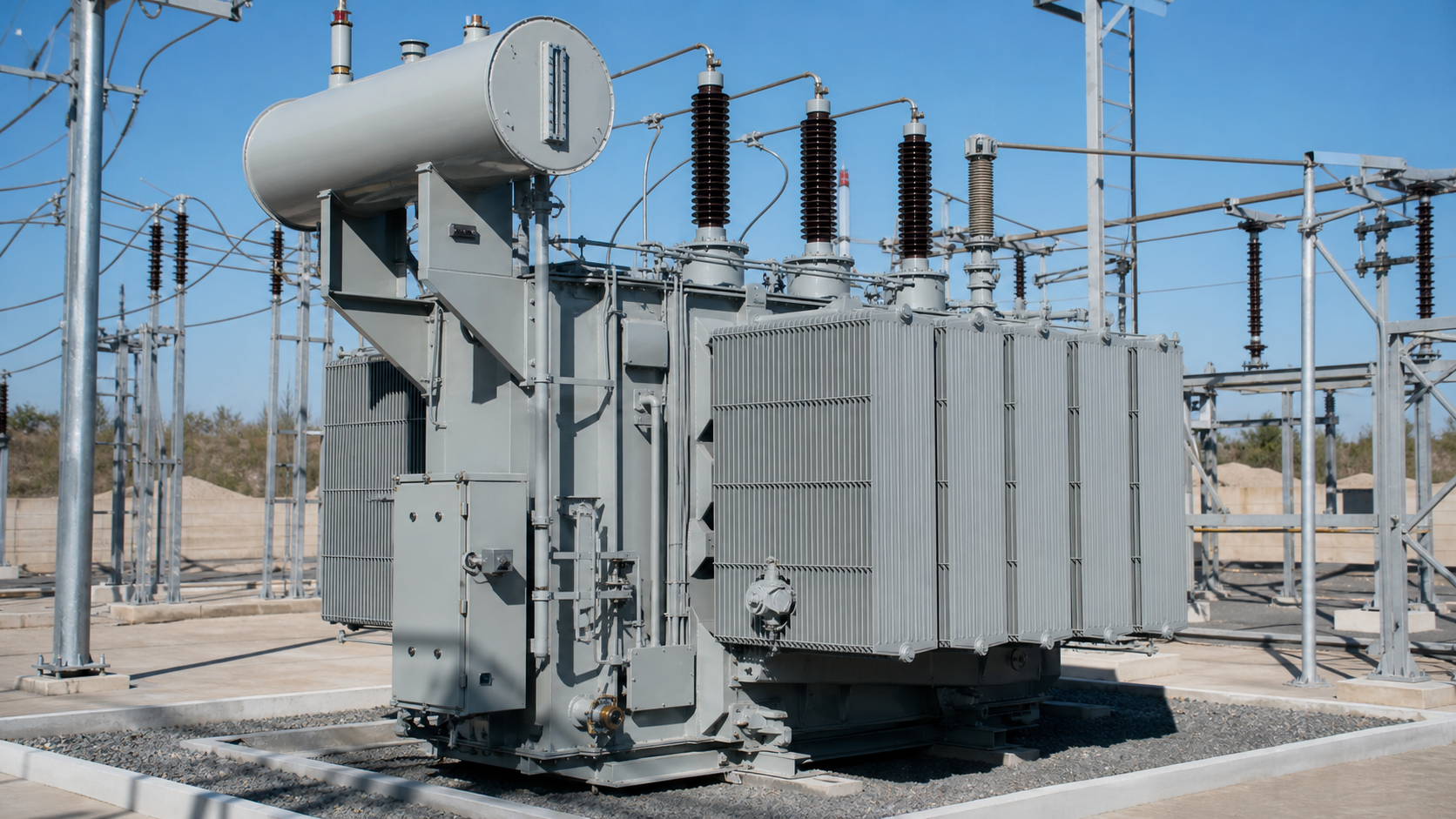
ONAN is the default for distribution ratings and for anything installed inside a package substation enclosure. Heat leaves the windings by natural convection, rises through the tank, and dissipates through corrugated walls or radiator banks. There are no fans, no pumps and no auxiliary supply to fail, which is why ONAN units dominate unattended sites.
ONAF keeps the same oil circuit and adds fans to the radiators. The fans usually stay off until top-oil or winding temperature crosses a set point, so the transformer is dual-rated: for example 1600/2000 kVA ONAN/ONAF. That second rating is genuinely useful for daily peaks and for N-1 contingency, but it depends on an auxiliary supply and on fan maintenance.
OFAF and OFWF add an oil pump so flow no longer depends on temperature difference. ODAF and ODWF go further and direct the pumped flow into the winding ducts, which attacks the hot spot rather than the bulk oil temperature. These arrangements belong to large power transformers, not to compact substations, and they introduce a real failure mode: lose the pumps and the thermal model changes instantly.
1. Reading the four-letter cooling code
IEC 60076-2 describes the cooling arrangement of a liquid-immersed transformer with four letters. Read them in pairs: the first pair describes the internal circuit, the second pair the external circuit.
So ONAN means oil, natural circulation, air, natural convection. KNAN is the same arrangement filled with an ester fluid. ODWF means directed oil flow into a water-cooled heat exchanger with a forced water circuit. Older IEEE labels such as OA and FA appear on legacy drawings and should be translated before comparison.
- Letter 1 — internal cooling medium: O for mineral oil or a synthetic fluid with fire point at or below 300 °C, K for an insulating liquid with fire point above 300 °C, L for a non-combustible liquid.
- Letter 2 — internal circulation: N for natural thermosiphon flow, F for forced flow by pump, D for forced and directed flow guided through the windings.
- Letter 3 — external cooling medium: A for air, W for water.
- Letter 4 — external circulation: N for natural convection, F for forced by fan or pump.
3. The thermal limits that define the rating
A kVA rating is a thermal statement. IEC 60076-2 fixes the temperature rise limits that the manufacturer must demonstrate in a heat-run test, referenced to an ambient of 40 °C maximum, 30 °C daily average and 20 °C yearly average.
Two consequences follow. First, if the site ambient exceeds the IEC reference values — a rooftop enclosure in the Gulf, an unventilated plant room — the nameplate rating must be de-rated or the cooling class upgraded. Second, thermally upgraded paper and ester fluids allow higher permitted rises under IEC 60076-14, which is how the same core and coil assembly can be sold at a higher rating in an ester fill.
- Top-oil temperature rise: 60 K for a conventional mineral-oil unit with a 105 °C insulation system.
- Average winding temperature rise: 65 K, measured by resistance.
- Winding hot-spot rise: 78 K, which is the number that actually governs paper ageing.
- Hot-spot temperature above roughly 98 °C accelerates cellulose ageing; a sustained 6 K increase approximately halves insulation life under the classic ageing model.
Technical diagram shown at a readable responsive scale.
4. Insulating fluids: mineral, synthetic ester, natural ester
The fluid is not only a coolant. It is also the primary liquid dielectric, a carrier for diagnostic gases and moisture, and — in a fire — the fuel load.
Mineral oil to IEC 60296 is refined from petroleum. It has low viscosity, excellent low-temperature behaviour, mature dissolved-gas-analysis interpretation and the lowest purchase price. Its weakness is a fire point around 170 °C and poor biodegradability.
Synthetic ester to IEC 61099 is a manufactured polyol ester. Fire point exceeds 300 °C, so it qualifies as a K-class fluid under IEC 61100. It tolerates far more dissolved water than mineral oil without losing dielectric strength, which protects the paper, and it performs well at low temperature. It is the most expensive option.
Natural ester to IEC 62770 is derived from vegetable oil. It shares the high fire point and the high moisture tolerance, is readily biodegradable, and costs less than synthetic ester. Its trade-offs are a higher pour point, higher viscosity — which slightly reduces natural convection efficiency — and greater sensitivity to oxidation, so sealed or nitrogen-blanketed tank designs are strongly preferred.
5. Fluid comparison table
Table — Typical properties of transformer insulating fluids
Read the pour point row against the coldest site temperature, and the viscosity row against the cooling class. A natural ester in an ONAN unit at −25 °C circulates far more slowly than mineral oil, which is exactly when a cold-start review is needed.
6. Matching cooling and fluid to the enclosure
In a package substation the transformer never sits alone. It shares a compact steel enclosure with a medium-voltage switching compartment and a low-voltage distribution compartment, and the enclosure controls how much of the calculated heat actually escapes.
NEUTRON manufactures package substations and photovoltaic step-up compact substations together with the low-voltage equipment inside them — GGD fixed-type switchgear, GCS draw-out switchgear, XL-21 power distribution cabinets, metering cabinets, capacitor cabinets and automatic transfer switch cabinets. Those assemblies are built and verified to IEC 61439-1 and IEC 61439-2 with CE and CB documentation and ISO 9001 quality control.
- Ventilation: size the louvre free area for the full ONAN loss at the worst-case site ambient, not at the 40 °C reference value.
- Ingress protection: IP54 or higher for outdoor enclosures, with vermin mesh and drainage that does not compromise the rating. Indoor units can run IP30 to IP42.
- Bunding: a mineral-oil fill in a populated area normally needs containment sized for the full fluid volume. A K-class ester fill often removes that requirement — confirm against local fire code before committing.
- Low-voltage compartment: rated currents from 100 A to 6300 A, 400 V, 415 V, 690 V or 1000 V, short-circuit withstand from 50 kA to 100 kA, copper or aluminium busbar.
- Finish: cold-rolled, galvanised or stainless steel with phosphating and electrostatic powder coating, standard RAL 7035 light grey.
- Monitoring: bring top-oil and winding temperature indicators, Buchholz and pressure relief contacts into the low-voltage compartment, and use RS485 or Modbus RTU where remote monitoring is required.
7. Procurement checklist and common errors
- Quote ONAN and ONAF ratings separately. A dual-rated nameplate is not a free capacity upgrade; the ONAF figure is only valid with the auxiliary supply and fans in service.
- State the real site ambient and altitude. Above 1000 m, air density falls and cooling capability falls with it.
- Do not retrofit an ester fluid into a transformer designed for mineral oil. Gasket compatibility, conservator sizing and thermal design all change.
- Specify the fluid standard, not just the fluid family — IEC 60296, IEC 61099 or IEC 62770 — plus the required acceptance tests.
- Ask for the heat-run test report with measured top-oil rise, average winding rise and calculated hot-spot rise, referenced to IEC 60076-2.
- Confirm the dissolved-gas-analysis baseline at delivery. Ester fluids gas differently from mineral oil, and a mineral-oil interpretation table will mislead the maintenance team.
- Agree the fire strategy with the client's insurer early. It is the single factor most likely to change the fluid decision after the order is placed.
Request a quote
NEUTRON builds package substations, photovoltaic step-up compact substations and the complete low-voltage line-up inside them, verified to IEC 61439 with CE, CB and ISO 9001 documentation. Send us the transformer rating, site ambient, altitude, fire strategy and single-line diagram, and our engineers will return an enclosure and cooling proposal with drawings and test scope.
This is general technical guidance, not a substitute for local electrical code, the applicable standard, product datasheets or a qualified engineer's design review. Confirm ratings and final configurations against the actual project.
Bring the project inputs to the first review.
NEUTRON can review the application context, electrical envelope, enclosure conditions and document requirements related to oil-immersed transformer cooling and fluid selection guide before quotation.
Discuss a technical requirementContinue learning
Explore related technical guidance in Power Distribution.
Converted from the approved Period 01 source article for Oil-Immersed Transformer Cooling and Fluid Selection Guide. Editorial instructions, duplicate anchor placeholders and embedded publishing directions were removed; the technical body is retained for educational use.