
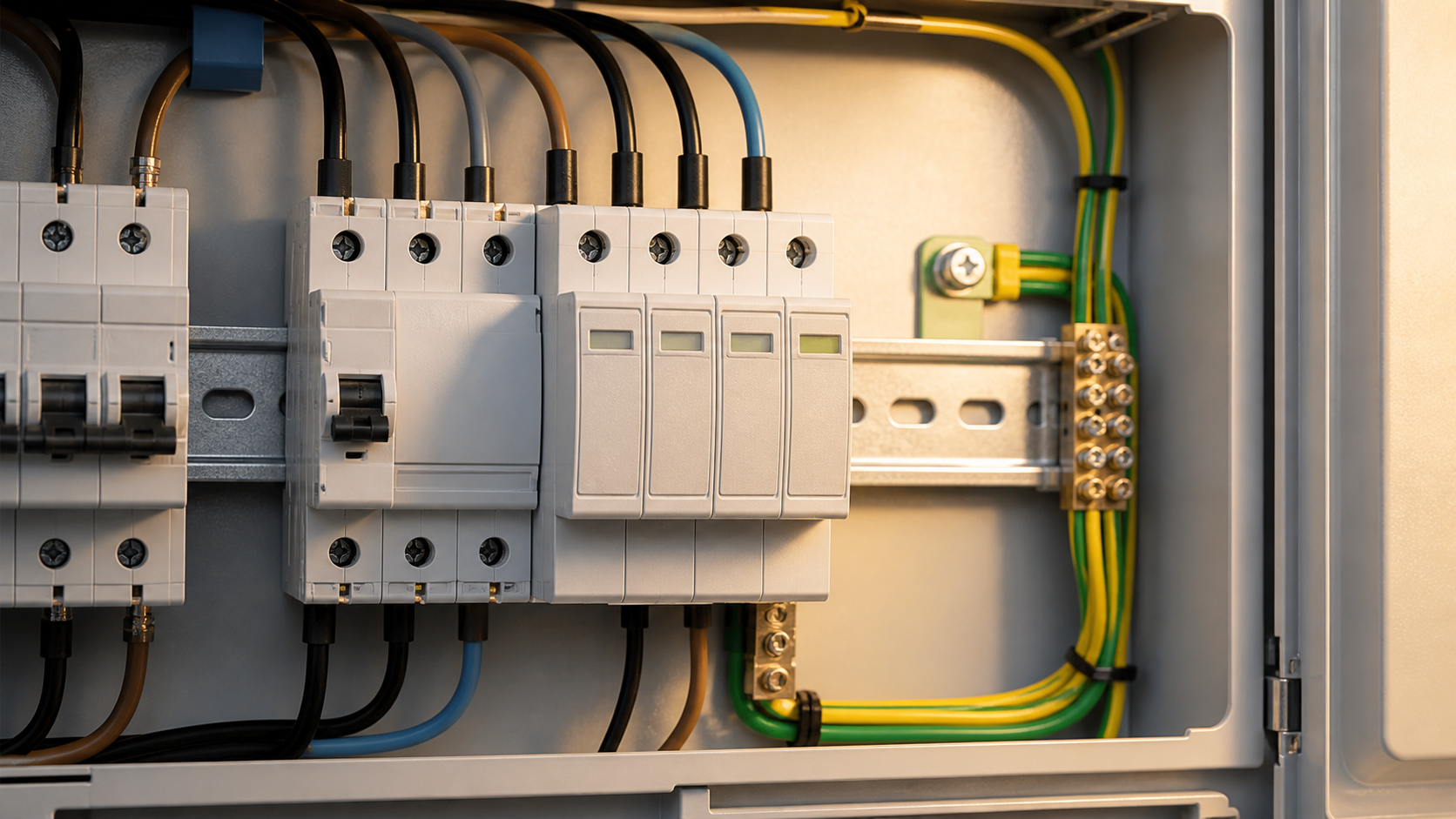
2. How MOV Technology Degrades
A metal oxide varistor is a sintered zinc oxide ceramic with a strongly non-linear voltage-current characteristic. Below its threshold it behaves almost like an insulator, drawing microamps. Above it, resistance collapses and the device conducts hundreds or thousands of amps, clamping the voltage seen by downstream equipment.
Degradation happens through two mechanisms. **Large single events** — a nearby lightning strike or a major switching transient — can melt localised paths through the ceramic grain structure. **Cumulative small events** — the dozens of modest transients a typical installation sees every week from motor starting, capacitor switching and utility operations — each remove a small increment of capability.
The visible consequence is rising leakage current at normal operating voltage. A degraded varistor warms up; the warmer it gets the more it leaks; the more it leaks the warmer it gets. Left unmanaged, that loop ends in thermal runaway. This is precisely why every SPD intended for a distribution board must contain a **thermal disconnector** that isolates the varistor before it can ignite, and why a bare varistor block with no disconnector has no place in a modern assembly.
1. The Short Answer: Energy Absorbed, Not Years Elapsed
The common advice to replace a surge protector every three to five years is a rule of thumb for consumer socket strips, and it is a poor basis for an industrial or commercial installation. The correct model is cumulative energy.
A metal oxide varistor sits idle at normal voltage and conducts hard when voltage rises above its clamping threshold. Every time it conducts, it dissipates energy as heat inside a ceramic disc, and a small fraction of that disc is permanently altered. Nothing recovers between events. When enough of the disc has degraded, the leakage current at normal voltage rises, the device runs warm, and eventually the internal thermal disconnector removes it from circuit.
This is why the status indicator, not the purchase date, governs replacement in a properly managed installation.
- **Benign indoor environment, underground supply, few transients:** eight to ten years is realistic.
- **Typical commercial building with mixed load and switching activity:** five to eight years.
- **Overhead rural supply, industrial plant with large inductive switching, PV array in a lightning region:** two to five years, sometimes less.
- **After one severe direct or nearby strike:** treat the device as end-of-life until proven otherwise.
3. Joules, In and Imax: What the Ratings Actually Mean
Consumer marketing sells joules. Engineering specifications use the parameters defined in **IEC 61643-11**, and they describe behaviour far more precisely.
Table: SPD parameters that determine service life and protection quality
Two practical rules follow. First, compare **In**, not joules, when assessing how long a device will last in a given position — a 20 kA In device in a 10 kA duty lasts far longer than a 10 kA device in the same place. Second, always check **Up** against the impulse withstand capability of the equipment being protected; a device with a high discharge rating but a poor protection level survives the surge while the load does not.
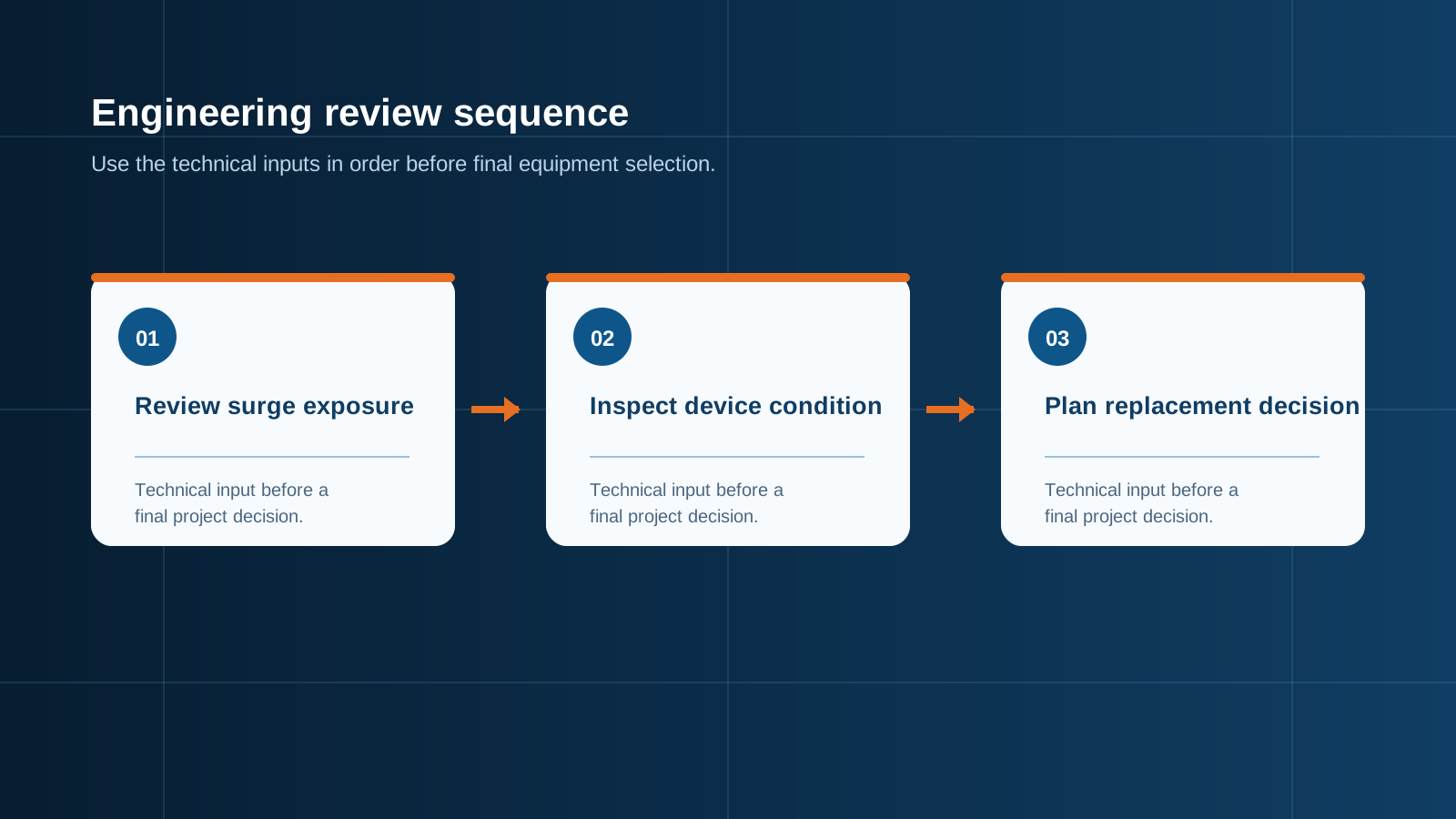
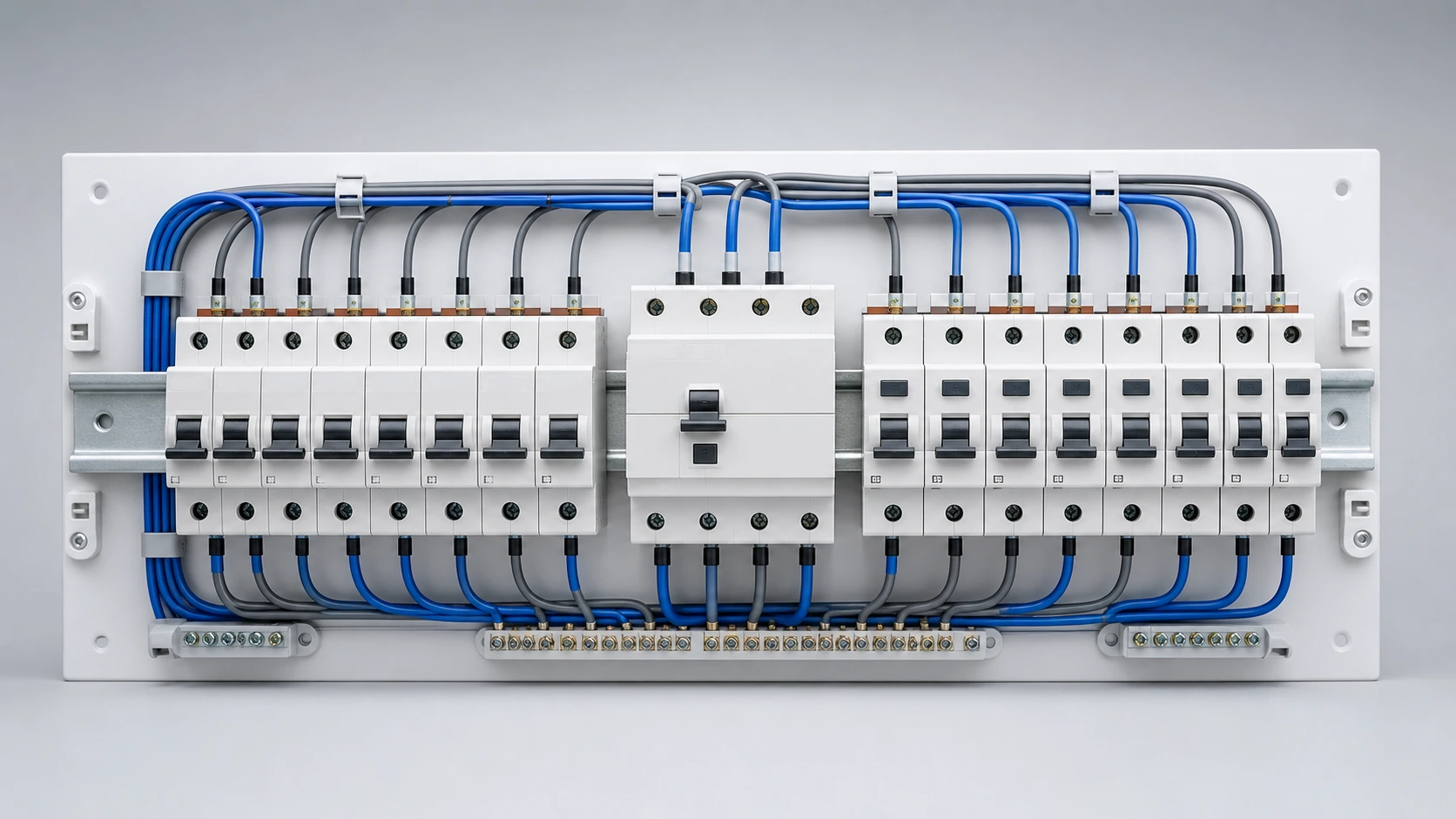
Technical diagram shown at a readable responsive scale.
4. Five Signs an SPD Needs Replacement
For unattended and remote installations, specify SPDs with a **volt-free remote signalling contact** and wire it into the monitoring system. In a PV plant this is the difference between knowing you are protected and assuming it.
- **The status window has changed colour, or the LED is out.** This is the designed end-of-life indication: the thermal disconnector has operated and the varistor is no longer in circuit. The installation is unprotected from that moment.
- **Discolouration, bulging or a burnt smell at the module.** Heat damage means the device has been conducting near its limit. Replace it and investigate why the duty was so severe.
- **A known major event.** A direct or nearby lightning strike, a utility fault, or a documented overvoltage incident. Inspect immediately rather than waiting for the next scheduled visit.
- **Age combined with a harsh position.** An SPD on an overhead-fed rural distribution board or an outdoor PV combiner box that has been in place for five years should be inspected on principle, indicator or not.
- **Loss of earth reference.** A protector diverts surge energy to earth. If the earth path has been compromised — a corroded bond, a removed conductor after building work — the device cannot function even though it looks healthy. Verify earth continuity as part of any SPD inspection.
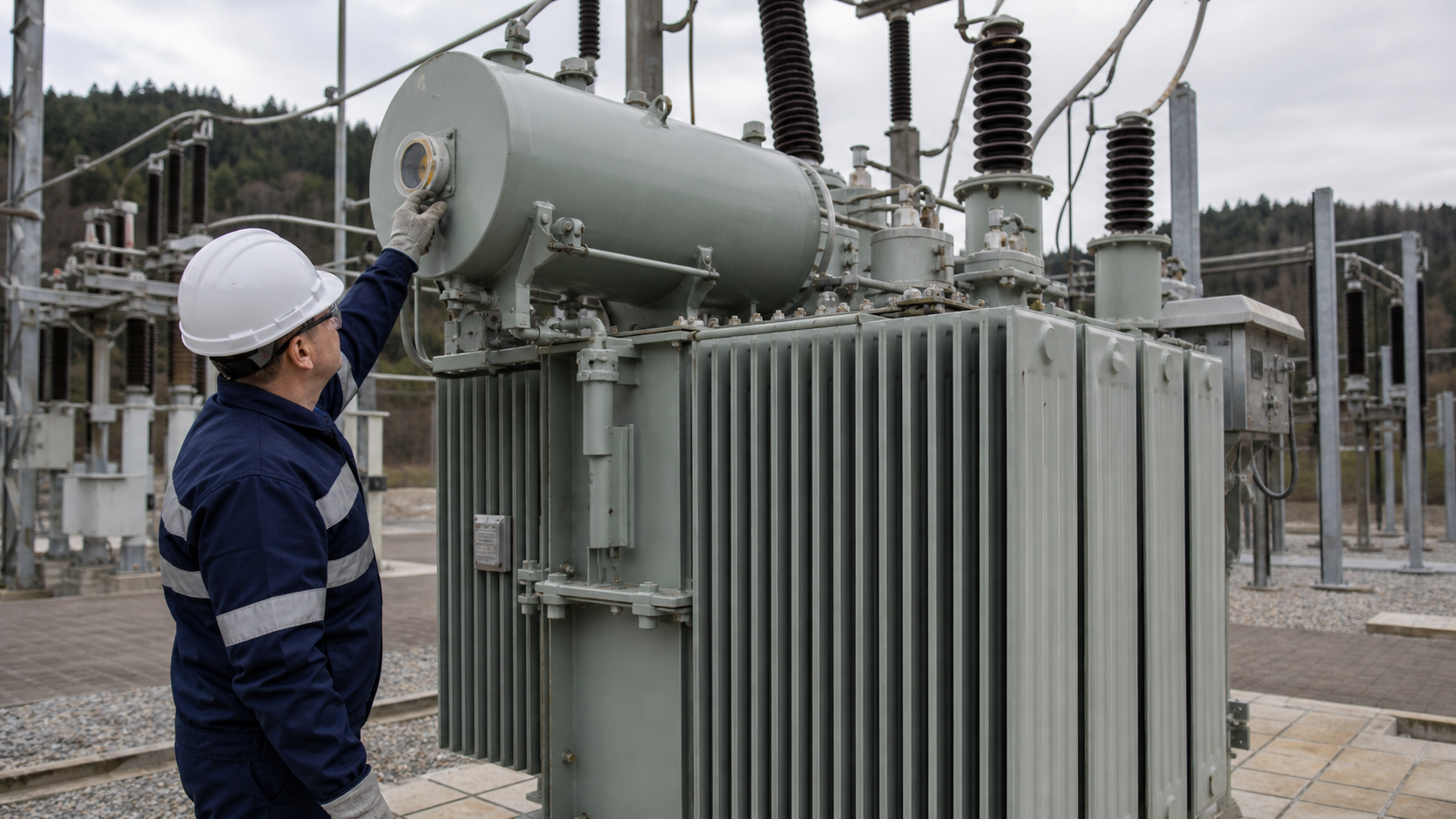
5. Surge Protective Device vs Socket Strip
The two are routinely confused, and the confusion causes real losses on commercial sites.
A **socket strip** extends one outlet into several. Unless it carries a declared surge rating and a status indicator, it provides no transient protection whatsoever — the internal wiring is simply paralleled. Many strips sold as protected contain a single small varistor with no thermal disconnector and no indication.
An **installed SPD** is coordinated equipment. It is mounted in the distribution assembly, connected with short leads to line and earth, has a defined Uc, In, Imax and Up, contains a thermal disconnector, and shows its status. It protects everything downstream of the board rather than one desk.
Good practice for a commercial building is layered: a **Type 1** device at the origin where the structure has an external lightning protection system, a **Type 2** device at each distribution board, and **Type 3** fine protection only immediately adjacent to particularly sensitive equipment. Connection quality matters as much as device choice — keep the total connecting lead length below roughly 0.5 m, because the inductive voltage drop along a long lead adds directly to the let-through voltage the load experiences.
6. Building a Replacement Strategy
The objective is to make replacement a routine, low-cost activity rather than an emergency.
NEUTRON integrates Type 1 and Type 2 surge protective devices into distribution boards, PV combiner boxes, AC combiner boxes and grid-connected cabinets, with status indication and, where specified, remote signalling brought out to terminals for monitoring.
- **Specify pluggable modules.** A plug-in cartridge on a base allows replacement in seconds without disturbing the wiring, and without an extended shutdown of the board.
- **Record positions and dates.** A simple register of every SPD, its rating, its installation date and its last inspection turns a guessing exercise into a maintenance task.
- **Set inspection intervals by environment.** Annually in benign indoor positions; twice yearly on overhead-fed, industrial or PV installations; immediately after any major electrical event.
- **Include SPDs in the thermographic survey.** A warm module on an otherwise cool board is an early warning that precedes indicator operation.
- **Hold spares on site.** For critical installations, one spare cartridge per type is inexpensive insurance against a device that has failed safe and left the board unprotected for weeks.
- **Verify the earth path** at every inspection, because a protector without a low-impedance earth reference is decorative.
7. Specification Checklist for Buyers
Treat the surge protector as consumable equipment with a defined duty, not as permanent hardware. That single change of mindset prevents most of the surge damage that reaches equipment in installations which believed they were protected.
- AC devices declared to **IEC 61643-11**; photovoltaic DC devices to **IEC 61643-31**.
- Correct type for the position: **Type 1** at the origin with external lightning protection, **Type 2** at distribution boards and combiner boxes, **Type 3** only for local fine protection.
- **Uc** above the maximum continuous operating voltage of the system, with margin — on PV DC circuits, above 1.2 × Uoc(STC).
- **In** of at least 10 kA (8/20 µs) for general distribution duty; higher where the position is exposed.
- **Up** verified against the impulse withstand category of the protected equipment.
- **Thermal disconnector fitted** and a **visible status indicator**; remote signalling contact where the installation is unattended.
- Overcurrent protection ahead of the SPD as required by the manufacturer's data.
- Connecting leads kept short — total line plus earth lead length under about 0.5 m.
- Assembly declared to **IEC 61439**, with **CE** and **CB** documentation and an **ISO 9001** manufacturer.
- A documented replacement route: pluggable cartridge, stated part number, and availability confirmed for the life of the installation.
Media & Assets
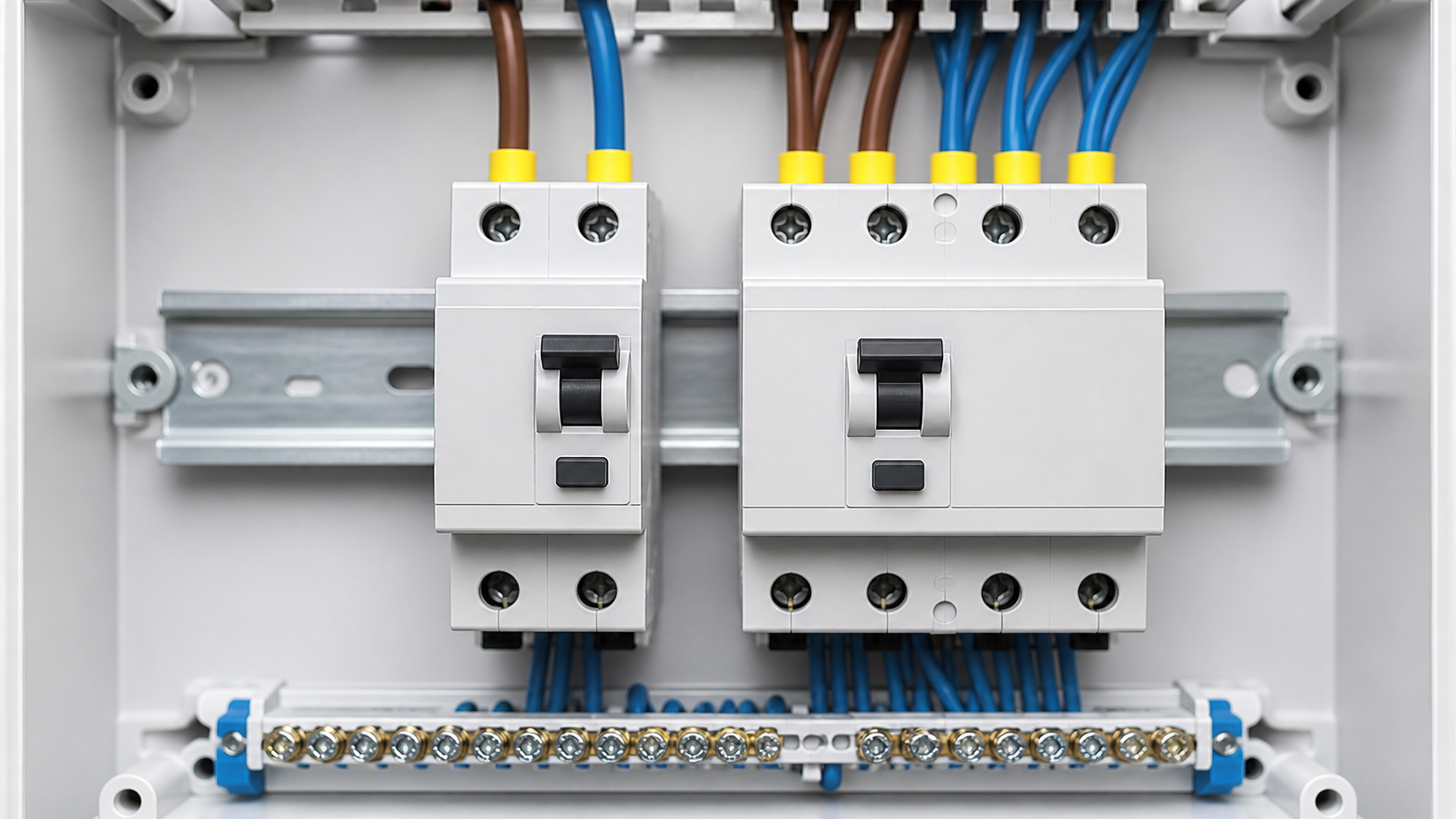
Subject: DIN rail mounted Type 2 surge protective device installed in a NEUTRON distribution board
Style: clean industrial B2B product photography
Details: three-pole plug-in SPD cartridges with green status windows, adjacent miniature circuit breakers, copper busbar, short connecting leads to line and earth clearly visible
Background: plain light-grey studio
Lighting: soft studio, even
Aspect ratio: 16:9 (hero)
No text, no logos unless specified.
Subject: macro detail of an SPD module status window, one green and one red
Style: clean industrial B2B product photography, macro detail
Details: two plug-in cartridges side by side, one showing a green healthy indicator and one showing a red end-of-life indicator, module markings with Uc and In values legible as generic text
Background: plain light-grey studio
- Hero image: 16:9 at the top of the article, above the Key takeaway block.
- Inline image 1 (4:5): inside Section 2, showing an SPD module with its status window.
- Inline image 2 (16:9 diagram): directly under the Section 3 parameter table.
- Inline image 3 (1:1): inside Section 5, showing layered Type 1 / Type 2 / Type 3 placement.
- All images need descriptive alt text and loading="lazy".
This is general technical guidance, not a substitute for local electrical code, the applicable standard, product datasheets or a qualified engineer's design review. Confirm ratings and final configurations against the actual project.
Bring the project inputs to the first review.
NEUTRON can review the application context, electrical envelope, enclosure conditions and document requirements related to what is the lifespan of a typical surge protector? a 2026 engineering guide before quotation.
Discuss a technical requirementContinue learning
Explore related technical guidance in Electrical Protection.
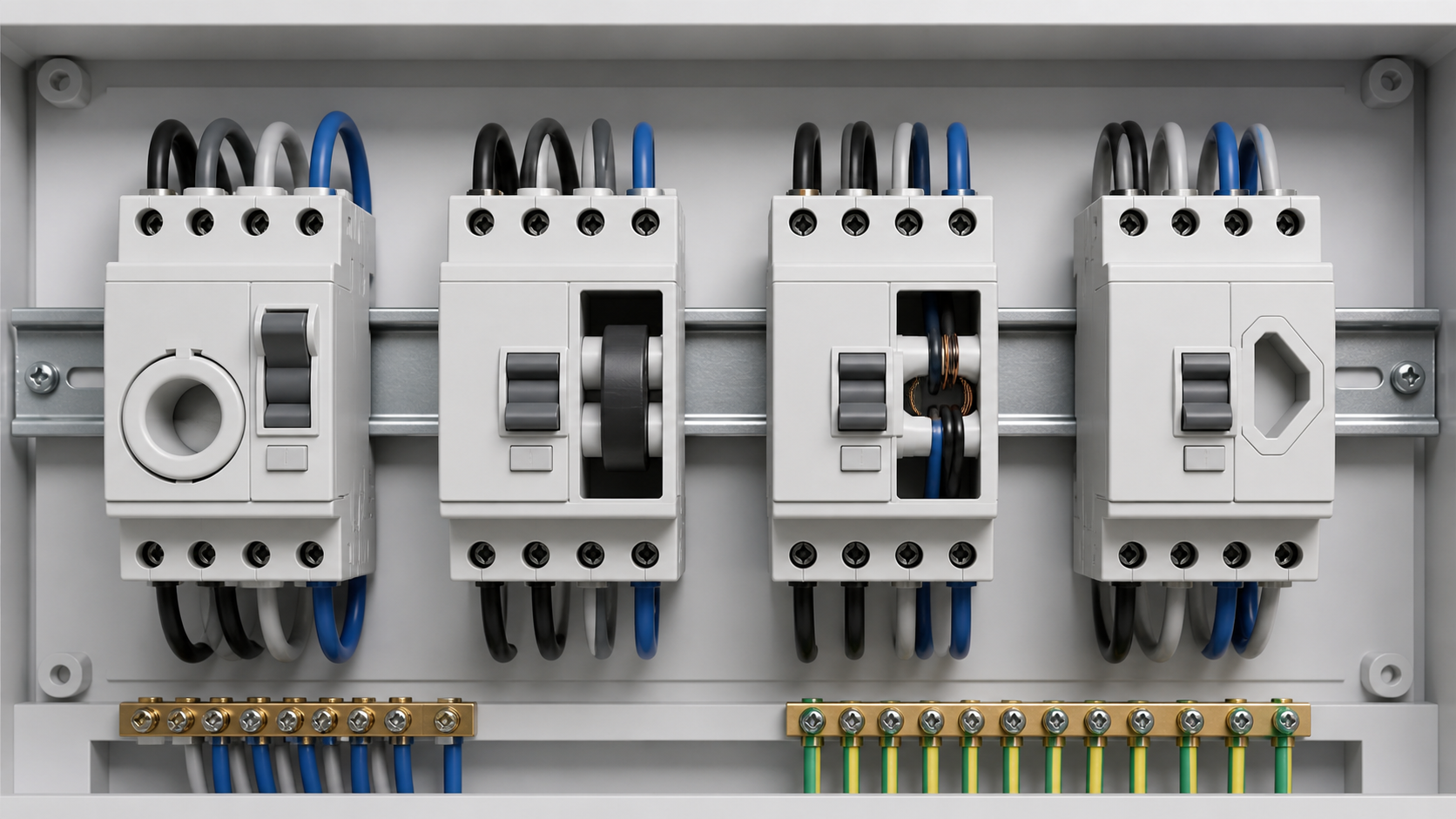
Converted from the approved Period 01 source article for What Is the Lifespan of a Typical Surge Protector? A 2026 Engineering Guide. Editorial instructions, duplicate anchor placeholders and embedded publishing directions were removed; the technical body is retained for educational use.