
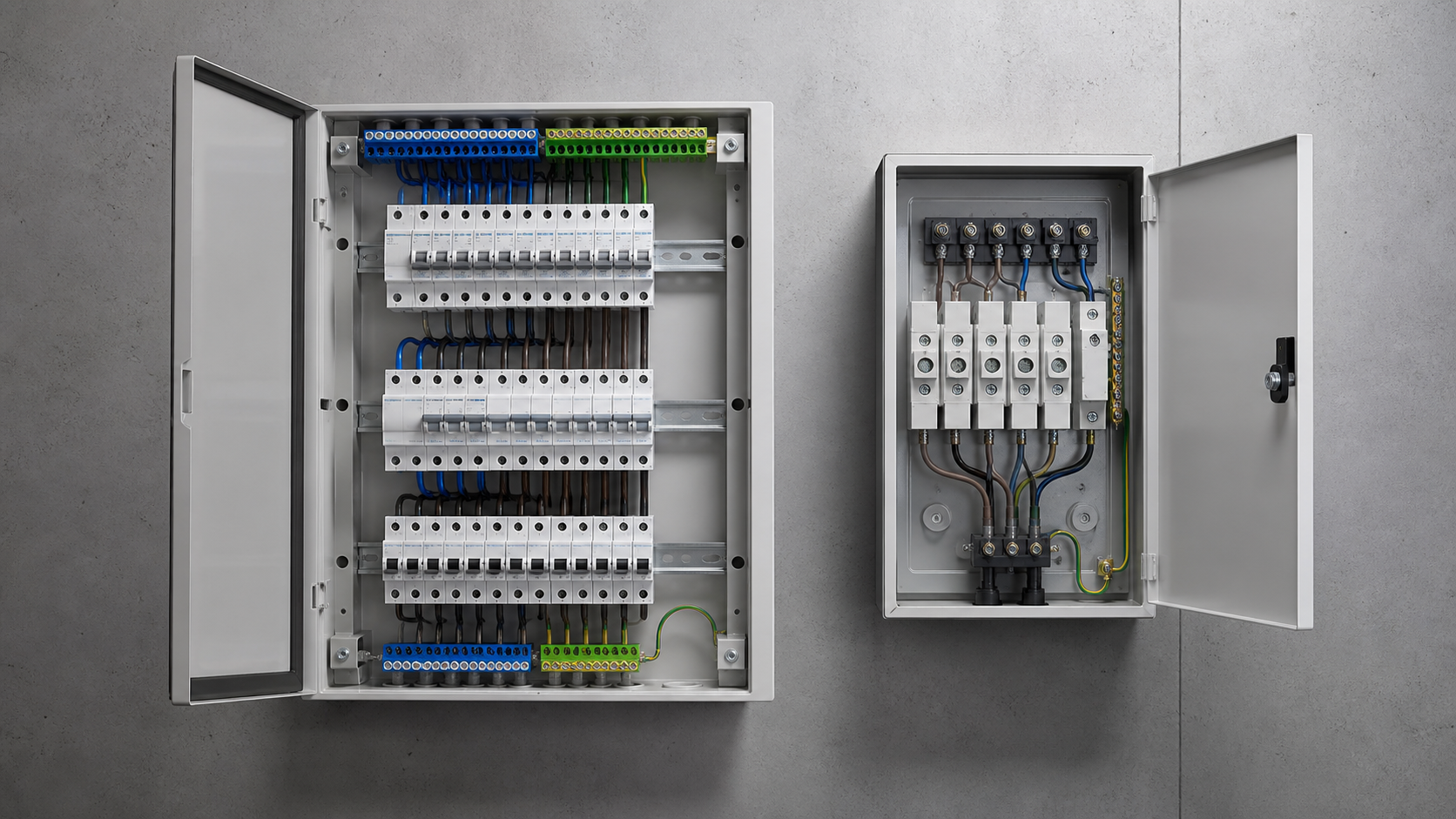
1. Defining the two assemblies
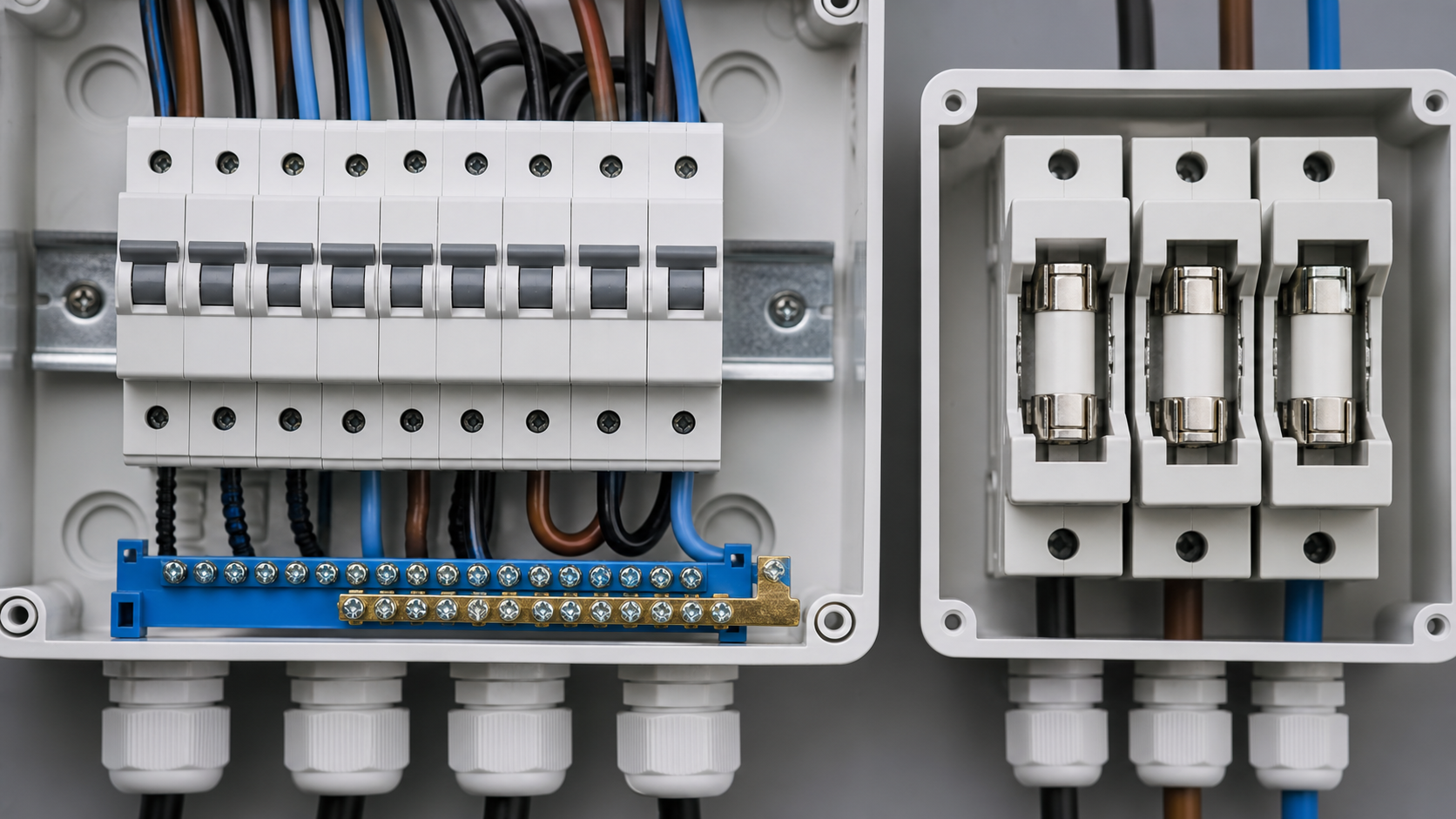
A fuse box is an enclosure containing fuse carriers, one per circuit. Each fuse holds a calibrated conductor that melts when current exceeds its rating for long enough. Once it has operated, the fuse link or the whole cartridge is discarded and replaced. Older rewireable types used a length of fuse wire fitted by hand.
A distribution box — also called a distribution board, consumer unit or distribution cabinet — is an enclosure containing circuit breakers on a common busbar. Each circuit breaker trips on overload or short circuit and is reset by moving a toggle. Modern boards also carry residual current protection, surge protection, isolation devices and, on larger assemblies, metering.
The distinction is not only about the protective element. A distribution assembly is engineered and verified as a complete unit — enclosure, busbars, devices, clearances and earthing tested together to IEC 61439. A traditional fuse box was a container for fuse ways with far less formal verification of the assembly as a whole.
2. Difference 1 — melting versus tripping
A fuse operates thermally. Current heats the element until it melts, opening the circuit. The characteristic is inherently inverse — small overloads take a long time, heavy faults clear very quickly. High-rupturing-capacity cartridge fuses are, in fact, extremely fast on severe short circuits and can be current-limiting, which is a genuine technical strength.
A circuit breaker operates by two mechanisms in one device. A thermal bimetal provides the inverse-time overload response; an electromagnetic trip provides near-instantaneous short-circuit response. Because the two are independent, the breaker's curve can be shaped by design — Type B, C or D characteristics for different inrush profiles — in a way a fuse cannot match.
The consequence for the installation is coordination. With breakers you can choose characteristics deliberately so that a fault clears at the nearest downstream device. NEUTRON's moulded-case ranges extend this further: the WCM7EL offers inverse-time long-delay overcurrent, inverse-time and definite-time short-delay short-circuit protection and instantaneous short-circuit protection with adjustable settings, so upstream and downstream devices can be graded for genuine selectivity.
3. Difference 2 — reset time and operating cost
This is the difference that facility managers feel. Restoring a tripped breaker takes seconds and no spare parts. Restoring a blown fuse requires the correct rating in stock, a competent person to fit it, and — with rewireable types — the discipline not to fit oversized wire.
The hidden cost of a fuse board is the wrong-rating substitution. When the correct fuse link is not on the shelf, the temptation to fit a larger one is real, and it silently removes the protection the cable was designed around. Circuit breakers make that substitution obvious: a 32 A breaker physically will not pretend to be a 16 A one.
Mechanical endurance also matters where circuits are switched routinely. NEUTRON's WH1-125 isolating switch is rated for 20,000 operating cycles, and miniature breaker ranges are qualified for defined load and no-load operation counts. A fuse carrier has no equivalent duty rating because it was never intended as a switching device.
4. Difference 3 — shock and earth-fault protection
This is the most important difference and the one most often overlooked. A fuse provides no protection against earth leakage. A person contacting a live conductor may draw 30 to 100 mA — far below the melting current of any fuse protecting a lighting or socket circuit. The fuse will not operate.
A modern distribution assembly includes residual current protection. A 30 mA residual current device detects the imbalance between live conductors and opens the circuit before the current becomes lethal. NEUTRON's WSB7L-63 residual current breaker with overcurrent protection trips within 0.1 s at rated residual current, 0.06 s at twice rated, and 0.04 s at five times rated, with a maximum breaking time of 0.04 s at 500 A, and does not operate below 0.5 times the rated residual current — the margin that prevents nuisance tripping.
For fire protection on feeders rather than personnel protection on final circuits, higher sensitivities are used. The DZ47LE-63 range provides combined leakage, overload and short-circuit protection at 230/400 V up to 63 A to IEC 61009-1, and the WCM7EL moulded-case device offers settable residual current at 100, 200, 300, 500 or 800 mA with a 0.06 s time delay for graded earth-fault protection on three-phase four-wire systems.
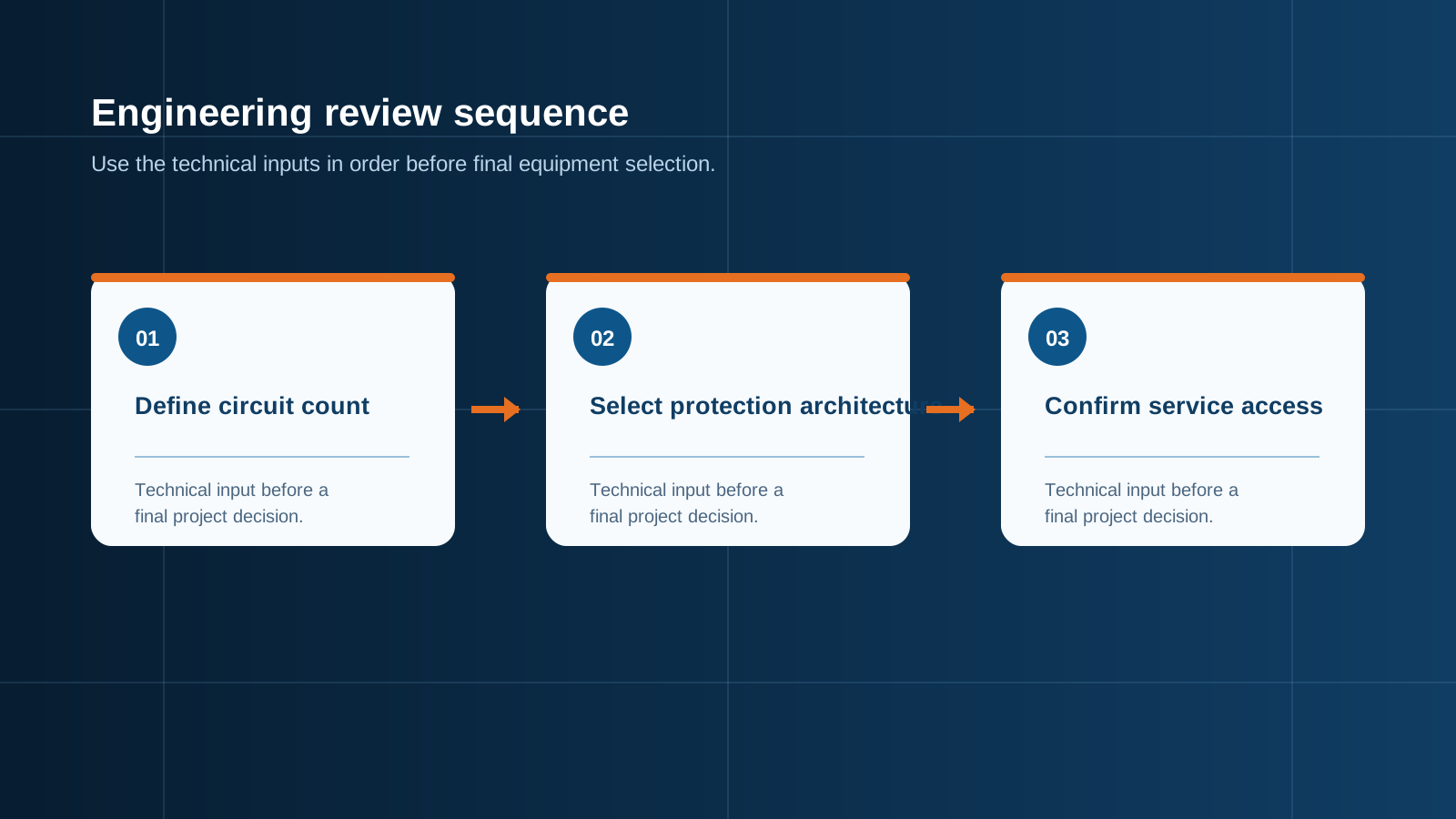
Technical diagram shown at a readable responsive scale.
5. Comparison at a glance
Functional comparison of a legacy fuse box and a modern distribution assembly.
6. Difference 4 — modularity, materials and expansion
A fuse box has a fixed number of ways. Adding a circuit means replacing the board. A distribution assembly is built around 35 mm DIN rail, so breakers, residual current devices, surge modules, contactors and metering can be added or rearranged within the existing enclosure as long as spare ways and busbar capacity were specified at the outset.
Enclosure engineering differs too. Modern assemblies use cold-rolled, galvanised or stainless steel with phosphating and powder coating — commonly RAL 7035 light grey — and are supplied with a verified protection class from IP30 or IP40 indoors up to IP54, IP55 or IP65 for exposed and washdown locations. Busbar systems are specified in copper or aluminium and rated from 100 A to 6300 A with short-circuit withstand from 50 kA to 100 kA.
That range is why the same product family covers a small wall-mounted board and a floor-standing switchboard. NEUTRON's XL-21 power distribution cabinet, GGD fixed-pattern switchgear and GCS withdrawable assemblies are all built on the same verification discipline, which lets a site standardise on one specification across very different load centres.
7. When replacement is justified
Not every fuse board needs immediate replacement. These conditions make the upgrade a straightforward decision.
- No residual current protection anywhere on the installation — this is the strongest single argument for replacement.
- Rewireable fuse carriers still in service — the wrong-rating risk is inherent to the design.
- No spare ways and new circuits are needed, particularly for EV charging, heat pumps or PV inverter connections.
- Signs of thermal distress — discoloured carriers, brittle insulation, an enclosure that runs warm.
- Fault level has risen at the supply point beyond the original board's withstand rating.
- Surge exposure from overhead supply, a lightning-prone site or sensitive electronic loads.
- Documentation is absent — no circuit schedule, no schematic, no test record.
8. NEUTRON distribution assemblies and devices
NEUTRON manufactures both the distribution assemblies and the devices inside them, which removes the coordination gap that appears when an enclosure builder and a device supplier are different companies.
Assemblies cover the XL-21 power distribution cabinet, GGD fixed-pattern low-voltage switchgear, GCS withdrawable assemblies, incoming and outgoing line cabinets, feeder panels, capacitor cabinets, metering cabinets, automatic transfer switch cabinets and motor control centres — built to IEC 61439 with GB/T 7251 as the national equivalent, protection class verified to IEC 60529, and devices to IEC 60947.
Devices include the WCM series moulded-case circuit breakers with rated insulation voltage of 800 V, frame currents from 63 A to 1250 A and breaking capacity up to 100 kA; the WCM1L, WCM30L and WCM7EL residual current moulded-case breakers; the DZ47LE-63, WSB7L-63 and WSB9LE miniature residual current ranges; WSH7-100 and WH1-125 isolators; and WCU8 surge protective modules with thermal disconnection and status indication.
9. Safety and limitations
Replacing a fuse board with a distribution assembly is electrical work on a live supply and must be carried out by a qualified person under the wiring rules of the destination market. The existing installation should be tested before and after the change, and any cable found to be undersized for the new protective device ratings must be corrected rather than protected optimistically.
Ratings are valid only within the stated envelope. Standard low-voltage devices are typically rated for -5 C to +40 C ambient, altitude up to 2000 m, pollution degree 3 and installation category III. Outside that envelope, derating must be agreed with the manufacturer at order stage.
This is general technical guidance, not a substitute for local electrical code, the applicable standard, product datasheets or a qualified engineer's design review. Confirm ratings and final configurations against the actual project.
Bring the project inputs to the first review.
NEUTRON can review the application context, electrical envelope, enclosure conditions and document requirements related to distribution box vs fuse box: what is the real difference? before quotation.
Discuss a technical requirementContinue learning
Explore related technical guidance in Power Distribution.
Converted from the approved Period 01 source article for Distribution Box vs Fuse Box: What Is the Real Difference?. Editorial instructions, duplicate anchor placeholders and embedded publishing directions were removed; the technical body is retained for educational use.