
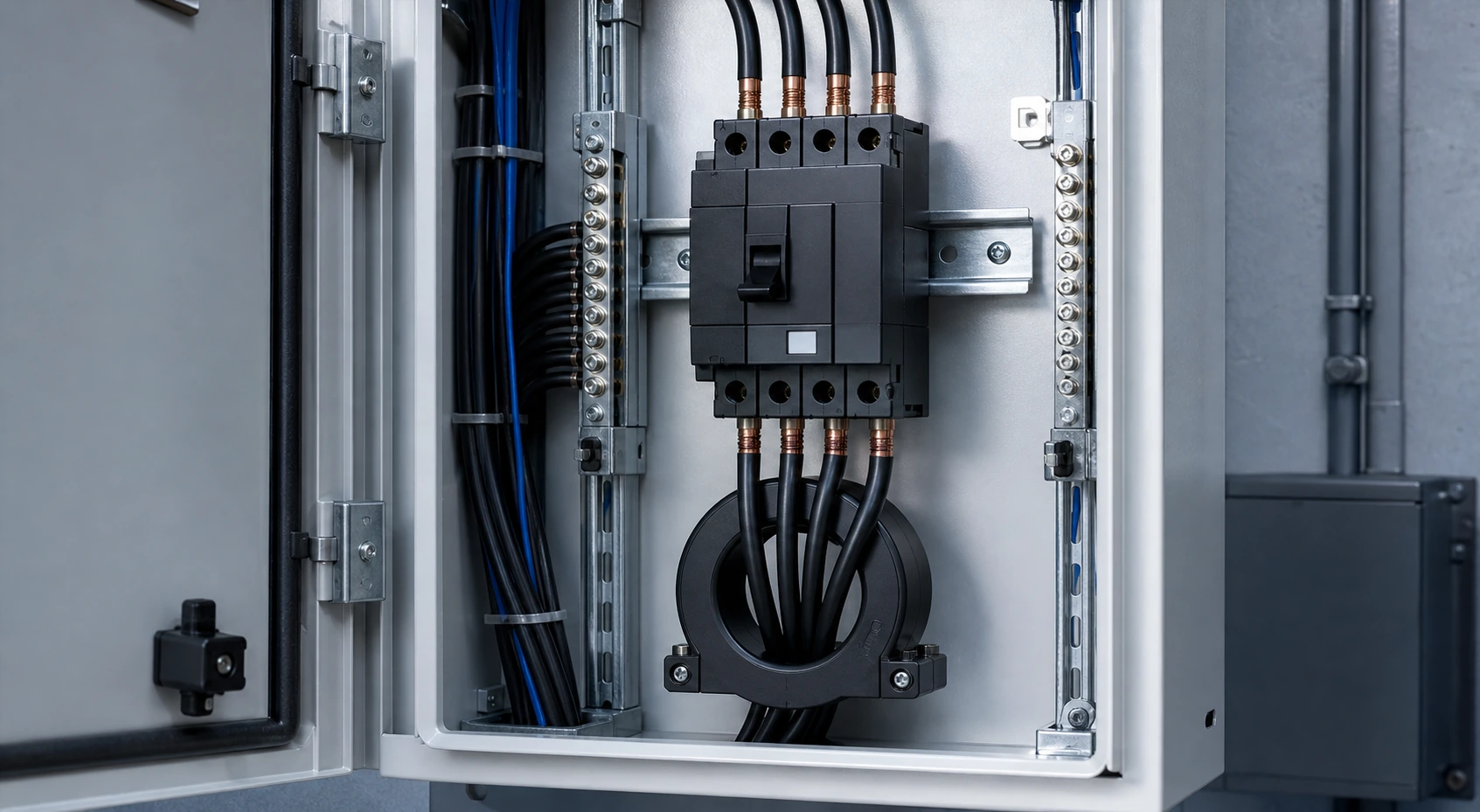
How a voltage-operated ELCB works
A voltage-operated ELCB connects its trip circuit between exposed metalwork and a separate earth electrode. It operates when the earth conductor or electrode rises to a specified potential during a fault.
- Parallel earth paths can shunt the trip circuit.
- A corroded or dry electrode can leave the device appearing normal while reducing its effectiveness.
- A person touching a live conductor while isolated from the metalwork may not create the earth potential rise the device needs.
- External earth potentials can cause nuisance operation.
How an RCCB detects leakage
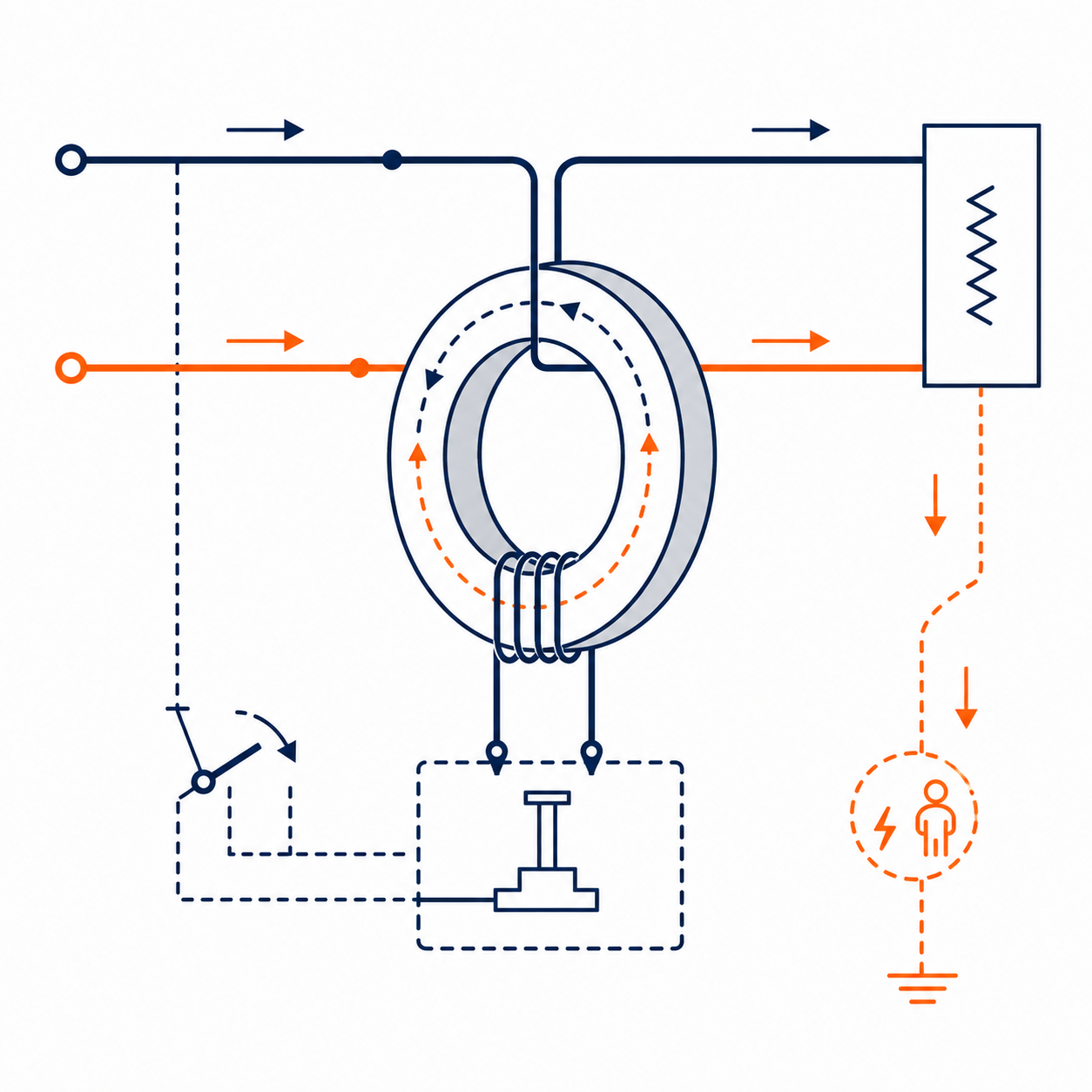
All live conductors pass through a zero-sequence current transformer. In a healthy circuit, outgoing and returning currents cancel. When current escapes through damaged insulation, moisture or a person, the imbalance drives the trip element and opens the contacts.
An RCCB protects against earth leakage and shock hazards, but it does not provide overload or short-circuit protection. It therefore needs an MCB or fuse upstream, or it can be replaced by an RCBO that combines the functions.
ELCB vs RCCB at a glance
| Characteristic | Voltage-operated ELCB | RCCB |
|---|---|---|
| Sensing principle | Earth-electrode voltage rise | Residual-current imbalance |
| Dependence | Depends on earth electrode and earth path | Measures current through all live conductors |
| Typical limitation | Parallel earth paths or electrode degradation | Needs separate overcurrent protection |
| New-installation approach | Generally obsolete technology | Select type, sensitivity, poles and rating to the load |
Choose AC, A, F or B for the waveform
The type letter describes the residual-current waveform the device can detect. Type AC is limited to sinusoidal AC. Type A adds pulsating DC, Type F adds composite and mixed-frequency currents, and Type B also detects smooth DC. Modern power electronics make waveform selection a design requirement rather than a quality label.
- Type AC: simple resistive or legacy inductive loads where permitted.
- Type A: a practical minimum for many circuits with switched-mode supplies, LED drivers or single-phase inverters.
- Type F: single-phase frequency-inverter and mixed-frequency applications.
- Type B: possible smooth-DC residual current from PV inverters, EV charging or battery systems.
Sensitivity and selectivity
30 mA is commonly used for personnel protection on final circuits. Higher values such as 100 mA or 300 mA are more often used for feeder or fire-protection duties, subject to local rules and the protection study. Upstream selective devices normally need a higher residual operating current and a time delay so downstream devices operate first.
Standing leakage from multiple electronic loads accumulates. Check the expected leakage before selecting sensitivity, especially on shared boards.
An RCCB cannot detect every line-to-neutral fault and cannot replace overcurrent protection or sound earthing. Test intervals and device selection must follow local wiring rules.
Frequently asked questions
Is an ELCB the same as an RCCB?
The terms are often used loosely, but the original ELCB was voltage-operated while an RCCB is current-operated. A current-operated ELCB is functionally an RCCB, so the sensing principle and applicable standard should be confirmed in the specification.
Does an RCCB protect against overload?
No. An RCCB detects residual current but does not provide overload or short-circuit protection. Use an associated MCB or fuse, or use an RCBO for combined protection.
Which RCCB type is suitable for an inverter load?
The type depends on the residual-current waveform and the equipment documentation. Type A is commonly considered for pulsating DC, while Type B is considered where smooth DC can occur.
What does 30 mA mean on an RCCB?
It is the rated residual operating current at which the device is designed to trip. It is commonly used for personnel protection on final circuits, subject to the local code and installation design.
Specify the correct residual-current device
Send the circuit schedule, earthing arrangement and load types so waveform class, sensitivity, pole count and overcurrent coordination can be checked together.
Request a quoteContinue learning
Explore related technical guidance in Electrical Protection.
This guide is general application guidance. Final ratings, protection coordination, standards evidence, installation and local code compliance must be confirmed against the actual project and destination-market requirements by qualified personnel.