
1. What 'best' actually means in a Gulf tender
An automatic transfer switch has one job: move the load from the normal supply to the standby supply, reliably, within the time the load can tolerate, for twenty years. In the Gulf that job is harder than in temperate markets for three reasons.
So 'best' is not a brand ranking. It is the supplier whose product is verified at your site conditions, whose assembly carries the short-circuit withstand your fault level demands, and whose paperwork the authority having jurisdiction will accept without a resubmission cycle.
- Ambient temperature. Plant rooms in Dubai, Riyadh and Doha routinely exceed the 40 °C reference ambient assumed by IEC 61439-1. Every current rating in a catalogue is stated at that reference.
- Duty cycle. Grid interruptions plus scheduled generator testing mean far more operations per year than a European standby installation.
- Dust and salinity. Fine desert dust and coastal salt attack contacts, seals and coatings simultaneously.
2. Know which supply layer you are buying from
Confusion between supply layers causes most ATS procurement disputes. Three different things are all called 'an ATS'.
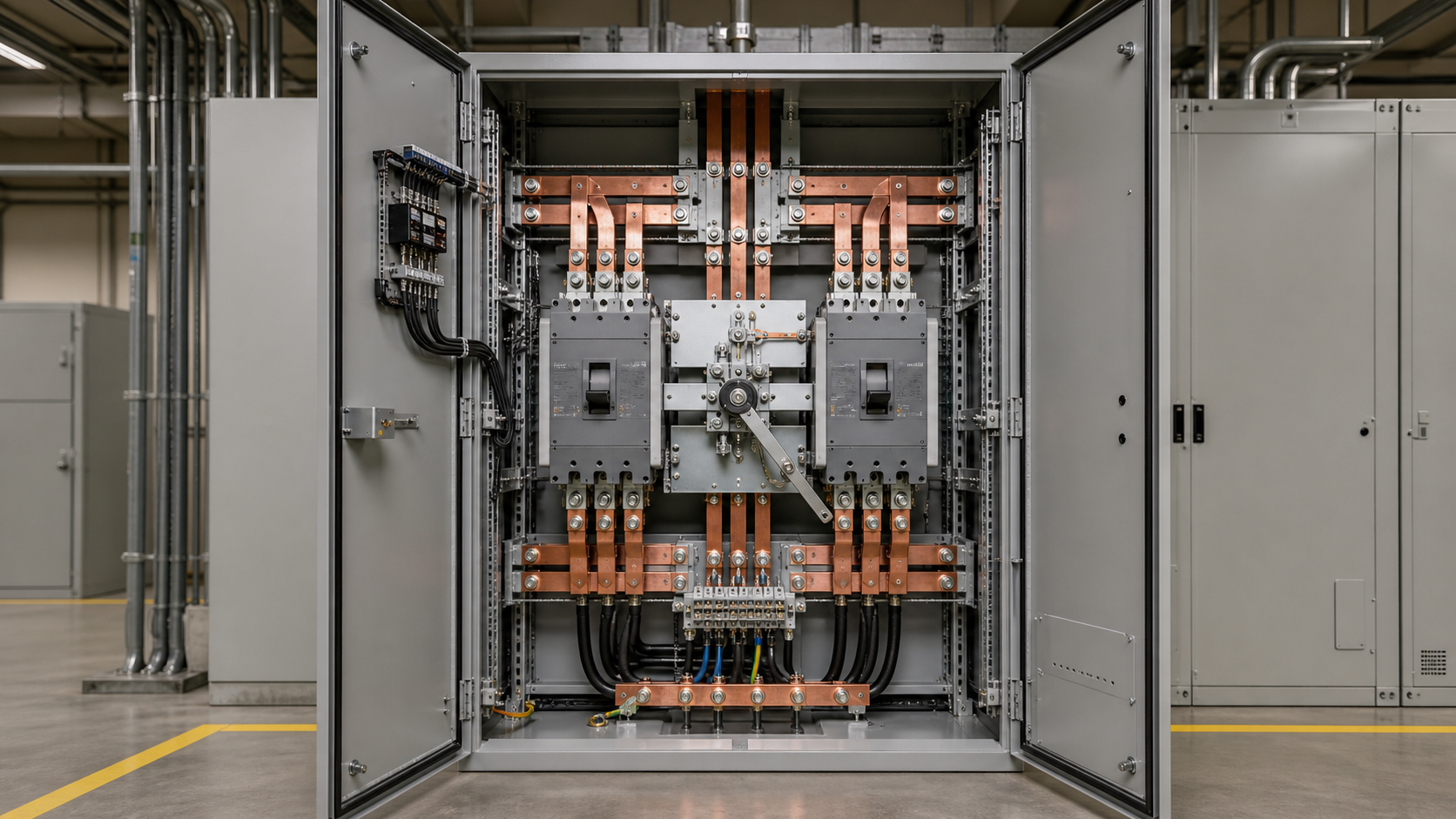
The critical point: an IEC 61439 type-tested assembly is a property of the finished panel, not of the switch inside it. A high-quality transfer switch dropped into an unverified enclosure gives you neither the short-circuit withstand nor the temperature-rise verification the specification asks for. If the tender demands IEC 61439-2 compliance, buy at the panel layer or above.
| Supply layer | What you receive | Who carries the design liability | Best for |
|---|---|---|---|
| Transfer switching device (ATSE) | The switching mechanism and controller only | You or your panel builder | Panel builders integrating into their own boards |
| ATS panel / dual-supply cabinet | Enclosed, wired, tested assembly with incoming and outgoing terminals | The assembly manufacturer | Contractors wanting a tested unit to install and connect |
| Turnkey assembly to single-line | Full switchboard including ATS section, metering, protection, capacitor and feeder sections | The assembly manufacturer | Projects with a consultant-issued single-line diagram |
3. Standards and utility approvals that gate acceptance
Beyond product standards, each Gulf utility maintains its own connection and equipment rules, and major consultants add project specifications on top. Confirm at enquiry stage which utility rules apply, whether a prior equipment registration is required, and what language the labelling and drawings must be in. Retro-fitting Arabic labelling and re-issuing drawings after manufacture is expensive and delays energisation.
4. PC class vs CB class: the decision that shapes the panel
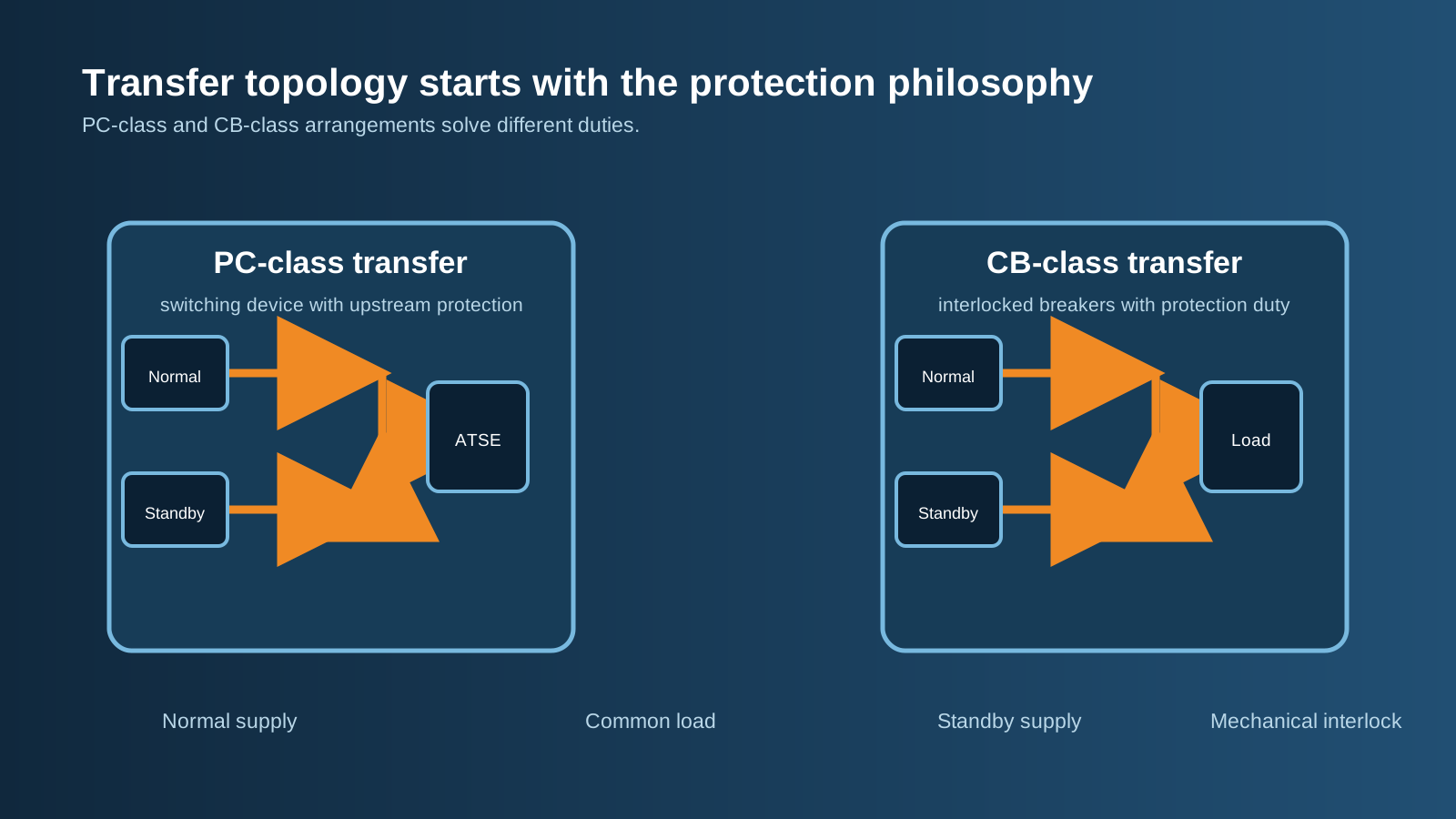
IEC 60947-6-1 divides transfer switching equipment into two classes. This choice drives panel size, cost and protection philosophy more than any other.
A common Gulf configuration is PC class for generator changeover downstream of a protected incomer, and CB class where the ATS sits at the main incoming position and must provide selective protection. Specify the class explicitly — leaving it to the supplier guarantees an apples-to-oranges tender comparison.
Technical diagram shown at a readable responsive scale.
5. Designing for 50 °C, dust and salt
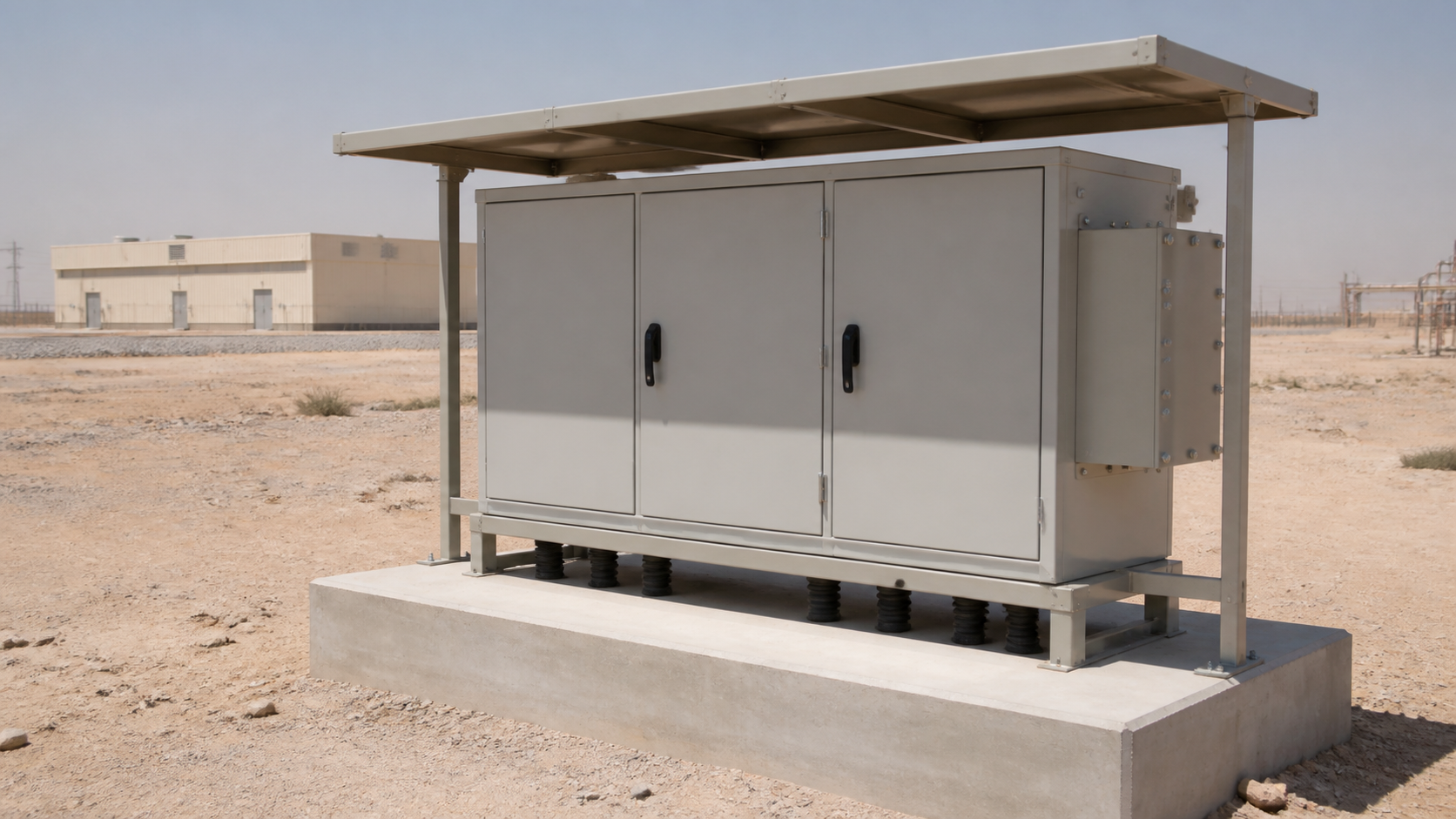
This is where many imported panels quietly fail. IEC 61439-1 assumes a maximum ambient of 40 °C with a 24-hour average of 35 °C. A plant room at 50 °C requires deliberate compensation.
- Derate current ratings. Ask the supplier for the derating factor applied and the calculation behind it, not a verbal assurance. A 630 A assembly at reference ambient is not a 630 A assembly at 50 °C.
- Upsize busbars and conductors. Copper cross-section and busbar spacing are the practical levers.
- Manage the enclosure. Forced ventilation with filters, or sealed enclosures with heat exchangers where dust prevents filtered ventilation.
- Choose the protection class honestly. IP54 for a clean indoor plant room, IP65 for dusty or outdoor positions and coastal exposure. Filtered vents and IP65 are mutually exclusive — resolve that conflict at design stage.
- Specify the finish for salinity. Phosphating pre-treatment plus electrostatic powder coating as a minimum; stainless steel enclosures and fasteners for direct coastal exposure.
- Confirm the controller's own temperature range. Electronic controllers often have a narrower rating than the switch mechanism, and they fail first.
6. Transfer logic and controller requirements
The mechanism is the easy part. Most field complaints trace back to control logic that was never matched to the load.
- Voltage and frequency sensing on both supplies, with adjustable under- and over-voltage thresholds and phase-loss detection.
- Adjustable time delays — start delay, transfer delay, retransfer delay and generator cool-down. Fixed delays cause nuisance transfers on brief grid dips.
- Neutral switching arrangement. 3-pole or 4-pole must match the earthing arrangement; a 4-pole switch with overlapping neutral is often required where separate earthing systems exist.
- In-phase or delayed transition for motor and UPS loads, to avoid out-of-phase reconnection damaging rotating plant.
- Mechanical interlock, not electrical interlock alone. The two supplies must be physically prevented from paralleling.
- Manual override with a clear operating handle and lockable positions for maintenance.
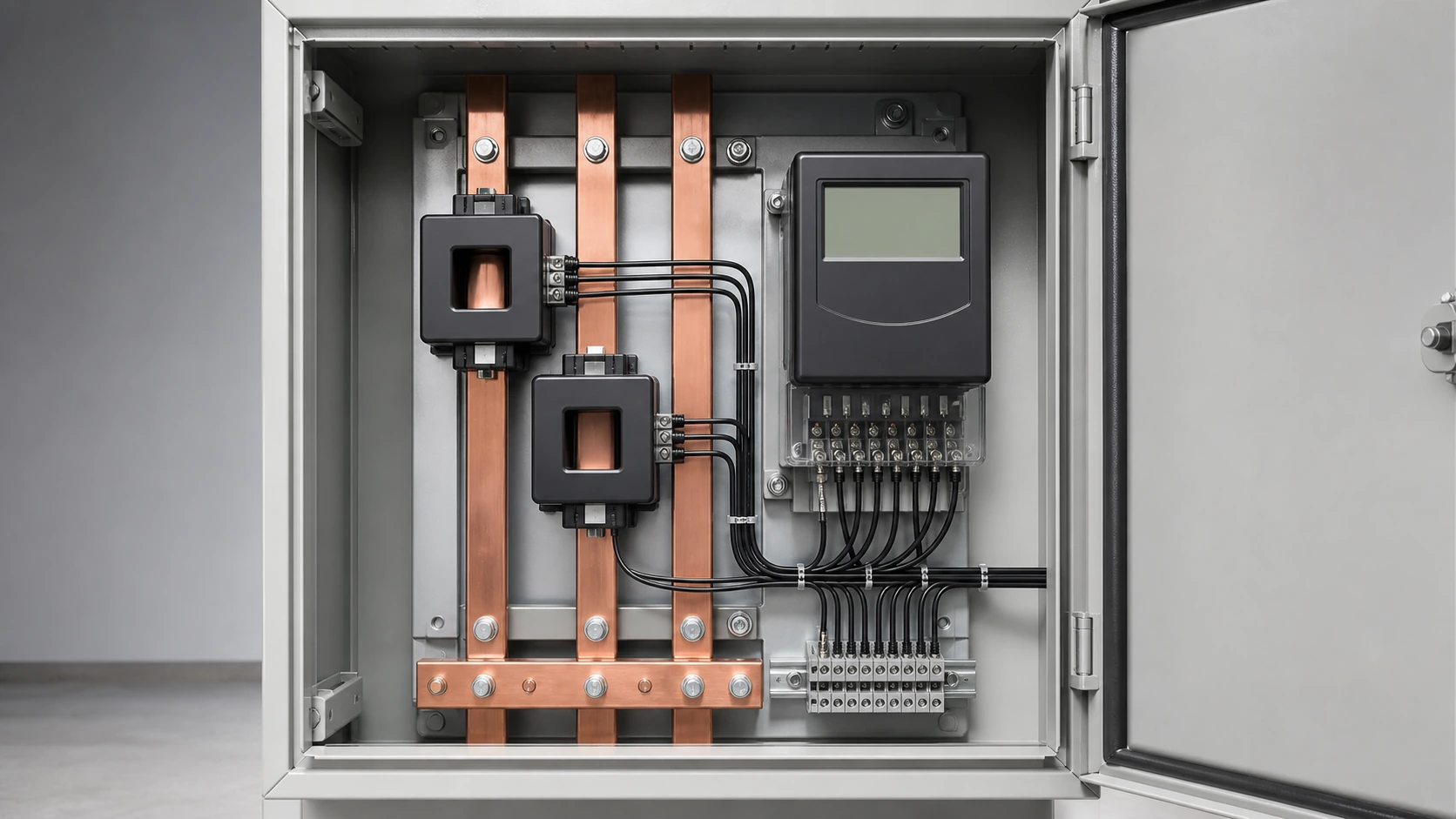
- Remote signalling — position status, alarm and fault contacts, and where required RS485 / Modbus-RTU to the building management system.
7. A practical supplier evaluation scorecard
Score each shortlisted supplier out of five on the criteria below. Anything scoring 1 or 2 on the first four rows should be eliminated regardless of price.
8. Total cost of ownership and lead time
Compare on installed and operated cost, not ex-works price:
- Panel footprint. A compact PC-class panel can save square metres of plant room — real money in a tower project.
- Commissioning time. A factory-tested assembly commissions in hours; a site-assembled one takes days and generates snags.
- Spare parts exposure. Proprietary controllers with long replacement lead times are a hidden liability.
- Maintenance access. Front-access designs cut labour cost over the asset life.
- Programme risk. A supplier quoting an unrealistically short production time usually delivers late; build a realistic sea-freight window into the schedule.
9. NEUTRON ATS cabinet capability
NEUTRON manufactures dual-supply ATS cabinets as part of a complete low-voltage assembly range, built to project drawings for export markets.
The ATS section can be supplied standalone or integrated with incomer, busbar, feeder, metering and capacitor cabinets in a single lineup, alongside GGD fixed-type and GCS draw-out switchgear, XL-21 power distribution cabinets, and motor control centres. OEM and ODM builds to a consultant's single-line diagram are standard practice, including customer labelling, drawing formats and destination-market documentation.
10. The documentation pack to demand
Safety and limitations: an ATS is a life-safety device in hospitals, data centres and evacuation systems, and the requirements for those loads exceed general guidance. Local regulations, utility connection rules and the authority having jurisdiction take precedence over anything in this guide. Installation, setting and periodic testing must be carried out by qualified personnel, and transfer testing should be scheduled rather than discovered during an outage.
- Design verification evidence to IEC 61439-1 / -2 covering temperature rise, short-circuit withstand and protection class.
- Transfer switch data to IEC 60947-6-1 with class, rated current, Icw and Icm.
- Derating calculation at the declared site ambient temperature and altitude.
- Routine test report for the specific assembly serial number, including dielectric test, wiring verification and functional transfer test.
- As-built single-line and wiring diagrams, with the schematic supplied inside the panel.
- Controller manual and setting record showing the delivered time-delay settings.
- Certificate of conformity, packing list and warranty terms.
Next step
Shortlisting ATS suppliers for a Gulf project? Send your single-line diagram, fault level, site ambient temperature, protection class and utility requirements. NEUTRON engineering will return a configured panel specification with a derating calculation and a drawing.
Browse low-voltage switchgear and ATS cabinets → https://neutronele.com/products/
This is general technical guidance, not a substitute for local electrical code, the applicable standard, product datasheets or a qualified engineer's design review. Confirm ratings and final configurations against the actual project.
Frequently asked questions
What should a Middle East ATS specification include?
State the transfer duty, PC or CB class, load type, site ambient, enclosure conditions, fault level, controls and documentation required for the project.
Why does ambient temperature matter for ATS selection?
High ambient temperature can affect the declared current capability and temperature rise of the completed assembly. Confirm the manufacturer's derating basis for the actual installation.
Does an ATS device prove the complete panel is compliant?
No. The switching device and the finished assembly are separate review scopes. The panel arrangement, busbars, enclosure and verification evidence must be confirmed for the final assembly.
Bring the project inputs to the first review.
NEUTRON can review the application context, electrical envelope, enclosure conditions and document requirements related to how to choose an ats manufacturer for middle east projects (2026 guide) before quotation.
Discuss a technical requirementContinue learning
Explore related technical guidance in Power Distribution.
Technical note: source article content is retained for educational use. Applicable standards, ratings, protection coordination and final configurations must be confirmed for the actual project and destination market.