

1. What ACDB means and where it sits
ACDB is the abbreviation for AC Distribution Box, also written as AC distribution board or AC distribution panel. It is a metal or moulded enclosure containing switching, protection and metering devices, arranged so that one incoming alternating-current supply feeds several outgoing circuits, each with its own protection.
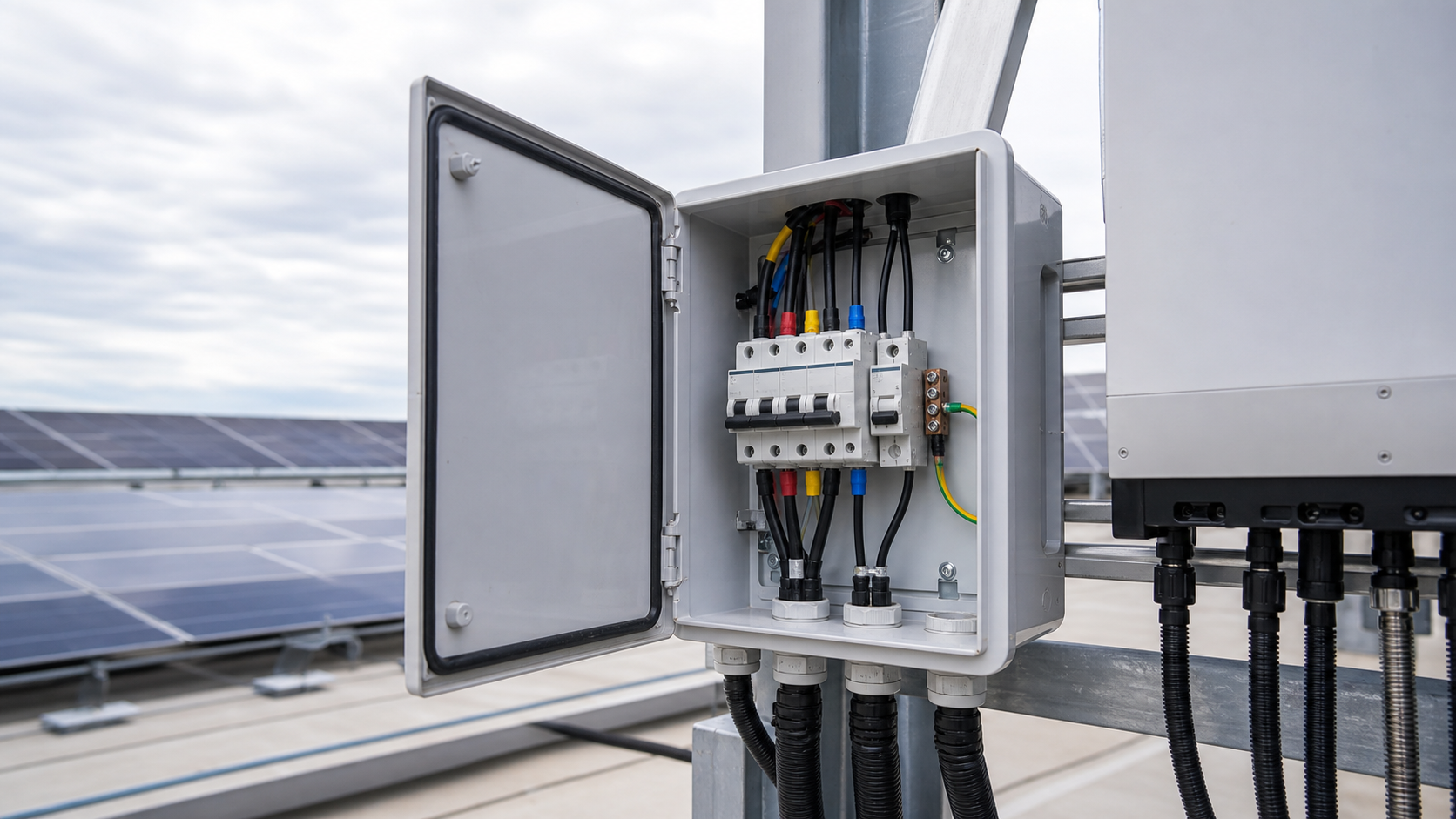
In a grid-connected solar installation the arrangement is straightforward. The array feeds a DCDB or PV combiner box on the DC side. The inverter converts DC to AC. The ACDB receives that AC output, protects it, provides a means of isolation, and passes power on to the main distribution board or the grid interface point.
Outside solar, the same equipment appears under different names. In building services it is a distribution board or consumer unit. In industrial plant it becomes a feeder panel, a power distribution cabinet or part of a low-voltage switchboard. The function is identical: controlled subdivision of an AC supply with protection at each subdivision.
- ACDB — AC Distribution Box, on the alternating-current side
- DCDB — DC Distribution Box, on the direct-current side of a PV array
- Position in a PV plant — inverter output to grid interface or main panel
- Equivalent terms — distribution board, distribution cabinet, feeder panel, power distribution panel
2. How an ACDB works
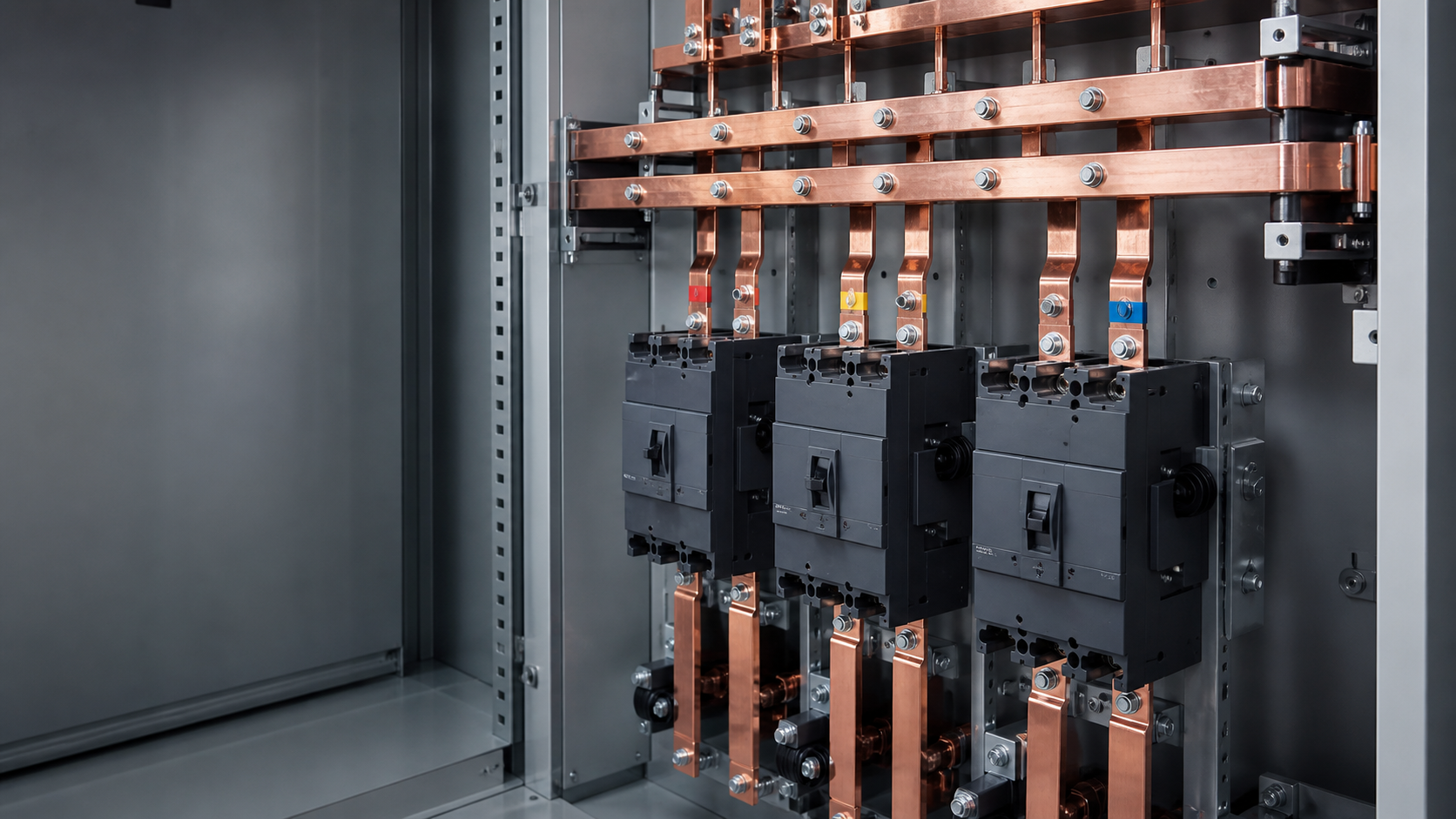
Power enters through the incoming terminals onto a set of busbars — commonly copper, sometimes aluminium on larger ratings. The busbars are the common node from which every outgoing circuit is tapped, and their cross-section is sized for the full incoming current plus the short-circuit stress the assembly must withstand.
Each outgoing circuit is taken from the busbar through its own protective device. Under normal conditions the device simply carries current. Under overload it trips on a thermal or long-time inverse characteristic. Under short circuit it trips instantaneously and must interrupt the fault current without damage to the enclosure. Under earth fault, where residual current protection is fitted, the device detects the imbalance between live conductors and opens.
The design intent is selectivity: a fault on one outgoing circuit should clear at that circuit's device only, leaving the incomer and every other circuit in service. Achieving that requires deliberate coordination of device ratings and trip characteristics from the incomer downward — it does not happen automatically because devices were bought from the same catalogue.
3. Core components inside an ACDB
The internal arrangement varies with rating and duty, but a competently built AC distribution box contains the same functional groups.
- Incoming switch or main circuit breaker — provides isolation and main protection. Miniature circuit breakers cover small boards; moulded-case breakers such as NEUTRON's WCM1 series cover frames from 63 A to 1250 A with rated insulation voltage of 800 V and breaking capacity up to 100 kA on the higher-rated types.
- Outgoing protective devices — miniature circuit breakers, moulded-case breakers, or residual current breakers with overcurrent protection where earth-fault protection is needed.
- Isolators and disconnectors — for safe maintenance access. NEUTRON's WSH7-100 miniature isolator covers 230/400 V circuits up to 100 A to GB 14048.3; the WH1-125 covers 63, 80 and 100 A in 1P to 4P with 20,000 mechanical operating cycles.
- Surge protective devices — clamp transient overvoltage from lightning and switching. NEUTRON's WCU8 modular range operates on AC 50/60 Hz supplies at 230 V and 440 V, mounts on 35 mm rail, and uses plug-in cartridges with a thermal disconnect device and a green-to-red status indicator.
- Busbars — copper or aluminium, sized to the incoming rating and the short-circuit withstand requirement, commonly specified between 100 A and 6300 A across NEUTRON's assembly range.
- Earth and neutral bars — the protective earth bar marked in yellow-green, with every conductive part of the enclosure bonded back to it.
- Metering and indication — voltmeters, ammeters, energy meters, phase indication lamps, and where required current transformers for measurement or protection.
- Terminals and glands — correctly sized terminations and cable entries; on outdoor units, waterproof glands matched to the actual cable diameter.
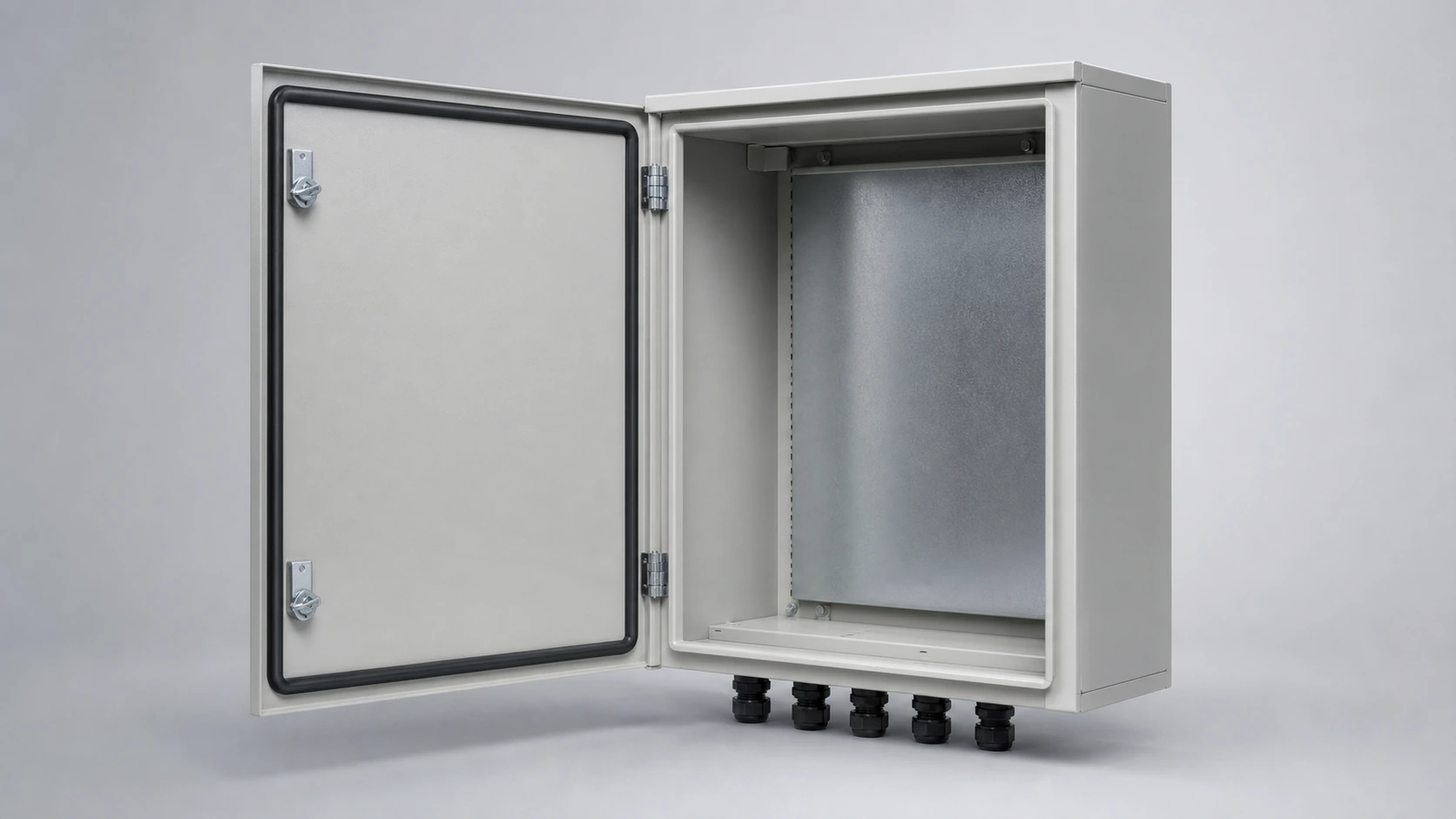
- Enclosure — cold-rolled, galvanised or stainless steel, powder coated, commonly RAL 7035 light grey, with protection class chosen from the installation environment.
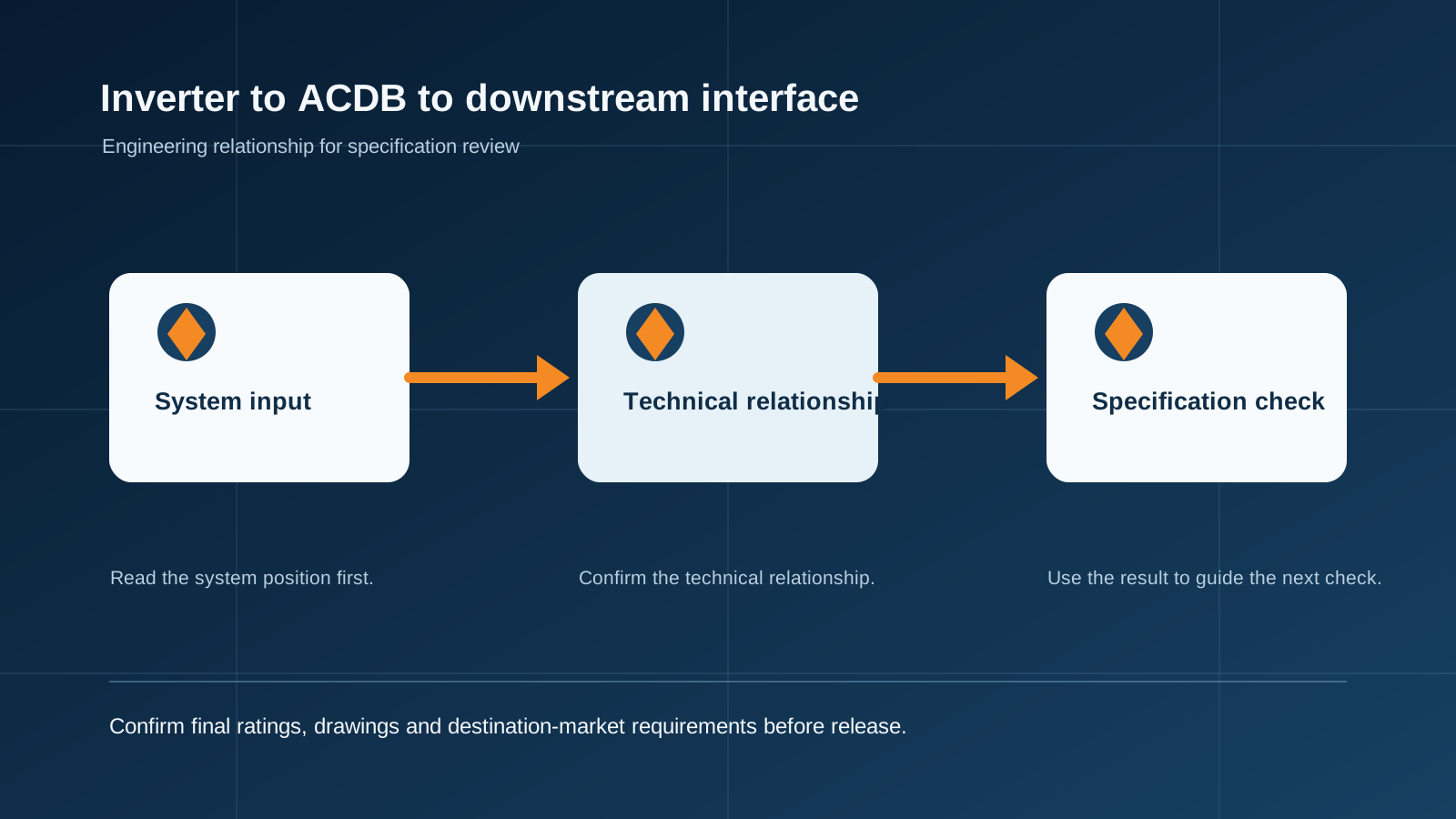
Technical diagram shown at a readable responsive scale.
4. ACDB versus DCDB — the differences that matter
Buyers frequently treat these as the same product with different labels. They are not, and the differences are safety-critical.
Functional comparison of AC and DC distribution boxes in a PV installation.
The critical point is that AC-rated devices must never be used in the DC circuit. An AC circuit breaker relies on the current passing through zero 100 or 120 times per second to extinguish the arc. A DC circuit has no current zero, so the arc has to be lengthened and cooled by design. Substituting an AC device into a DC combiner box is one of the most damaging shortcuts in PV construction.
5. Ratings and standards to specify
An ACDB enquiry should be written as a set of ratings, not as a product name. The following list covers what a manufacturer needs in order to quote accurately and what an inspector will check on delivery.
- Rated operational voltage — AC 220 V, 380 V, 400 V, 415 V or 690 V depending on the system
- Rated current — the incomer rating; NEUTRON's assembly range covers 100 A through 6300 A
- Rated short-time withstand current (Icw) — commonly 50 kA, 65 kA, 80 kA or 100 kA depending on the fault level at the connection point
- Protection class to IEC 60529 — IP30, IP40, IP41, IP42 indoors; IP54, IP55 or IP65 outdoors
- Assembly standard — IEC 61439 for low-voltage switchgear and controlgear assemblies, with GB/T 7251 as the equivalent national standard
- Device standard — IEC 60947 for circuit breakers, switches and isolators
- Enclosure material and finish — cold-rolled, galvanised or stainless steel, phosphated and powder coated, RAL 7035 standard
- Busbar material — copper or aluminium, with the cross-section stated
- Certification — CE and CB for export markets, CCC for the Chinese domestic market, with ISO 9001, ISO 14001 and ISO 45001 as manufacturer quality-system indicators
Technical diagram shown at a readable responsive scale.
6. Specification mistakes to avoid
- Quoting only rated current — without a short-circuit withstand figure the assembly cannot be engineered.
- Choosing IP class from the catalogue default — protection class comes from the installation environment, not from the model number.
- Ignoring selectivity — buying correctly rated devices does not guarantee that a downstream fault clears downstream.
- Omitting surge protection on an inverter output that connects to overhead lines or a lightning-exposed site.
- Undersized busbars — sized on load current with no allowance for short-circuit stress or ambient temperature.
- No spare ways — leave capacity for future circuits; retro-fitting into a full board is expensive.
- Using AC-rated devices in a DC box — the most dangerous error in PV distribution work.
7. NEUTRON AC distribution equipment
NEUTRON manufactures AC distribution assemblies across the range from wall-mounted distribution boxes to floor-standing switchboards, built to IEC 61439 with devices to IEC 60947 and protection class verified to IEC 60529.
The XL-21 power distribution cabinet is the workhorse for industrial and commercial AC distribution, with GGD fixed-pattern low-voltage switchgear and GCS withdrawable assemblies covering larger and more maintainable installations. Related lines include incoming and outgoing line cabinets, feeder panels, capacitor cabinets for power factor correction, metering cabinets, automatic transfer switch cabinets, motor control centres, energy storage control cabinets and PV grid-connection cabinets.
Standard configuration covers rated currents from 100 A to 6300 A, operational voltages at 400 V, 415 V and 690 V, short-circuit withstand from 50 kA to 100 kA, and protection classes from IP30 to IP65. Enclosures are cold-rolled, galvanised or stainless steel with phosphating and powder coating, finished in RAL 7035 unless a project colour is specified. Internal devices are drawn from the same in-house catalogue — WCM series moulded-case breakers, DZ47LE and WSB series miniature and residual current breakers, WSH and WH isolators, and WCU8 surge protection.
8. Safety and limitations
An AC distribution box is engineered for a defined system. Its ratings are valid only for the fault level, voltage, frequency, ambient temperature and altitude stated at order. Standard low-voltage devices are typically rated for -5 C to +40 C ambient and altitude up to 2000 m; operation outside that envelope requires derating agreed with the manufacturer.
Installation, earthing arrangement and final circuit design remain the responsibility of a qualified engineer working to the wiring rules of the destination market. Do not open an energised assembly, do not modify busbar arrangements in the field, and confirm that any local product listing requirement is satisfied before shipment.
This is general technical guidance, not a substitute for local electrical code, the applicable standard, product datasheets or a qualified engineer's design review. Confirm ratings and final configurations against the actual project.
Frequently asked questions
What does ACDB stand for in electrical systems?
ACDB stands for AC Distribution Box. It distributes alternating-current power through protective devices, busbars and outgoing circuits.
What should be confirmed before selecting an ACDB?
Confirm system voltage, incoming and outgoing current, fault level, enclosure conditions, protection arrangement and the approved single-line diagram.
Is an ACDB the same as a DC combiner box?
No. An ACDB handles alternating-current distribution, typically after inverters or at a building distribution point. A DC combiner box combines PV strings before the inverter.
Bring the project inputs to the first review.
NEUTRON can review the application context, electrical envelope, enclosure conditions and document requirements related to acdb full form in electrical: understanding the ac distribution box before quotation.
Discuss a technical requirementContinue learning
Explore related technical guidance in Power Distribution.
Technical note: source article content is retained for educational use. Applicable standards, ratings, protection coordination and final configurations must be confirmed for the actual project and destination market.