
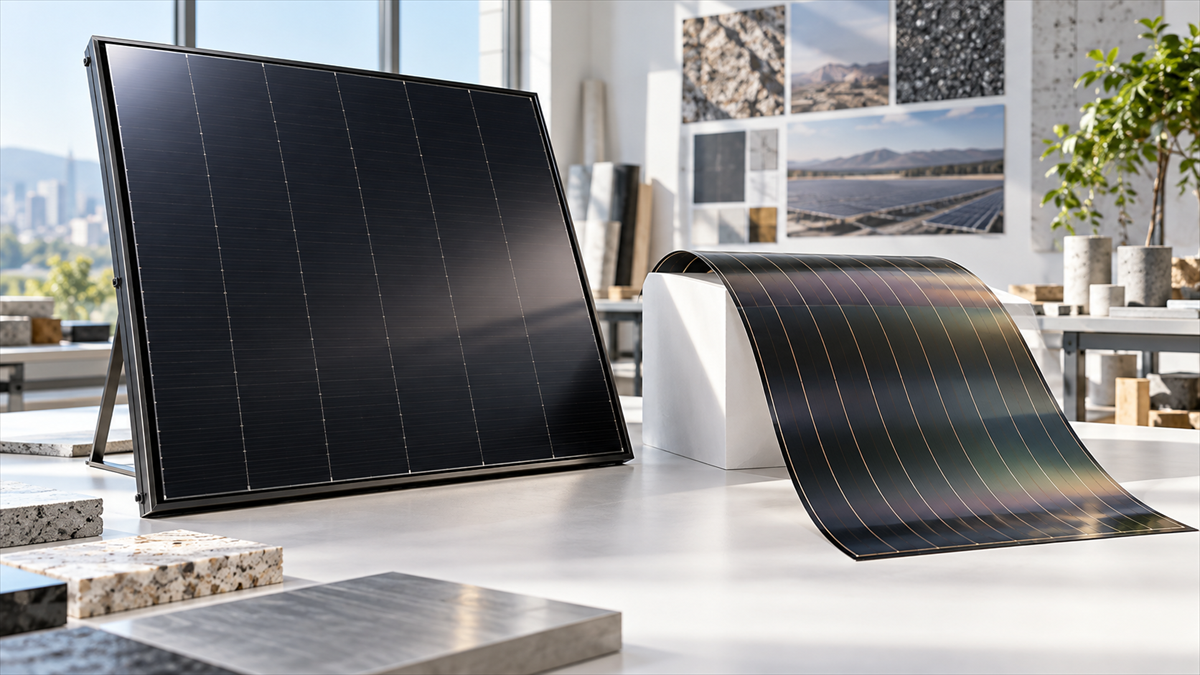
Two thin-film routes, different trade-offs
The U.S. Department of Energy identifies cadmium telluride (CdTe) and copper indium gallium diselenide (CIGS) as the two principal thin-film PV semiconductor families used in the market. Both deposit thin absorber layers onto a supporting structure, but their material systems and manufacturing routes differ.
This is not a new technology ranking. It is a 2026 buyer-facing comparison built from current manufacturer and research references, with efficiency and durability kept tied to the exact product and test basis.
Where CdTe is established
CdTe has an established utility-scale manufacturing base. First Solar's Series 7 FT1 datasheet identifies a CdTe thin-film device and publishes model-specific electrical, mechanical and temperature characteristics, including a maximum-power temperature coefficient of −0.32%/°C over its stated 25–75°C range.
That figure belongs to the named datasheet and model family. It should not be generalized to every CdTe module or compared with another product unless test conditions, construction and the measured quantity are aligned.
Where CIGS can be differentiated
CIGS can be deposited on different supporting materials, creating options for lightweight or flexible products. DOE notes that the multielement composition and manufacturing control make scaling more complex than the material concept alone may suggest.
Fraunhofer ISE's efficiency comparison places cell and module results in separate categories. The gap between a laboratory cell record and a module figure illustrates why buyers should compare like-for-like area and product format rather than infer commercial performance from a cell chart.
Qualification and sourcing checks
For either technology, review the full module datasheet, environmental and safety qualification, warranty, recycling pathway and supplier-specific product availability. A temperature coefficient or degradation statement is meaningful only with its measurement definition and warranty conditions.
CdTe also requires clear material-handling, end-of-life and jurisdictional compliance documentation. Regulatory language should be checked against the applicable product scope; broad claims about a universal ban or exemption can mislead procurement teams.
Selection should follow the application
Thin-film PV is not one uniform category. The choice between CdTe, CIGS and crystalline silicon depends on site conditions, available product formats, supplier bankability, mounting constraints and lifecycle requirements—not on a single cell-efficiency figure.
Frequently asked questions
Are CdTe and CIGS the same kind of solar module?
Both are thin-film PV technologies, but they use different absorber materials and manufacturing routes. Product construction, efficiency and mechanical format vary by manufacturer and model.
Does First Solar's temperature coefficient apply to every CdTe module?
No. The −0.32%/°C value cited here is from the Series 7 FT1 datasheet and applies within the temperature range stated there. It is not a generic CdTe specification.
Can a flexible CIGS cell result predict module output?
Not by itself. The module area, interconnection, encapsulation, stabilization and measurement method must be considered. Compare module-level data for the actual product format.
Use the news as a project input, then verify the scope.
This News item is editorial context. Confirm the final datasheet, applicable standard, project conditions and acceptance evidence before changing a design or purchase decision.
Discuss a project implication