
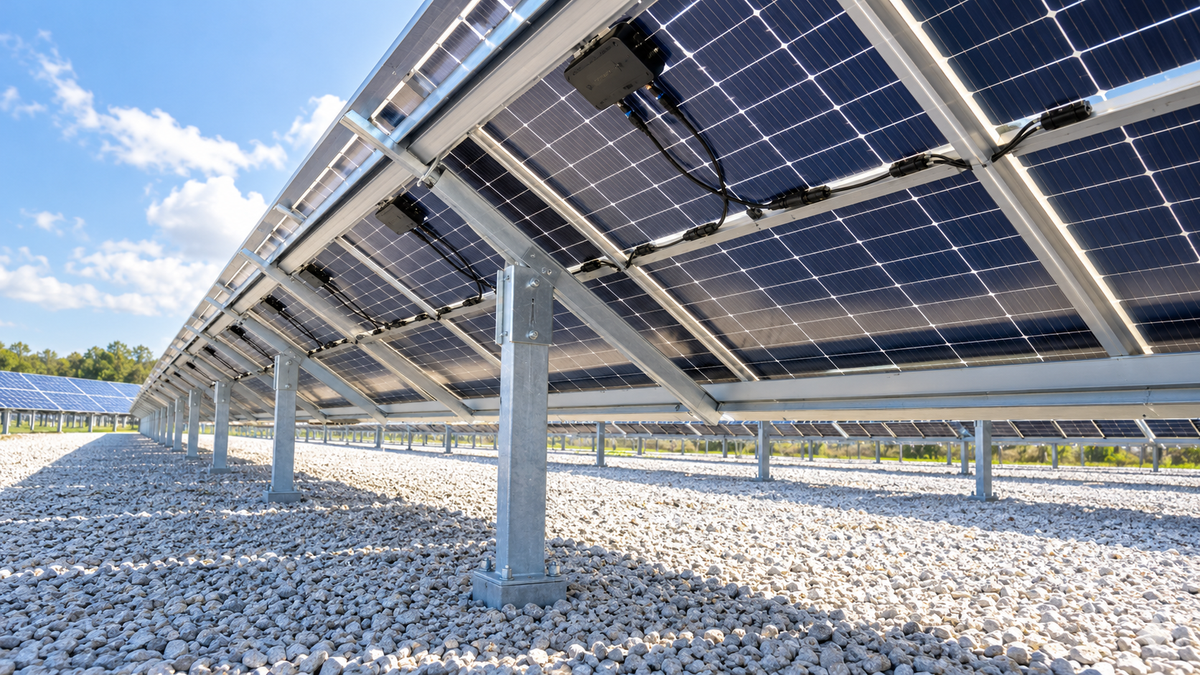
A defined field dataset with a recorded update
The public Golden, Colorado bifacial vertical-testbed catalogue records a December 6, 2024 submission and a March 12, 2026 update. It provides field, weather and setup resources associated with validation of optical models for vertical photovoltaics under high-albedo conditions. The update date does not make every measurement a new 2026 experiment.
The dataset gives modelers a documented case to study. Its vertical geometry and site conditions are part of that case. It cannot establish one annual gain for horizontal rooftops, tilted ground arrays and trackers, nor does the catalogue page alone quantify the accuracy of every commercial modeling package.
Define the comparison before assigning a gain
For a project comparison, define bifacial gain as additional energy relative to a specified reference over the same period. State whether the reference holds module front-side rating, array layout and other equipment constant. Otherwise, a reported difference may include changes beyond rear-side collection.
Keep the module's rear-to-front response separate from system energy gain. A bifaciality parameter describes a device property under stated measurement conditions. Annual energy also depends on the irradiance reaching the rear, the array configuration and electrical losses. The two percentages cannot be substituted for each other.
Record the geometry and ground conditions
A modeling review should specify albedo assumptions, row spacing, clearance, orientation and nearby obstructions. Inspect whether the rear sees open ground or substantial shading from mounting members and neighboring rows. Retain the input geometry with the result so another engineer can reproduce the comparison.
The laboratory's bifacial_radiance software entry identifies an open-source tool for this work. Selecting a tool does not remove the need to build and validate the scene correctly. A model label by itself cannot establish that a proposed array is accurately represented or that one mounting height is optimal for every site.
Use the field case within its scope
To evaluate a model against the Golden dataset, follow its setup documentation, measurement times and weather inputs. Compare modeled and measured quantities at equivalent locations and periods. Report the data coverage and the error measure, rather than selecting a favorable interval and extending it to an annual project forecast.
The 2021 IEA PVPS bifacial report remains useful background on technology and field experience. Its publication year should remain visible when cited alongside the updated dataset. Historical guidance and a current catalogue update serve different roles; neither supplies a new universal gain range for 2026.
Translate the review into a project sensitivity
For a project estimate, test plausible ground-reflectance and shading cases, then include inverter and other system constraints before comparing annual output. State which assumptions are measured and which are scenario inputs. A sensitivity range is more informative than importing a single gain from an unrelated installation.
Request a traceable energy model with its geometry, weather source and loss assumptions. The next useful field evidence would show how that model performs under the conditions of the intended site. This update does not prescribe one albedo, clearance height, mounting arrangement or guaranteed energy uplift.
Frequently asked questions
Does the updated dataset establish a universal bifacial gain?
No. It is a defined vertical-array validation case under particular site and ground conditions.
Is module bifaciality the same as annual energy gain?
No. Device response and the system's additional energy have different definitions and inputs.
What makes a model comparison reproducible?
The reference design, geometry, weather, albedo, measurement periods, loss assumptions and stated error measure.
Use the news as a project input, then verify the scope.
This News item is editorial context. Confirm the final datasheet, applicable standard, project conditions and acceptance evidence before changing a design or purchase decision.
Discuss a project implication