
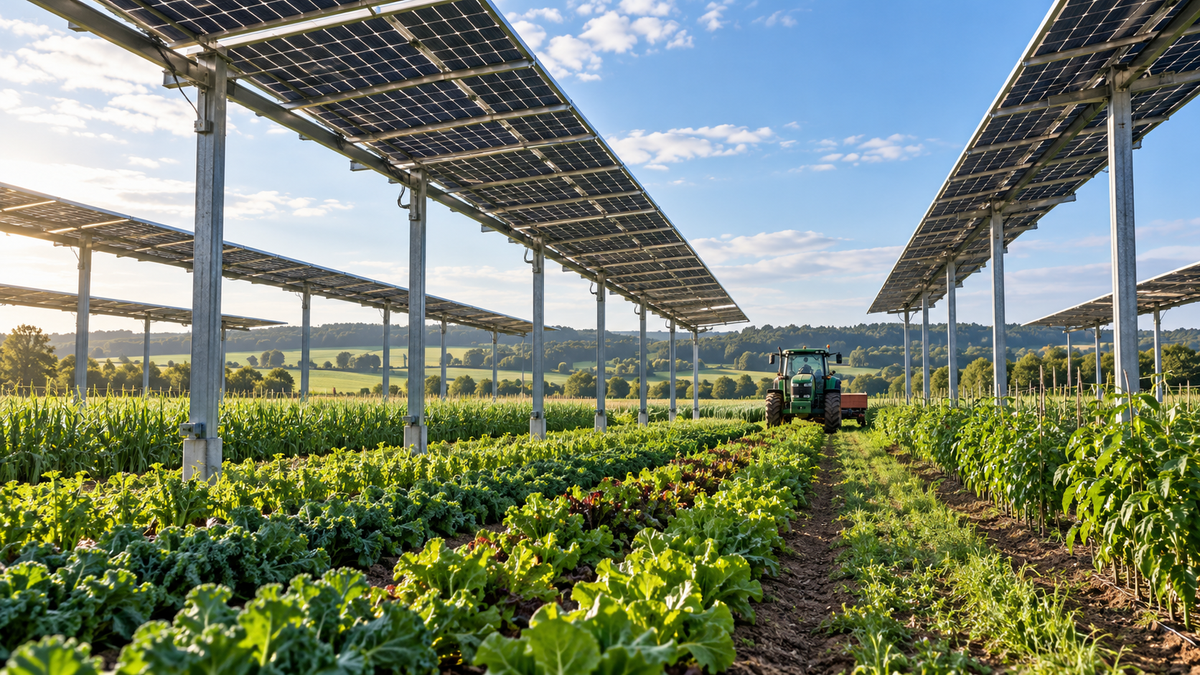
What the documented guidance establishes
Fraunhofer ISE's February 2024 agrivoltaics guideline examines combining agricultural production with renewable electricity on the same land. It discusses technical options, practical implementation and the German regulatory setting. This is an established research and planning reference being reviewed in 2026; it is not evidence of a new global deployment target.
The guideline identifies opportunities for land-use efficiency, water management and additional farm income. Whether a particular farm captures those benefits depends on its crops, weather and project design. Its historical cost examples should remain tied to the original study context rather than being used as a current project quotation.
Start with an agricultural comparison
For a project appraisal, define the agricultural baseline before estimating a benefit. Compare the proposed crop rotation with a nearby, documented reference area and record irrigation, soil conditions and management practices. Agricultural performance needs its own measurement plan alongside the electricity meter.
A useful specification asks how shading changes across the growing season and which crop stages are most sensitive. Annual electricity production alone cannot answer that question. Ask the agronomist and solar designer to review the same layout, with explicit assumptions for row geometry and the intended farming operations.
Make access part of the layout decision
Map the actual equipment routes, turning space and working envelope before fixing the array arrangement. Include harvest operations, access after rain and maintenance vehicles. A drawing that fits modules onto a parcel can still require changes when the farmer reviews the operating sequence.
For an elevated or vertical arrangement, request a construction-specific review of clearances, foundations and cable routes. Neither label establishes a universally suitable crop or best array height. Include the responsibilities for vegetation, irrigation and solar maintenance in the operating agreement.
Keep the two income streams auditable
Evaluate crop sales and electricity income separately before combining them. Identify who owns the generation equipment, who receives the electricity payment and who bears additional agricultural labour. Run scenarios for crop prices, financing, downtime and changes in farming costs rather than assuming two revenues automatically mean a higher margin.
Check the local land-use classification, approvals and grid-connection conditions for the actual parcel. German guidance can inform questions but does not establish permission in another jurisdiction. Farm continuity and energy export each need evidence from the parties responsible for them.
What a useful field update should report
A strong project update would identify the crop, location, seasons observed and reference treatment together with energy production. Record interruptions and layout changes so a reader can understand whether differences arose from the solar structure, weather or farming practice.
For procurement, translate that evidence into a site-specific acceptance plan. Agree who collects the data, how agricultural access is maintained and when the combined performance will be reviewed. This makes the dual-use proposition testable without promising one revenue uplift for every farm.
Frequently asked questions
Does agrivoltaics guarantee higher farm profit?
No. Compare crop revenue, energy revenue and the additional capital and operating costs for the specific farm.
Is one array height suitable for every crop?
No. Crop needs, machinery clearance, structural design and local conditions must be reviewed together.
Is the cited guideline a new 2026 policy?
No. The English Fraunhofer ISE guideline cited here is dated February 2024.
Use the news as a project input, then verify the scope.
This News item is editorial context. Confirm the final datasheet, applicable standard, project conditions and acceptance evidence before changing a design or purchase decision.
Discuss a project implication