
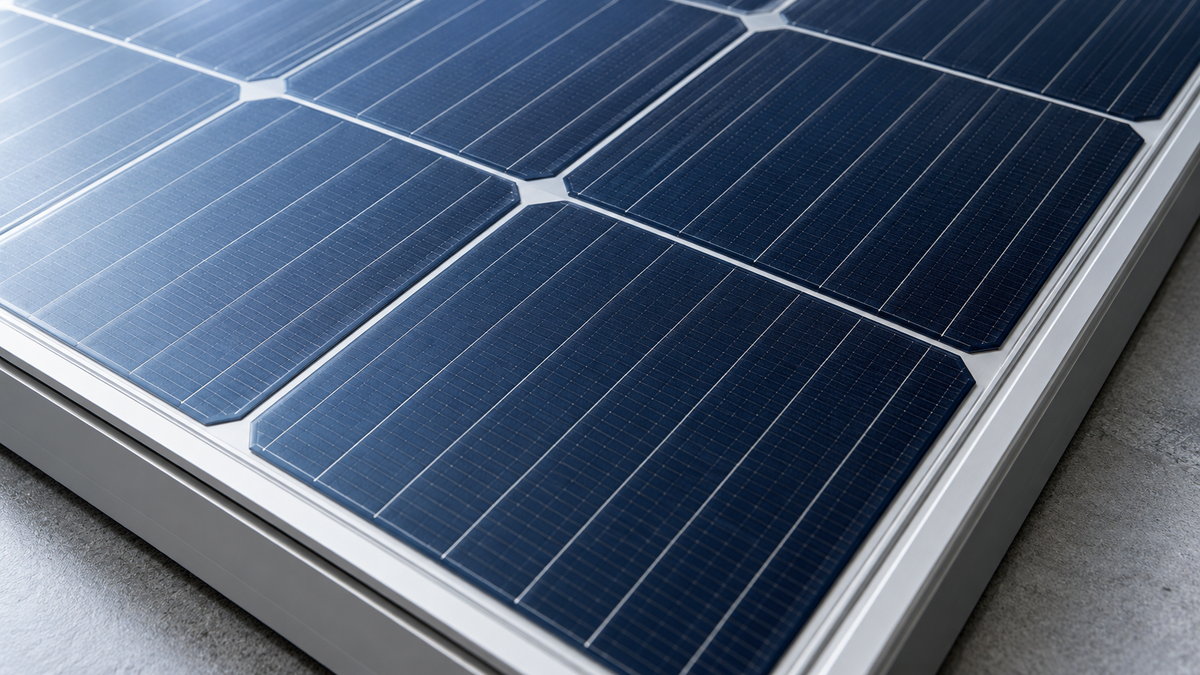
Packaging density is a design lever, not a universal result
In 2026, two manufacturers described module designs that increase active cell coverage or reduce non-active gaps. The announcements are useful examples of how module packaging is being engineered, but their measurements belong to separate products and companies. They do not establish a guaranteed gain for every module that uses narrow spacing, hidden busbars or a zero-busbar layout.
This update keeps the claims separate: Huasun’s April 1, 2026 report concerns its Himalaya Plus 2000V HJT module shown at the Clean Energy Expo China; AIKO’s event page concerns products presented at SNEC in Shanghai from June 3 to 5, 2026. Neither result is attributed to the other manufacturer or to NEUTRON.
Huasun: a specific 2000V HJT module
Huasun reported that its Himalaya Plus 2000V module used a high screen-to-body ratio and negative-gap design. The company stated that the design increased effective power-generating area by 2.1%, reached a 95.8% screen ratio, improved conversion efficiency by 0.66% and added 20 W. These are manufacturer-reported figures for the identified Huasun product and its stated comparison; they should not be restated as a general packaging formula.
The announcement does not provide, in the short news item, a full independent side-by-side data table for every baseline configuration. A buyer comparing the claimed increment should therefore request the relevant datasheets, product dimensions, test conditions and reference model. A 20 W difference has meaning only when the compared module format and baseline are clear.
AIKO: a separate SNEC 2026 product claim
AIKO’s SNEC 2026 page says the event took place June 3–5 and reports that its G4 Ultra ABC modules reached mass-production efficiency of up to 26%, with standard-size 2382 × 1134 mm modules entering a 690 W class. The page separately describes high cell coverage and full-screen design features. These are AIKO’s own claims about its products and presentation; they are not Huasun specifications.
The page discusses multiple cell and module design changes, so the 26% and 690 W figures should not be attributed solely to packaging density. Product power depends on active area, cell efficiency, electrical layout and the measurement conditions. The public event page is a manufacturer source, not a cross-vendor standardized comparison.
Do not combine unlike numbers
A percentage-point change in module conversion efficiency, a percentage change in active area, and an increase in nameplate watts are different quantities. They may describe the same product development from different angles, but they are not interchangeable and should not be added together. Nor should figures from distinct manufacturers be combined into one implied industry result.
A valid comparison needs a defined baseline: the same outer dimensions, cell architecture or product class, test conditions, front-glass and frame design, rated-power convention and datasheet revision. If any of these differ, the comparison may still be commercially useful, but its limitations should be explicit.
What module buyers should check
Request the exact model number and current datasheet, module dimensions, rated power and tolerance, efficiency basis, temperature coefficients, mechanical loads, mounting zones and warranty. For a claim about a design increment, ask for the baseline product and test method. Confirm that the offered variant—not merely a family name—matches the report being cited.
Then translate a higher nameplate wattage into the project’s constraints. Module area, string voltage and current, inverter input limits, mechanical fit, transport handling and replacement compatibility can matter as much as watts per panel. A design with higher cell coverage is not automatically the best choice if it does not fit the project’s electrical and structural envelope.
Use the examples without turning them into promises
The 2026 announcements show two distinct approaches to high-density module design: a Huasun HJT product with company-reported area, efficiency and power increments, and AIKO ABC products with separate manufacturer-reported efficiency and power figures. They are dated examples, not universal outcomes. Keep the maker, product, baseline and metric attached to every number.
Frequently asked questions
What did Huasun report for its Himalaya Plus 2000V module?
Huasun reported a 2.1% increase in effective power-generating area, a 95.8% screen ratio, a 0.66% conversion-efficiency increase and a 20 W gain for that specific product design.
Are Huasun’s figures the same as AIKO’s 26% and 690 W claims?
No. Huasun and AIKO reported separate products and metrics. The figures must remain attributed to their respective manufacturers and must not be combined.
Does packaging alone explain AIKO’s 26% or 690 W figures?
AIKO’s page describes multiple cell and module changes. It does not support attributing those product figures solely to packaging density.
Can buyers compare wattage claims directly?
Only after aligning product dimensions, baseline model, test conditions, rating convention and datasheet revision. Otherwise the comparison may not be like-for-like.
Use the news as a project input, then verify the scope.
This News item is editorial context. Confirm the final datasheet, applicable standard, project conditions and acceptance evidence before changing a design or purchase decision.
Discuss a project implication