
One study with two reported efficiency measures
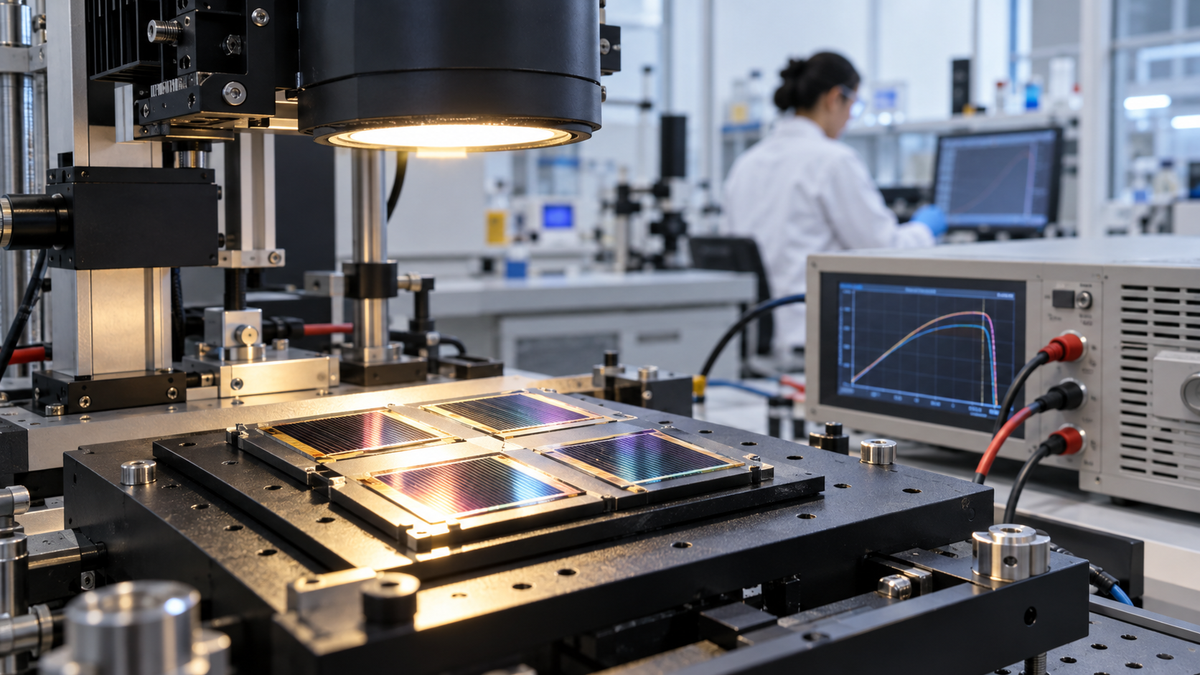
A Nature paper published on July 13, 2026 reports a perovskite–organic tandem solar cell using a photo-transformable additive. The authors report a power conversion efficiency of 28.80% and a certified steady-state value of 28.04%. These figures describe the research device and should remain distinguished in any subsequent comparison.
The same paper reports retention of 90% of initial efficiency after 625 hours of operation under the ISOS-L-1 protocol. This is a defined experimental observation. It does not establish a commercial module warranty, an outdoor service life or qualification for operation in space.
The material strategy addresses a particular limitation
The researchers introduce an additive into the wide-bandgap perovskite precursor and describe its role during crystallisation and illumination. Their explanation connects improved initial mixing with suppression of later light-induced halide segregation. The work concerns a perovskite front cell paired with an organic rear cell.
That device architecture should not be relabelled as perovskite–silicon or as an all-perovskite tandem. When comparing records, preserve the absorber combination and test format. A higher number from a different device family does not by itself invalidate or reproduce this result.
Separate a research result from a purchasing specification
For technology assessment, request the supporting measurement conditions, sample construction and stability procedure before comparing retention figures. Record the reference efficiency and how the device was operated during exposure. An elapsed test duration has meaning only with its stress and measurement conditions attached.
A development review can then ask what changes when the active area or manufacturing process is scaled. Relevant evidence would include repeat samples, process uniformity, interconnection and encapsulation results. These are questions for the next development stage, rather than outcomes that can be inferred from the reported efficiency alone.
Keep application prospects conditional
Lightweight and flexible applications are a useful research direction, but a possible use in buildings, portable systems or spacecraft requires application-specific evidence. Structural, environmental and electrical requirements should be identified for the actual proposed format. Laboratory illumination does not reproduce every field or mission exposure.
The immediate contribution is a documented materials and device result. A practical next comparison would connect that result with reproducible larger-format samples and a clearly described operating test, while preserving the original efficiency and stability measurements as separate pieces of evidence.
Frequently asked questions
Which efficiency value is certified steady state?
The paper reports 28.04% certified steady-state efficiency, alongside a reported 28.80% power conversion efficiency.
Does 625 hours establish years of field life?
No. It is an ISOS-L-1 operating test and requires a separate validated relationship before any service-life inference.
Is this a perovskite–silicon tandem?
No. The study combines a perovskite front cell with an organic rear cell.
Use the news as a project input, then verify the scope.
This News item is editorial context. Confirm the final datasheet, applicable standard, project conditions and acceptance evidence before changing a design or purchase decision.
Discuss a project implication