
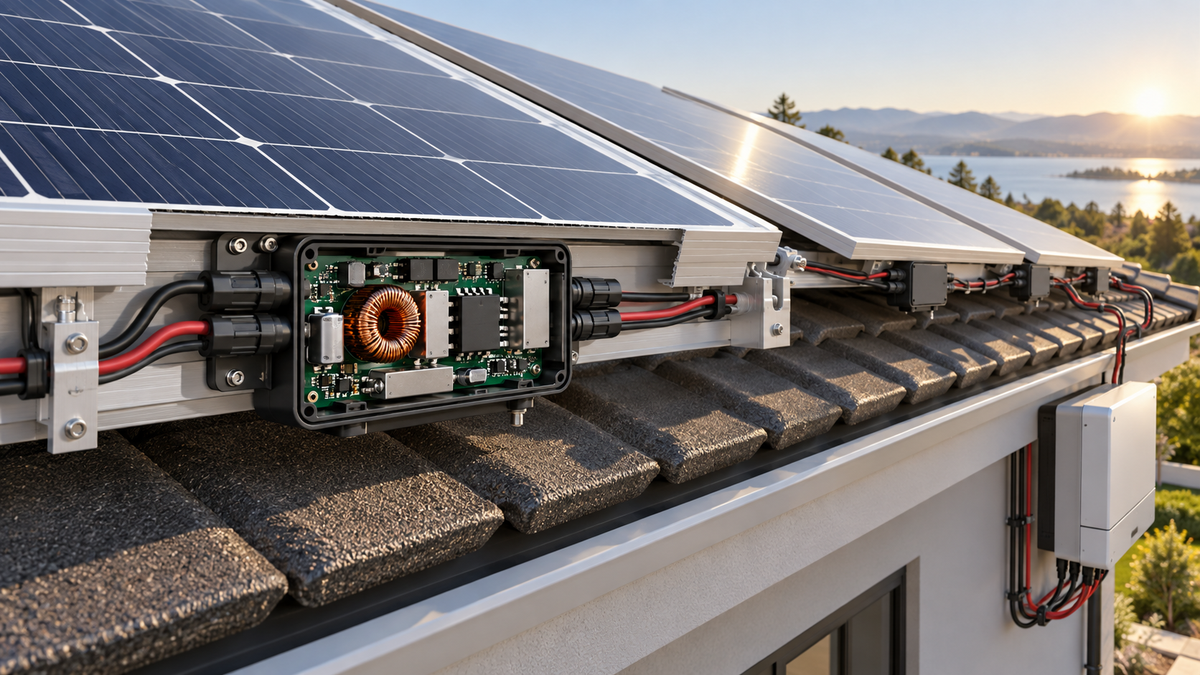
The announcement concerns a particular converter stage
An Infineon announcement dated 23 June 2026 says BRC Solar selected CoolGaN 100 V devices for a module-level PV power optimizer. The application concerns a DC/DC converter stage within a larger PV system. The announcement identifies a supplier design selection, rather than independently proving the complete product’s field performance or system-voltage rating.
This is evidence of a component design selection, not a standalone certification of the optimizer, inverter or entire array. It also does not establish a generic conclusion about every SiC or GaN gate structure.
Separate four voltage boundaries
A switch blocking-voltage rating describes the stress the semiconductor is designed to withstand under its specified conditions. Module input voltage, optimizer output limits and maximum system voltage describe different electrical boundaries.
A circuit can place lower-voltage devices inside equipment used in a higher-voltage system, but isolation, topology and coordination determine whether that equipment is suitable. A 100 V component statement cannot be used as proof of a 1500 V system rating.
An optimizer is not a microinverter
The optimizer application performs DC/DC conversion. A microinverter also supplies AC and therefore has additional output, grid-interface and protection requirements. Their shared use of module-level electronics does not make the terms interchangeable.
For a proposed optimizer string, check the supported module envelope, permitted string configuration and compatibility with the downstream inverter. Include start-up and shutdown behaviour rather than considering maximum-power-point operation alone.
Ask for evidence at each product boundary
Component data can inform switching-loss, thermal and reliability analysis. Product decisions need the complete converter ratings, applicable test reports, installation instructions and defined environmental conditions.
The announcement provides a useful example of GaN entering a concrete PV application. Its significance is clearer when the semiconductor selection is kept distinct from claims about certified system voltage, universal lifetime or the comparative reliability of unrelated device architectures.
Frequently asked questions
Does a 100 V switch make the whole array 100 V?
No. Device stress and equipment system voltage have different boundaries.
Is the reported product an AC microinverter?
The reported application is a module-level DC/DC power optimizer.
What evidence establishes system suitability?
Use the optimizer and inverter specifications, approved configuration and applicable product-level tests.
Use the news as a project input, then verify the scope.
This News item is editorial context. Confirm the final datasheet, applicable standard, project conditions and acceptance evidence before changing a design or purchase decision.
Discuss a project implication