
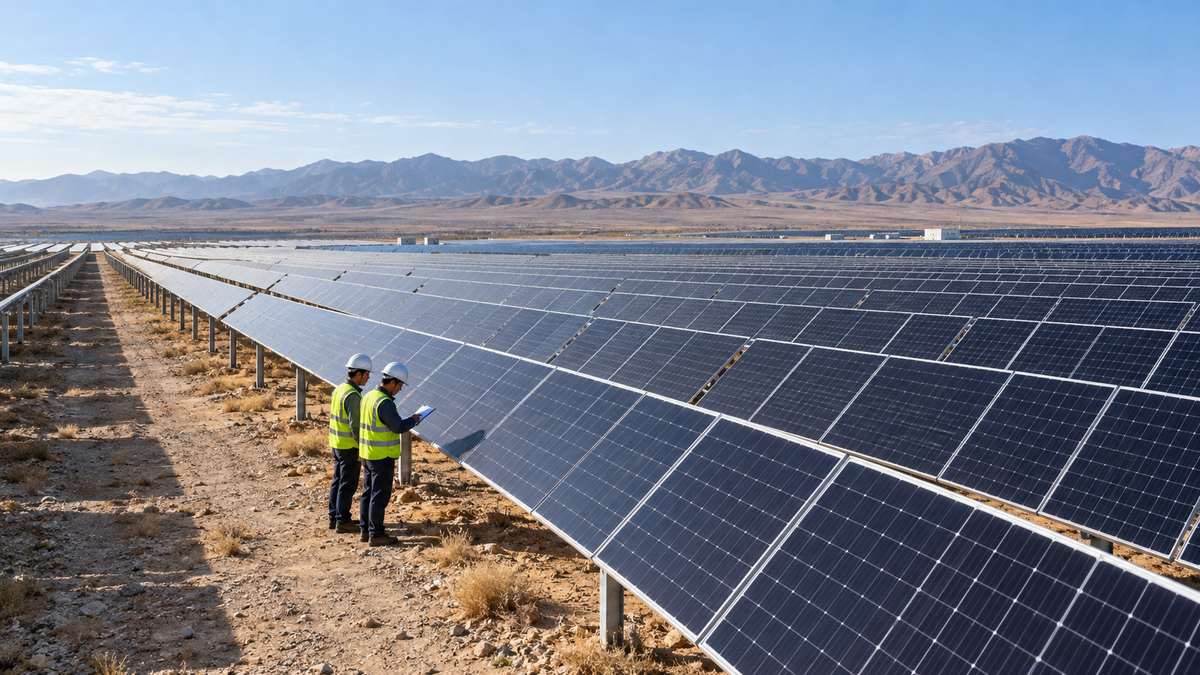
Separate the project report from the market narrative
A Jiemian finance article published on February 24, 2026 reports that a 500 MW desert-control PV project in Dalate Banner had reached full-capacity grid connection using back-contact modules. The same article discusses a space-solar investment theme. Its project account is attributed secondary reporting; the owner’s commissioning documents and as-built module schedule were not independently examined.
A project team considering back-contact modules can use the lead to request the owner's commissioning record, delivered module schedule and operating data. The report alone should not establish an independently verified national size ranking or the acceptance status of every component supplied to the project.
Define what a field comparison would establish
A useful comparison identifies the installed construction, site, monitoring interval and reference system. Record irradiation measurements, availability, curtailment and relevant maintenance during the period. Without those boundaries, an observed difference can be attributed to cell architecture when other operating conditions were responsible.
Keep initial power, annual energy and degradation as separate measures. A module can have a particular nameplate rating without demonstrating a universal annual-energy advantage. The comparison should explain the baseline and uncertainty rather than presenting the largest installation as the strongest technical proof.
Review the complete delivered module
For procurement, request electrical characteristics, physical dimensions and qualification records for the offered construction. Review mounting and handling requirements with the project designer. The relevant question is whether the delivered module meets the project specification, including the intended environmental conditions.
Ask how construction changes and replacement products are controlled. A field result for one bill of materials may not transfer automatically to another model carrying a similar technology label. Traceability between the tender, delivery documents and operating records makes the comparison more useful.
Terrestrial deployment is a different evidence boundary
A discussion of space photovoltaics does not convert a ground-mounted module into a spacecraft-qualified power source. Mission requirements and qualification programmes need their own review. Keep the terrestrial project evidence attached to terrestrial operation rather than using it to imply demonstrated orbital performance.
The next useful project update would publish owner-backed commissioning information and a transparent operating comparison. That would allow readers to assess the deployment on its actual technical record while keeping investment commentary, technology forecasts and mission prospects in their respective contexts.
Frequently asked questions
Does a large ground project establish space qualification?
No. Terrestrial operation and spacecraft qualification have different evidence and application boundaries.
What should support a reported commissioning claim?
An owner-backed commissioning record, delivered equipment schedule and the relevant operating or acceptance documents.
Does project size prove an energy-yield advantage?
No. Yield requires a defined reference, monitoring period and comparable operating conditions.
Use the news as a project input, then verify the scope.
This News item is editorial context. Confirm the final datasheet, applicable standard, project conditions and acceptance evidence before changing a design or purchase decision.
Discuss a project implication